Lashkarivand Aslan, Eide Per Kristian
Department of Neurosurgery, Oslo University Hospital-Rikshospitalet, Nydalen, N-0424, Pb 4950, Oslo, Norway.
Institute of Clinical Medicine, Faculty of Medicine, University of Oslo, Oslo, Norway.
Curr Neurol Neurosci Rep. 2023 Oct;23(10):593-605. doi: 10.1007/s11910-023-01297-9. Epub 2023 Sep 7.
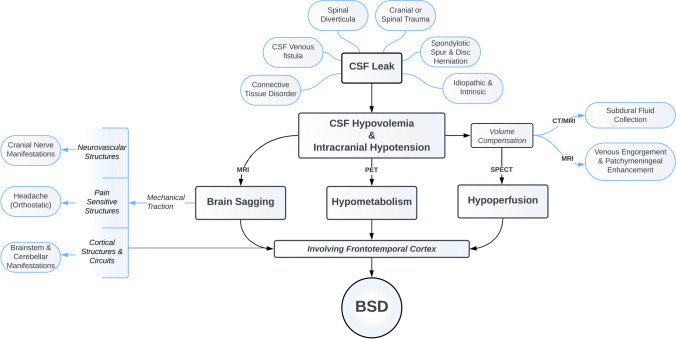
Brain sagging dementia (BSD) is a rare but devastating form of early-onset dementia characterized by intracranial hypotension and behavioral changes resembling behavioral variant frontotemporal dementia. This review aims to provide a comprehensive overview of BSD, highlighting its pathomechanism, diagnostic tools, and available treatment options.
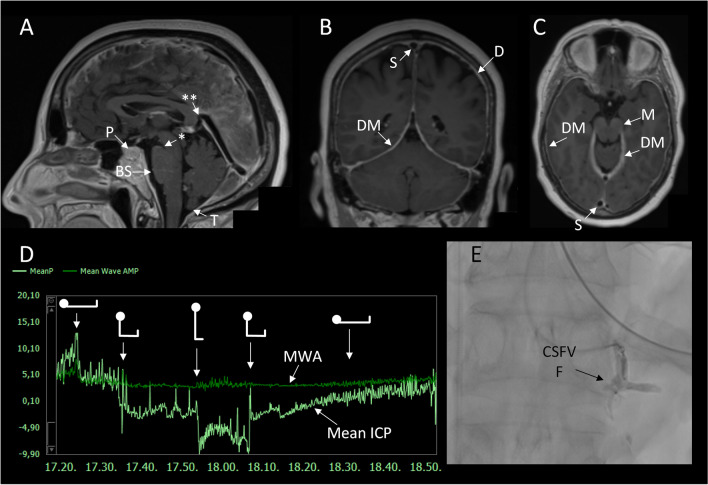
BSD exhibits a complex clinical manifestation with insidious onset and gradual progression of behavioral disinhibition, apathy, inertia, and speech alterations. Additionally, patients may exhibit brainstem and cerebellar signs such as hypersomnolence and gait disturbance. Although headaches are common, they may not always demonstrate typical orthostatic features. Recent radiological advances have improved the detection of CSF leaks, enabling targeted treatment and favorable outcomes. Understanding the pathomechanism and available diagnostic tools for BSD is crucial for a systematic approach to timely diagnosis and treatment of this reversible form of early-onset dementia, as patients often endure a complex and lengthy clinical course.
脑下垂性痴呆(BSD)是一种罕见但极具破坏性的早发性痴呆形式,其特征为颅内低压以及类似于行为变异型额颞叶痴呆的行为改变。本综述旨在全面概述BSD,重点介绍其发病机制、诊断工具及可用的治疗方案。
BSD临床表现复杂,起病隐匿,行为抑制解除、冷漠、惰性及言语改变呈渐进性发展。此外,患者可能出现脑干和小脑体征,如嗜睡和步态障碍。虽然头痛很常见,但不一定总是表现出典型的直立性特征。近期影像学进展提高了脑脊液漏的检测能力,使靶向治疗成为可能并带来良好预后。了解BSD的发病机制和可用诊断工具对于系统地及时诊断和治疗这种可逆转的早发性痴呆至关重要,因为患者往往要经历复杂且漫长的临床病程。