Porter School of Environmental and Earth Sciences, Tel Aviv University, Tel Aviv, Israel.
School of Mechanical Engineering, Tel Aviv University, Tel Aviv, Israel.
Sci Rep. 2023 Sep 7;13(1):14784. doi: 10.1038/s41598-023-41605-4.
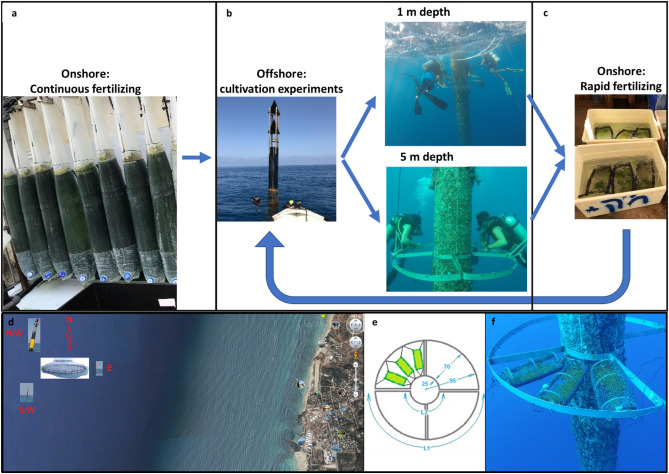
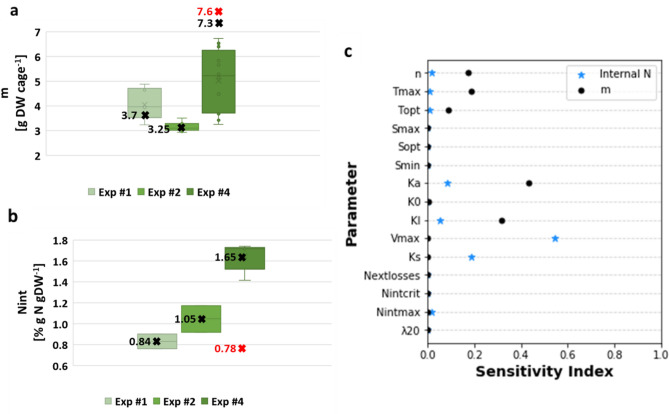
Offshore macroalgae production could provide an alternative source of biomass for food, materials and energy. However, the offshore environment in general, specifically the Eastern Mediterranean Sea (EMS) offshore, is a high energy and low nutrients environment, thus challenging for macroalgae farming. In this study, we experimentally investigated the impact of season, depth, and pre-cultivation fertilization duration on the growth rates and chemical composition of offshore Ulva biomass, and developed a predictive model tailored to offshore conditions, capable of estimating both biomass growth rate and nitrogen content. Specifically, we measured Ulva biomass growth rate and internal nitrogen in the nitrogen-poor EMS a few kilometers offshore the Israeli coast at various depths and on-shore pre-cultivation fertilization schedules. Based on these data, we constructed a predictive cultivation model of Ulva offshore growth, which allows for the optimization of fertilization requirements for offshore cultivation. This study provides new insights on the effects of seasonality, depth, and pre-cultivation fertilization duration on growth rates and chemical composition of offshore Ulva sp. biomass production.
近海大型藻类生产可以为食品、材料和能源提供替代生物量来源。然而,一般来说,近海环境,特别是东地中海(EMS)近海,是一种高能量、低营养的环境,因此对大型藻类养殖具有挑战性。在这项研究中,我们通过实验研究了季节、深度和预培养施肥持续时间对近海巨藻生物量生长率和化学成分的影响,并开发了一种适合近海条件的预测模型,能够估计生物量生长率和氮含量。具体来说,我们在以色列海岸几公里外的 EMS 中测量了不同深度和岸上预培养施肥方案下的巨藻生物量生长率和内部氮含量。基于这些数据,我们构建了一个巨藻近海生长的预测养殖模型,该模型可以优化近海养殖的施肥需求。本研究为季节变化、深度和预培养施肥持续时间对近海巨藻生物质生产的生长率和化学成分的影响提供了新的见解。