Department of Medicine, School of Medicine, Johns Hopkins University, Baltimore, MD, USA.
Department of Biostatistics, Johns Hopkins Bloomberg School of Public Health, Baltimore, MD, USA.
Sci Rep. 2023 Sep 7;13(1):14747. doi: 10.1038/s41598-023-41400-1.
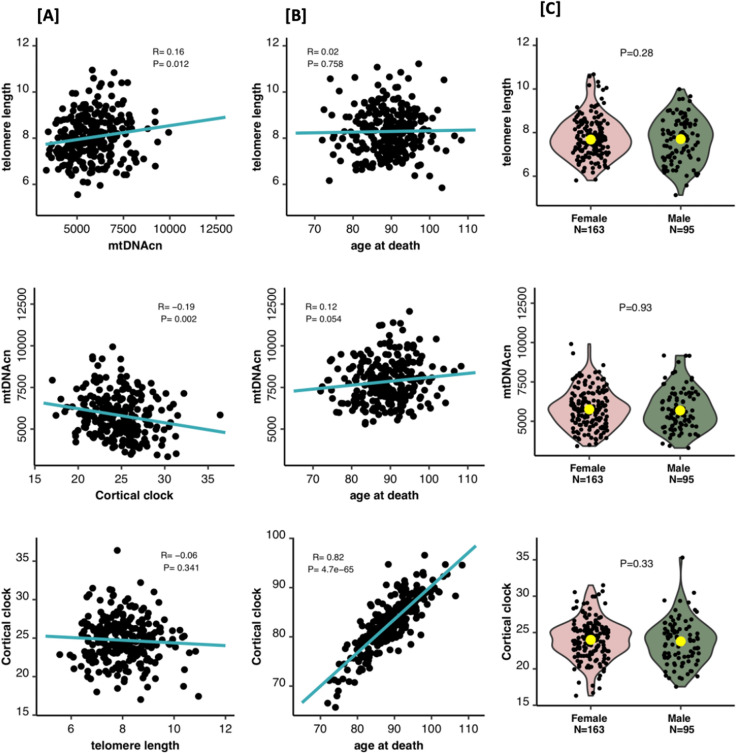
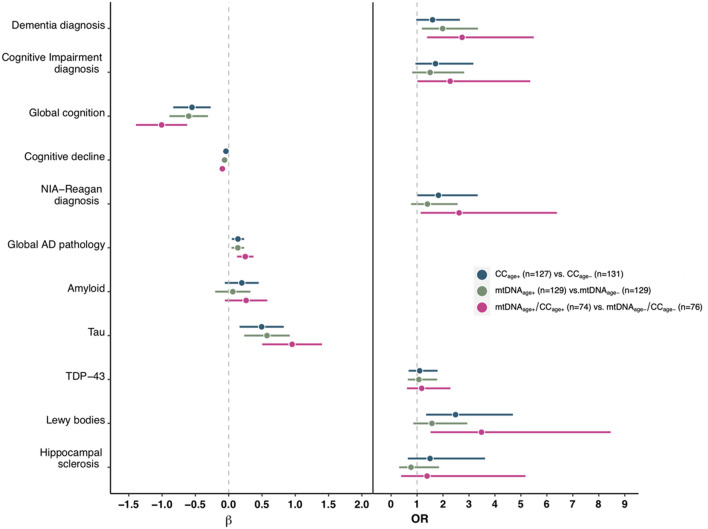
Telomere length (TL) attrition, epigenetic age acceleration, and mitochondrial DNA copy number (mtDNAcn) decline are established hallmarks of aging. Each has been individually associated with Alzheimer's dementia, cognitive function, and pathologic Alzheimer's disease (AD). Epigenetic age and mtDNAcn have been studied in brain tissue directly but prior work on TL in brain is limited to small sample sizes and most studies have examined leukocyte TL. Importantly, TL, epigenetic age clocks, and mtDNAcn have not been studied jointly in brain tissue from an AD cohort. We examined dorsolateral prefrontal cortex (DLPFC) tissue from N = 367 participants of the Religious Orders Study (ROS) or the Rush Memory and Aging Project (MAP). TL and mtDNAcn were estimated from whole genome sequencing (WGS) data and cortical clock age was computed on 347 CpG sites. We examined dementia, MCI, and level of and change in cognition, pathologic AD, and three quantitative AD traits, as well as measures of other neurodegenerative diseases and cerebrovascular diseases (CVD). We previously showed that mtDNAcn from DLPFC brain tissue was associated with clinical and pathologic features of AD. Here, we show that those associations are independent of TL. We found TL to be associated with β-amyloid levels (beta = - 0.15, p = 0.023), hippocampal sclerosis (OR = 0.56, p = 0.0015) and cerebral atherosclerosis (OR = 1.44, p = 0.0007). We found strong associations between mtDNAcn and clinical measures of AD. The strongest associations with pathologic measures of AD were with cortical clock and there were associations of mtDNAcn with global AD pathology and tau tangles. Of the other pathologic traits, mtDNAcn was associated with hippocampal sclerosis, macroscopic infarctions and CAA and cortical clock was associated with Lewy bodies. Multi-modal age acceleration, accelerated aging on both mtDNAcn and cortical clock, had greater effect size than a single measure alone. These findings highlight for the first time that age acceleration determined on multiple genomic measures, mtDNAcn and cortical clock may have a larger effect on AD/AD related disorders (ADRD) pathogenesis than single measures.
端粒长度 (TL) 损耗、表观遗传年龄加速和线粒体 DNA 拷贝数 (mtDNAcn) 下降是衰老的既定标志。每一个都与阿尔茨海默病痴呆症、认知功能和病理性阿尔茨海默病 (AD) 单独相关。表观遗传年龄和 mtDNAcn 已在脑组织中直接研究,但以前关于大脑中 TL 的工作仅限于小样本量,并且大多数研究都检查了白细胞 TL。重要的是,TL、表观遗传年龄时钟和 mtDNAcn 尚未在 AD 队列的脑组织中联合研究。我们检查了 N = 367 名宗教秩序研究 (ROS) 或拉什记忆和衰老项目 (MAP) 参与者的背外侧前额叶皮层 (DLPFC) 组织。TL 和 mtDNAcn 是从全基因组测序 (WGS) 数据中估计的,皮质时钟年龄是在 347 个 CpG 位点上计算的。我们检查了痴呆症、MCI 以及认知水平和变化、病理性 AD 和三种定量 AD 特征,以及其他神经退行性疾病和脑血管疾病 (CVD) 的测量。我们之前表明,来自 DLPFC 脑组织的 mtDNAcn 与 AD 的临床和病理特征相关。在这里,我们表明这些关联独立于 TL。我们发现 TL 与β-淀粉样蛋白水平相关(beta=-0.15,p=0.023),与海马硬化(OR=0.56,p=0.0015)和脑动脉粥样硬化(OR=1.44,p=0.0007)相关。我们发现 mtDNAcn 与 AD 的临床测量值之间存在很强的关联。与 AD 的病理测量值最强的关联是与皮质时钟,并且 mtDNAcn 与全球 AD 病理学和 tau 缠结有关。在其他病理特征中,mtDNAcn 与海马硬化、宏观梗死和 CAA 以及皮质时钟与路易体有关。多模态年龄加速,即 mtDNAcn 和皮质时钟上的加速老化,比单一措施具有更大的效应量。这些发现首次强调,基于多个基因组测量(mtDNAcn 和皮质时钟)确定的年龄加速对 AD/AD 相关疾病 (ADRD) 的发病机制可能比单一措施更大。