Catecholamine and Peptides Laboratory, Service of Clinical Pharmacology and Toxicology, Lausanne University Hospital and University of Lausanne, 1011, Lausanne, Switzerland.
Division of Radiopharmaceutical Chemistry, Clinic of Radiology and Nuclear Medicine, University Hospital Basel, 4031, Basel, Switzerland.
J Transl Med. 2023 Sep 7;21(1):604. doi: 10.1186/s12967-023-04466-z.
Neuroblastoma (NB) and pheochromocytoma/paraganglioma (PHEO/PGL) are neuroendocrine tumors. Imaging of these neoplasms is performed by scintigraphy after injection of radiolabeled meta-iodobenzylguanidine (mIBG), a norepinephrine analog taken up by tumoral cells through monoamine transporters. The pharmacological induction of these transporters is a promising approach to improve the imaging and therapy (theranostics) of these tumors.
Transporters involved in mIBG internalization were identified by using transfected Human Embryonic Kidney (HEK) cells. Histone deacetylase inhibitors (HDACi) and inhibitors of the PI3K/AKT/mTOR pathway were tested in cell lines to study their effect on mIBG internalization. Studies in xenografted mice were performed to assess the effect of the most promising HDACi on I-mIBG uptake.
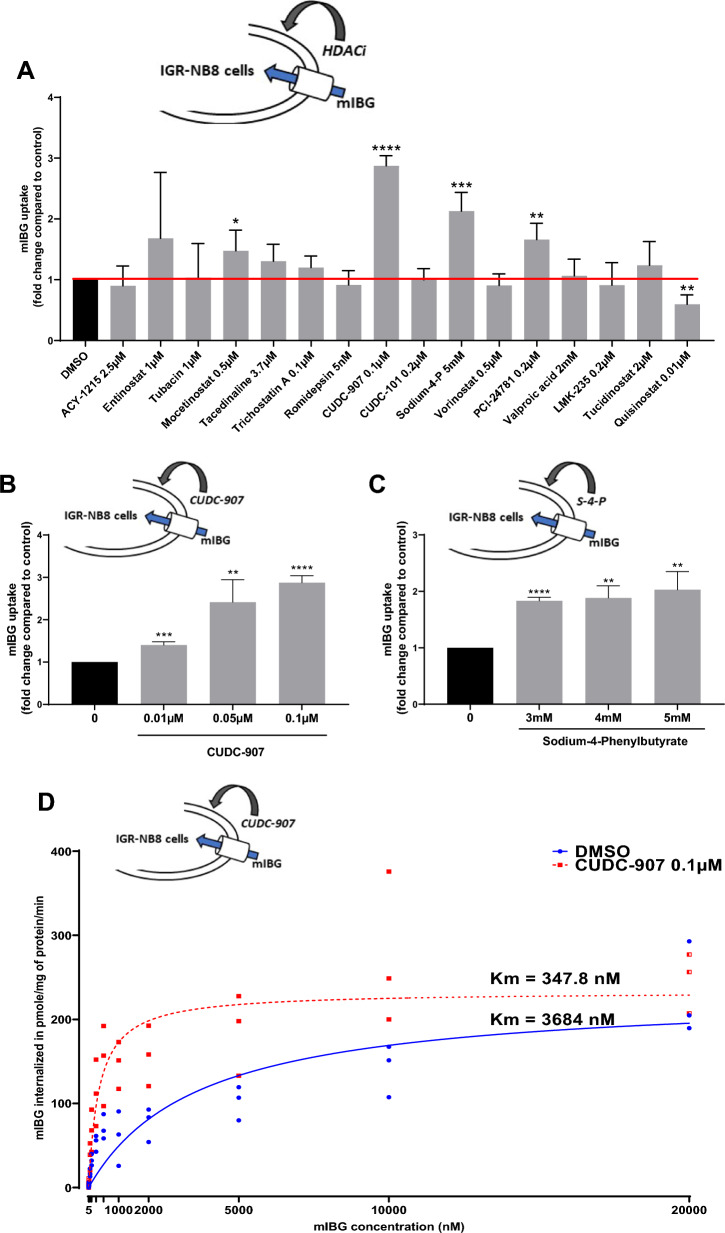
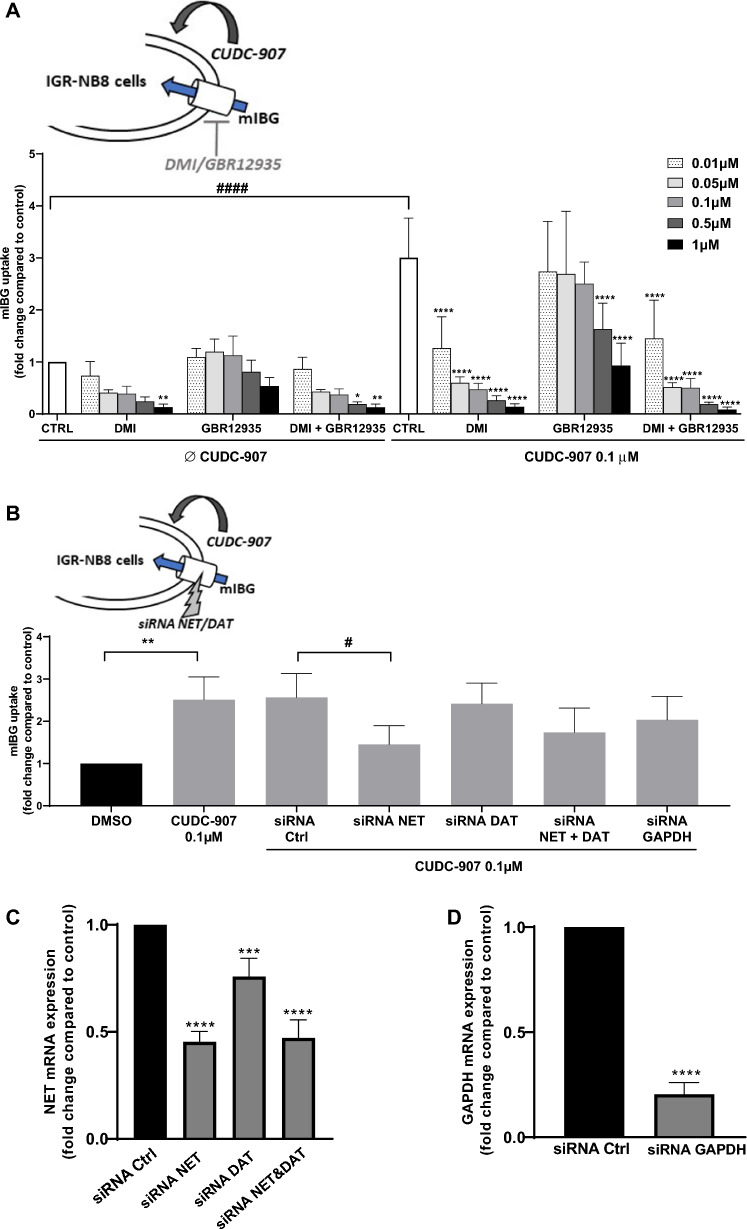
Transfected HEK cells demonstrated that the norepinephrine and dopamine transporter (NET and DAT) avidly internalizes mIBG. Sodium-4-phenylbutyrate (an HDACi), CUDC-907 (a dual HDACi and PI3K inhibitor), BGT226 (a PI3K inhibitor) and VS-5584 and rapamycin (two inhibitors of mTOR) increased mIBG internalization in a neuroblastoma cell line (IGR-NB8) by 2.9-, 2.1-, 2.5-, 1.5- and 1.3-fold, respectively, compared with untreated cells. CUDC-907 also increased mIBG internalization in two other NB cell lines and in one PHEO cell line. We demonstrated that mIBG internalization occurs primarily through the NET. In xenografted mice with IGR-NB8 cells, oral treatment with 5 mg/kg of CUDC-907 increased the tumor uptake of I-mIBG by 2.3- and 1.9-fold at 4 and 24 h post-injection, respectively, compared to the untreated group.
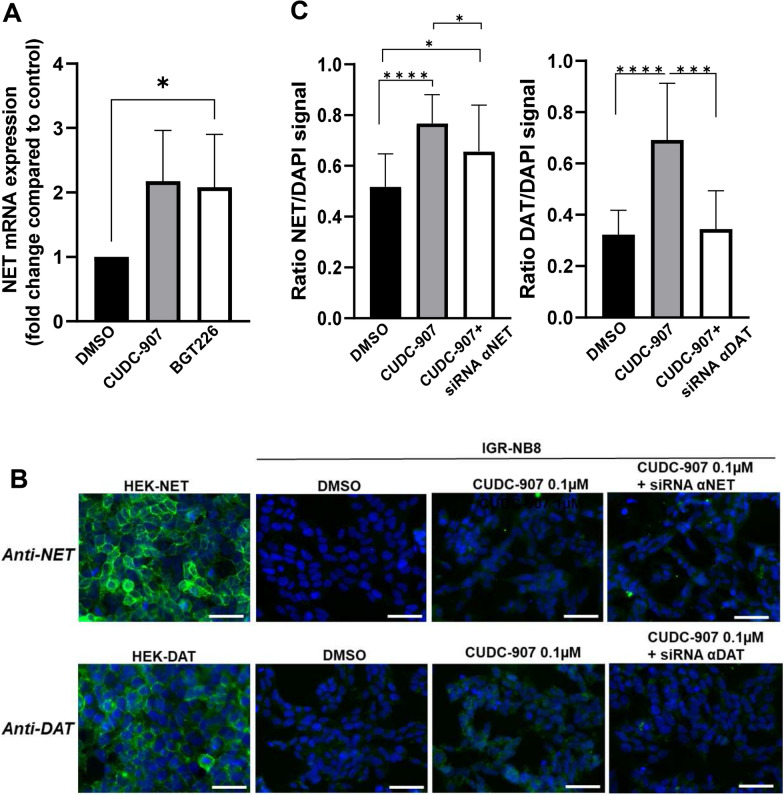
Upregulation of the NET by CUDC-907 lead to a better internalization of mIBG in vitro and in vivo.
神经母细胞瘤(NB)和嗜铬细胞瘤/副神经节瘤(PHEO/PGL)是神经内分泌肿瘤。这些肿瘤的成像通过注射放射性标记的间碘苄胍(mIBG)后进行闪烁扫描来完成,mIBG 是一种通过单胺转运体被肿瘤细胞摄取的去甲肾上腺素类似物。这些转运体的药理诱导是改善这些肿瘤的成像和治疗(治疗诊断学)的一种很有前途的方法。
通过转染人胚肾(HEK)细胞鉴定参与 mIBG 内化的转运体。在细胞系中测试组蛋白去乙酰化酶抑制剂(HDACi)和 PI3K/AKT/mTOR 通路抑制剂,以研究它们对 mIBG 内化的影响。在异种移植小鼠中进行研究,以评估最有前途的 HDACi 对 I-mIBG 摄取的影响。
转染的 HEK 细胞表明去甲肾上腺素和多巴胺转运体(NET 和 DAT)能够强烈地内化 mIBG。苯丁酸钠(一种 HDACi)、CUDC-907(一种双重 HDACi 和 PI3K 抑制剂)、BGT226(一种 PI3K 抑制剂)和 VS-5584 和雷帕霉素(两种 mTOR 抑制剂)使神经母细胞瘤细胞系(IGR-NB8)中的 mIBG 内化分别增加了 2.9、2.1、2.5、1.5 和 1.3 倍,与未处理的细胞相比。CUDC-907 还增加了另外两种 NB 细胞系和一种 PHEO 细胞系中的 mIBG 内化。我们证明 mIBG 内化主要通过 NET 发生。在 IGR-NB8 细胞的异种移植小鼠中,口服 5mg/kg 的 CUDC-907 使肿瘤对 I-mIBG 的摄取在注射后 4 小时和 24 小时分别增加了 2.3 倍和 1.9 倍,与未处理组相比。
CUDC-907 上调 NET 导致 mIBG 在体外和体内更好地内化。