Amsterdam UMC Location University of Amsterdam, Rehabilitation Medicine, Meibergdreef 9, Amsterdam, The Netherlands.
Amsterdam Movement Sciences, Rehabilitation and Development, Amsterdam, The Netherlands.
J Neuroeng Rehabil. 2023 Sep 7;20(1):117. doi: 10.1186/s12984-023-01239-z.
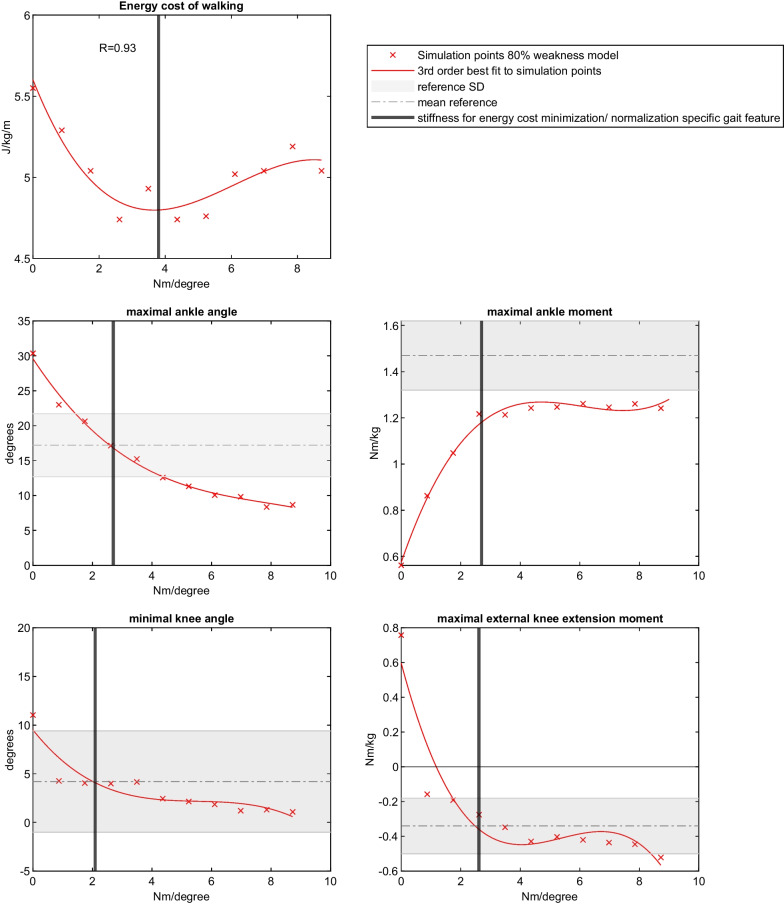
The stiffness of a dorsal leaf AFO that minimizes walking energy cost in people with plantarflexor weakness varies between individuals. Using predictive simulations, we studied the effects of plantarflexor weakness, passive plantarflexor stiffness, body mass, and walking speed on the optimal AFO stiffness for energy cost reduction.
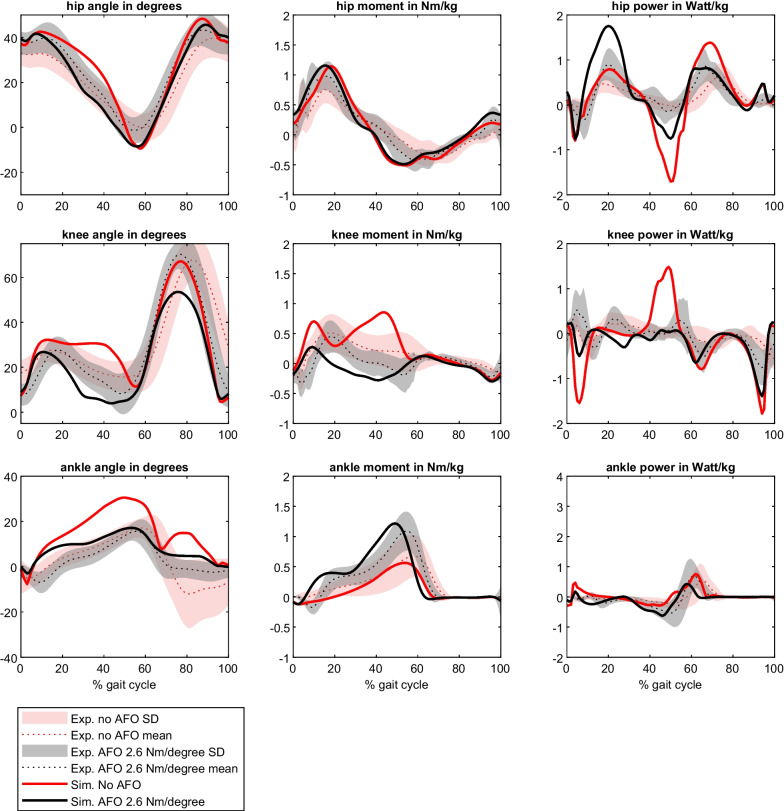
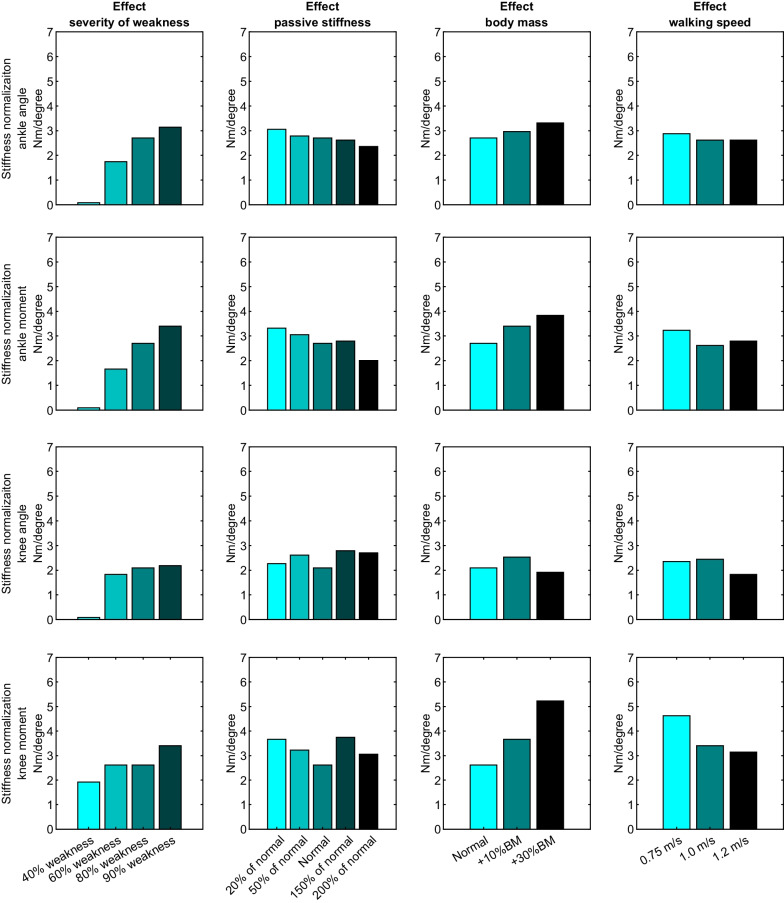
We employed a planar, nine degrees-of-freedom musculoskeletal model, in which for validation maximal strength of the plantar flexors was reduced by 80%. Walking simulations, driven by minimizing a comprehensive cost function of which energy cost was the main contributor, were generated using a reflex-based controller. Simulations of walking without and with an AFO with stiffnesses between 0.9 and 8.7 Nm/degree were generated. After validation against experimental data of 11 people with plantarflexor weakness using the Root-mean-square error (RMSE), we systematically changed plantarflexor weakness (range 40-90% weakness), passive plantarflexor stiffness (range: 20-200% of normal), body mass (+ 30%) and walking speed (range: 0.8-1.2 m/s) in our baseline model to evaluate their effect on the optimal AFO stiffness for energy cost minimization.
Our simulations had a RMSE < 2 for all lower limb joint kinetics and kinematics except the knee and hip power for walking without AFO. When systematically varying model parameters, more severe plantarflexor weakness, lower passive plantarflexor stiffness, higher body mass and walking speed increased the optimal AFO stiffness for energy cost minimization, with the largest effects for severity of plantarflexor weakness.
Our forward simulations demonstrate that in individuals with bilateral plantarflexor the necessary AFO stiffness for walking energy cost minimization is largely affected by severity of plantarflexor weakness, while variation in walking speed, passive muscle stiffness and body mass influence the optimal stiffness to a lesser extent. That gait deviations without AFO are overestimated may have exaggerated the required support of the AFO to minimize walking energy cost. Future research should focus on improving predictive simulations in order to implement personalized predictions in usual care. Trial Registration Nederlands Trial Register 5170. Registration date: May 7th 2015. http://www.trialregister.nl/trialreg/admin/rctview.asp?TC=5170.
足背屈肌无力患者的背侧叶片踝足矫形器(AFO)的最小化行走能量成本的刚度因人而异。通过预测模拟,我们研究了足背屈肌无力、被动跖屈肌刚度、体重和行走速度对降低能量成本的最佳 AFO 刚度的影响。
我们采用了一个平面的、九自由度的运动学模型,在该模型中,通过降低 80%的最大跖屈肌力量来验证。使用基于反射的控制器生成了最小化综合成本函数的行走模拟,其中能量成本是主要贡献者。生成了没有 AFO 和刚度在 0.9 到 8.7 Nm/度之间的 AFO 的行走模拟。在使用 11 名足背屈肌无力患者的实验数据对根均方误差 (RMSE) 进行验证后,我们在基线模型中系统地改变了足背屈肌无力(范围 40-90%的肌无力)、被动跖屈肌刚度(范围:正常的 20-200%)、体重(增加 30%)和行走速度(范围:0.8-1.2 m/s),以评估它们对最小化能量成本的最佳 AFO 刚度的影响。
我们的模拟除了没有 AFO 时的膝关节和髋关节功率外,所有下肢关节运动学和运动学的 RMSE 都<2。当系统地改变模型参数时,更严重的足背屈肌无力、较低的被动跖屈肌刚度、较高的体重和行走速度会增加最小化能量成本的最佳 AFO 刚度,其中足背屈肌无力的严重程度影响最大。
我们的正向模拟表明,在双侧足背屈肌无力的个体中,行走能量成本最小化所需的 AFO 刚度在很大程度上受足背屈肌无力严重程度的影响,而行走速度、被动肌肉刚度和体重的变化对最佳刚度的影响较小。没有 AFO 的步态偏差可能被高估,这可能夸大了 AFO 最小化行走能量成本的支撑需求。未来的研究应侧重于改进预测模拟,以便在常规护理中实施个性化预测。
荷兰试验注册处 5170。注册日期:2015 年 5 月 7 日。http://www.trialregister.nl/trialreg/admin/rctview.asp?TC=5170。