Ali Jaber Haj, Walter Michael
Institute of Laboratory Medicine, Clinical Chemistry and Pathobiochemistry, Charité Universitätsmedizin Berlin, Augustenburger Platz 1, 13353, Berlin, Germany.
Institute of Clinical Chemistry and Laboratory Medicine, Universitätsmedizin Rostock, Ernst-Heydemann-Straße 6, 18057, Rostock, Germany.
Cancer Cell Int. 2023 Sep 7;23(1):197. doi: 10.1186/s12935-023-03041-2.
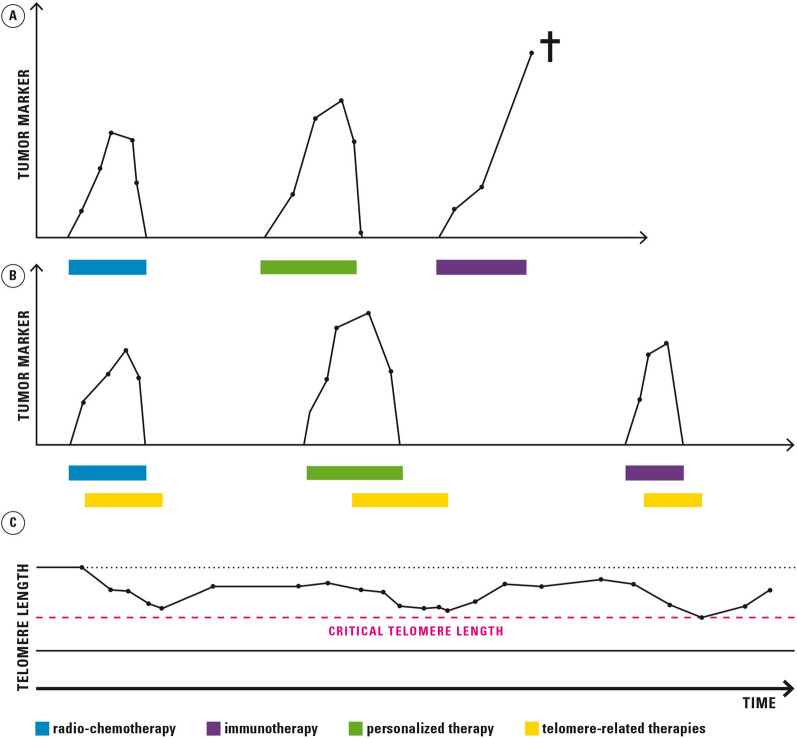
Telomerase can overcome replicative senescence by elongation of telomeres but is also a specific element in most cancer cells. It is expressed more vastly than any other tumor marker. Telomerase as a tumor target inducing replicative immortality can be overcome by only one other mechanism: alternative lengthening of telomeres (ALT). This limits the probability to develop resistance to treatments. Moreover, telomerase inhibition offers some degree of specificity with a low risk of toxicity in normal cells. Nevertheless, only one telomerase antagonist reached late preclinical studies. The underlying causes, the pitfalls of telomerase-based therapies, and future chances based on recent technical advancements are summarized in this review. Based on new findings and approaches, we propose a concept how long-term survival in telomerase-based cancer therapies can be significantly improved: the TICCA (Transient Immediate Complete and Combinatory Attack) strategy.
端粒酶可通过延长端粒来克服复制性衰老,但它也是大多数癌细胞中的一个特定元素。它的表达比任何其他肿瘤标志物都更为广泛。作为一种诱导复制永生的肿瘤靶点,端粒酶只能通过另一种机制来克服:端粒的替代延长(ALT)。这限制了产生治疗抗性的可能性。此外,端粒酶抑制具有一定程度的特异性,对正常细胞的毒性风险较低。然而,只有一种端粒酶拮抗剂进入了临床前后期研究。本综述总结了其潜在原因、基于端粒酶疗法的缺陷以及基于近期技术进步的未来机遇。基于新的发现和方法,我们提出了一个概念,即如何显著提高基于端粒酶的癌症治疗中的长期生存率:TICCA(瞬时即刻完全联合攻击)策略。