Viola Luiz F, Valerio Cynthia M, Araujo-Neto João M, Santos Fabio F, Matsuura Felipe, Moreira Rodrigo O, Godoy-Matos Amélio F
Instituto Estadual de Diabetes e Endocrinologia Luiz Capriglione (IEDE), Rua Moncorvo Filho 90, Rio de Janeiro, CEP: 20211-340, Brazil.
Federal University of São Paulo (UNIFESP), São Paulo, Brazil.
Diabetol Metab Syndr. 2023 Sep 7;15(1):182. doi: 10.1186/s13098-023-01156-0.
Lipodystrophies are a heterogeneous group of diseases characterized by the selective loss of subcutaneous adipose tissue and ectopic fat deposition in different organs, including the liver. This study aimed to determine the frequencies of liver steatosis (LS) and liver fibrosis (LF) in a sample of individuals with LMNA-related and unrelated Familial Partial Lipodystrophy.
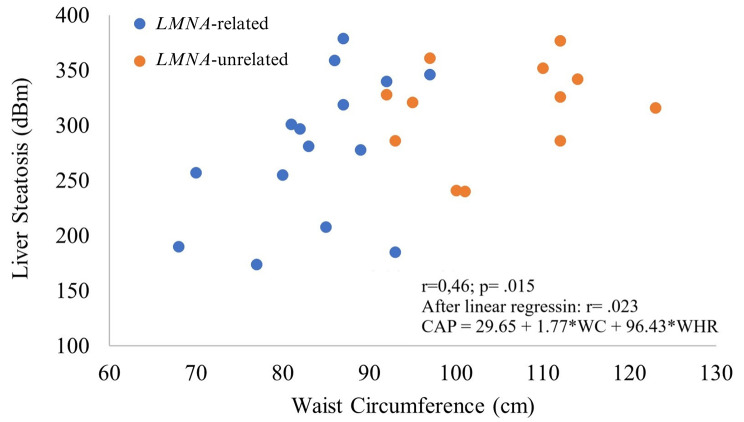
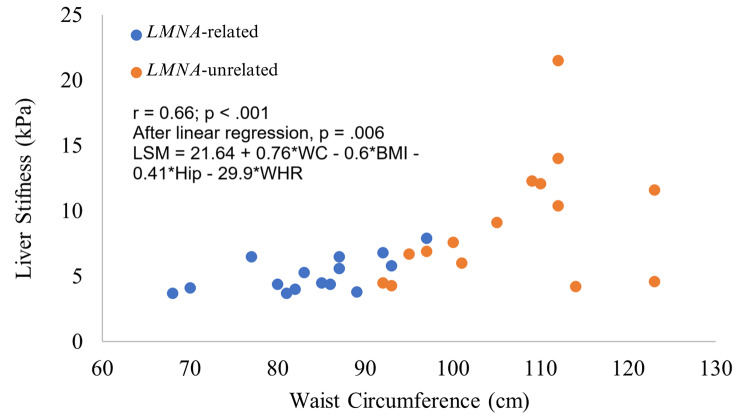
This cross-sectional study included 17 women with LMNA-related FPLD and 15 women with unrelated FPLD. LS and LF were assessed using transient elastography (TE) with FibroScan®. Anthropometric and biochemical variables were included in a multiple linear regression analysis to identify the variables that were independently related to liver disease.
Regarding the presence of LF, 22 (68.2%) women were classified as having non-significant fibrosis, and 10 (31.8%) were classified as having significant or severe fibrosis. Regarding LS, only six women (20.7%) were classified as having an absence of steatosis, and 23 (79.3%) had mild to severe steatosis. After multiple linear regression, waist circumference (but not age, body mass index, or waist-to-hip ratio) was found to be independently related to LS and LF. Among the biochemical variables, only triglyceride levels were independently related to LS but not LF.
In women with FPLD, visceral fat accumulation appears to be the most important determinant of liver disease, including LF, rather than fat scarcity in the lower limbs.
脂肪营养不良是一组异质性疾病,其特征为皮下脂肪组织选择性缺失以及不同器官(包括肝脏)出现异位脂肪沉积。本研究旨在确定与LMNA相关和不相关的家族性部分脂肪营养不良个体样本中肝脂肪变性(LS)和肝纤维化(LF)的发生率。
这项横断面研究纳入了17名与LMNA相关的家族性部分脂肪营养不良女性和15名不相关的家族性部分脂肪营养不良女性。使用FibroScan®通过瞬时弹性成像(TE)评估LS和LF。人体测量和生化变量纳入多元线性回归分析,以确定与肝脏疾病独立相关的变量。
关于LF的存在情况,22名(68.2%)女性被归类为无显著纤维化,10名(31.8%)被归类为有显著或严重纤维化。关于LS,只有6名女性(20.7%)被归类为无脂肪变性,23名(79.3%)有轻度至重度脂肪变性。经过多元线性回归分析,发现腰围(而非年龄、体重指数或腰臀比)与LS和LF独立相关。在生化变量中,只有甘油三酯水平与LS独立相关,而与LF无关。
在家族性部分脂肪营养不良女性中,内脏脂肪堆积似乎是包括LF在内的肝脏疾病的最重要决定因素,而非下肢脂肪缺乏。