Yu Qian, Lan Tianwei, Ma Zhina, Wang Zhanlei, Zhang Chunmei, Jiang Yichuan, Zhao Zhongyan
Department of Pharmacy, China-Japan Union Hospital of Jilin University, Changchun, China.
Department of Critical Medicine, China-Japan Union Hospital of Jilin University, Changchun, China.
Transl Androl Urol. 2023 Aug 31;12(8):1296-1307. doi: 10.21037/tau-23-376. Epub 2023 Aug 28.
Lobaplatin (LBP) is a third-generation platinum-based drug that has been approved only in China for the treatment of several cancer types. Nonetheless, its efficacy in treating bladder cancer (BC) is unclear thus far. Through and experiments, this study aimed to explore whether LBP has an antitumor effect on T24 and 5637 BC cells and whether the effect is related to B-cell lymphoma-2 (Bcl-2), Bcl-2-associated X protein (Bax) and regulation of the phosphoinositide 3-kinase (PI3K)/protein kinase B (Akt) pathway.
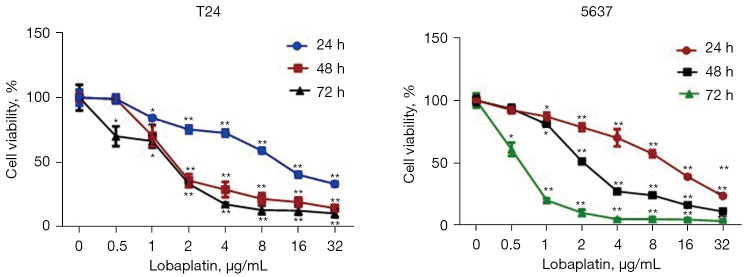
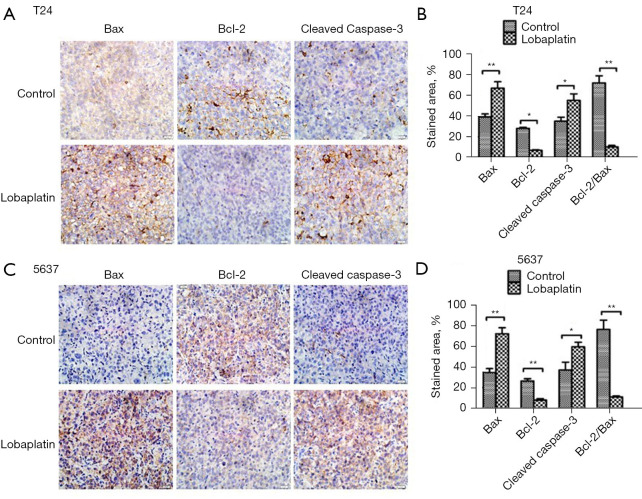
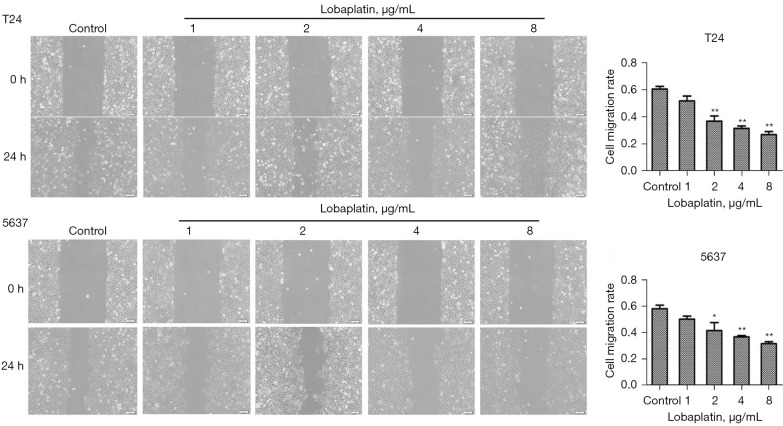
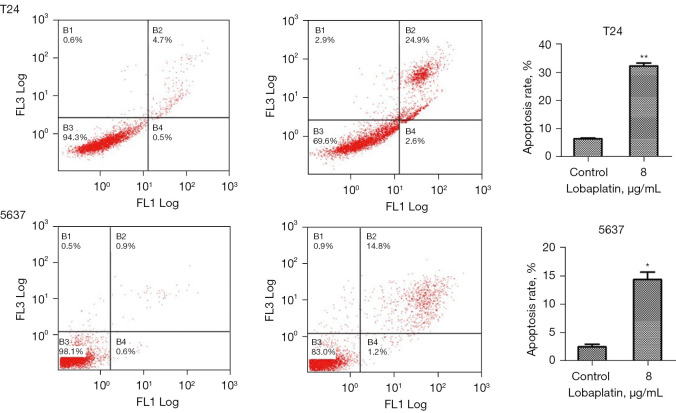
For experiments, the cell counting kit-8 (CCK-8) method was used to determine how different concentrations of LBP affect the viability of two types of BC cells. A wound healing assay was used to test the inhibitory effect of LBP on the migration of the two cell lines. Annexin V-fluorescein isothiocyanate isomer I (V-FITC)/propidium iodide (PI) staining was used to detect changes in cell apoptosis before and after LBP treatment, and Western blotting was used to detect the expression of apoptosis-related proteins and PI3K/Akt pathway proteins. For experiments, a cell-derived xenograft (CDX) model was employed, and the weight of nude mice and the tumor size were measured. Immunohistochemistry was used to detect the effect of LBP on the expression of apoptosis-related proteins in tumor xenografts.
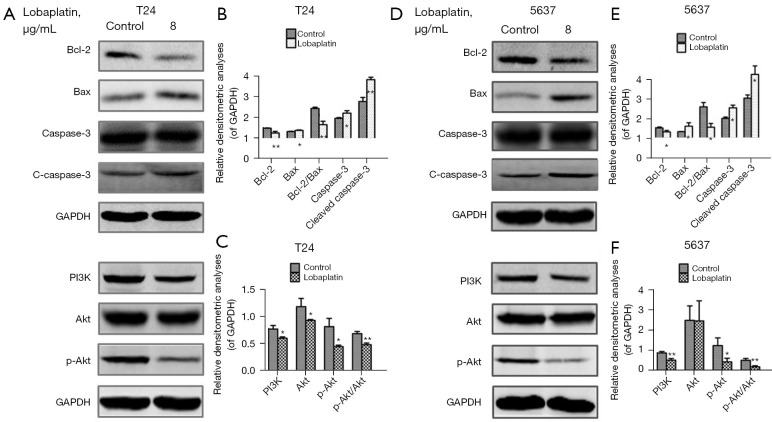
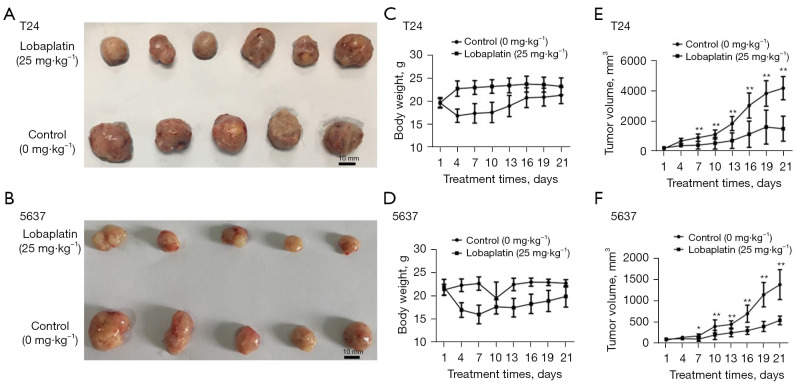
, LBP reduced proliferation (P<0.05), inhibited migration (P<0.05), and induced apoptosis in T24 (31.25%±1.20%, P<0.01) and 5637 (14.3%±2.24%, P<0.05) BC cells, in a dose-dependent manner (P<0.05); increased the expression of proapoptotic proteins, including Bax, caspase-3 and cleaved caspase-3 (P<0.05); and suppressed the expression of antiapoptotic proteins, including Bcl-2, PI3K, Akt and phosphorylated Akt (p-Akt). The experiment confirmed that LBP can reduce the size of subcutaneous tumors in nude mice (P<0.05), increase the expression levels of Bax and cleaved caspase-3 and lower the expression of Bcl-2 (P<0.05) in bladder tumor tissue.
The results obtained from both experiments suggest that LBP can inhibit the proliferation of T24 and 5637 BC cells, which might be credited to its effects in regulating Bcl-2 and Bax expression and inhibiting the PI3K/Akt pathway.
洛铂(LBP)是一种第三代铂类药物,仅在中国被批准用于治疗几种癌症类型。然而,其治疗膀胱癌(BC)的疗效至今尚不清楚。通过体外和体内实验,本研究旨在探讨LBP对T24和5637膀胱癌细胞是否具有抗肿瘤作用,以及该作用是否与B细胞淋巴瘤-2(Bcl-2)、Bcl-2相关X蛋白(Bax)以及磷酸肌醇3激酶(PI3K)/蛋白激酶B(Akt)信号通路的调节有关。
体外实验中,采用细胞计数试剂盒-8(CCK-8)法测定不同浓度的LBP对两种膀胱癌细胞活力的影响。采用伤口愈合实验检测LBP对两种细胞系迁移的抑制作用。采用膜联蛋白V-异硫氰酸荧光素异构体I(V-FITC)/碘化丙啶(PI)染色检测LBP处理前后细胞凋亡的变化,并用蛋白质免疫印迹法检测凋亡相关蛋白和PI3K/Akt信号通路蛋白的表达。体内实验中,采用细胞源异种移植(CDX)模型,测量裸鼠体重和肿瘤大小。采用免疫组织化学法检测LBP对肿瘤异种移植物中凋亡相关蛋白表达的影响。
体外实验中,LBP以剂量依赖性方式(P<0.05)降低T24(31.25%±1.20%,P<0.01)和5637(14.3%±2.24%,P<0.05)膀胱癌细胞的增殖(P<0.05)、抑制迁移(P<0.05)并诱导凋亡;增加促凋亡蛋白Bax、半胱天冬酶-3和裂解的半胱天冬酶-3的表达(P<0.05);抑制抗凋亡蛋白Bcl-2、PI3K、Akt和磷酸化Akt(p-Akt)的表达。体内实验证实,LBP可减小裸鼠皮下肿瘤的大小(P<0.05),增加膀胱肿瘤组织中Bax和裂解的半胱天冬酶-3的表达水平,并降低Bcl-2的表达(P<0.05)。
体外和体内实验结果均表明,LBP可抑制T24和5637膀胱癌细胞的增殖,这可能归因于其对Bcl-2和Bax表达的调节作用以及对PI3K/Akt信号通路的抑制作用。