Fannin Luke D, Joy Mary S, Dominy Nathaniel J, McGraw W Scott, DeSilva Jeremy M
Department of Anthropology, Dartmouth College, Hanover, NH 03755, USA.
Ecology, Evolution, Environment and Society, Dartmouth College, Hanover, NH 03755, USA.
R Soc Open Sci. 2023 Sep 6;10(9):230145. doi: 10.1098/rsos.230145. eCollection 2023 Sep.
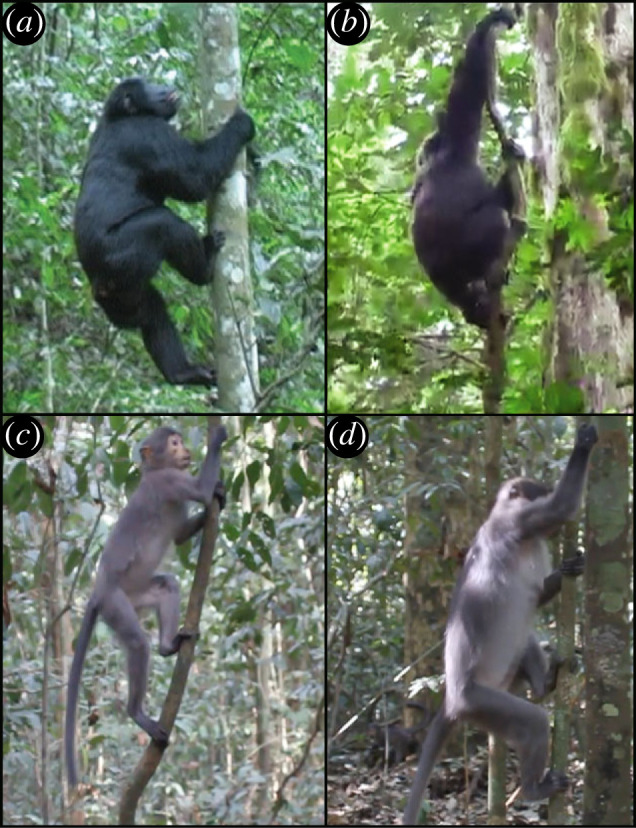
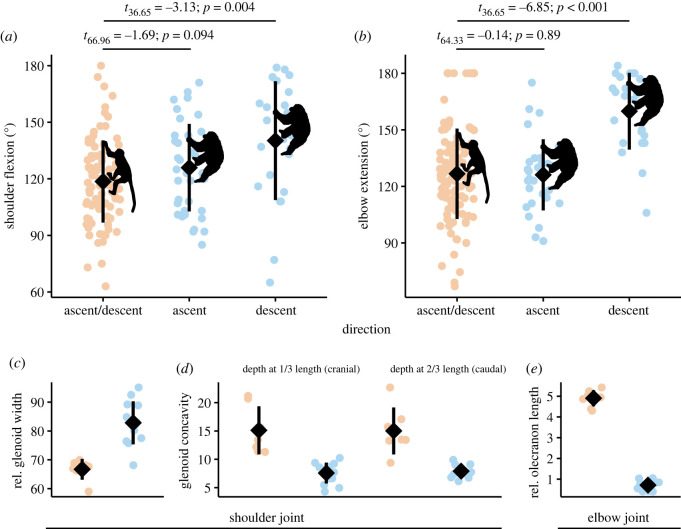
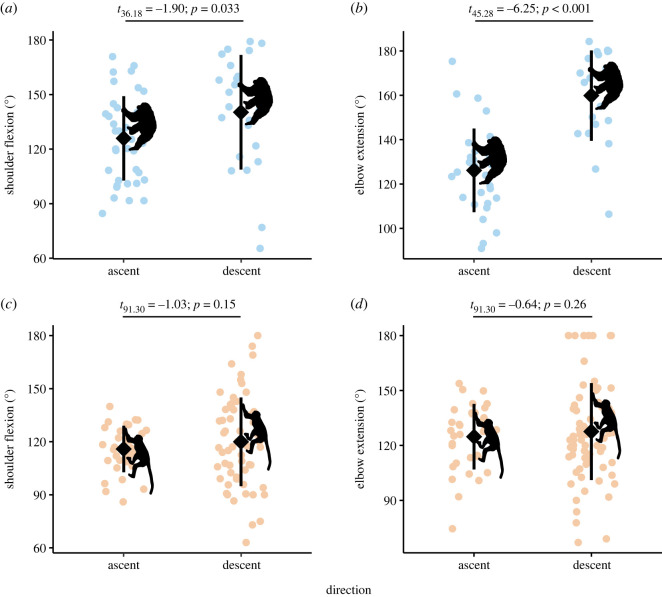
The forelimbs of hominoid primates (apes) are decidedly more flexible than those of monkeys, especially at the shoulder, elbow and wrist joints. It is tempting to link the greater mobility of these joints to the functional demands of vertical climbing and below-branch suspension, but field-based kinematic studies have found few differences between chimpanzees and monkeys when comparing forelimb excursion angles during vertical ascent (upclimbing). There is, however, a strong theoretical argument for focusing instead on vertical descent (downclimbing), which motivated us to quantify the effects of climbing directionality on the forelimb kinematics of wild chimpanzees () and sooty mangabeys (). We found that the shoulders and elbows of chimpanzees and sooty mangabeys subtended larger joint angles during bouts of downclimbing, and that the magnitude of this difference was greatest among chimpanzees. Our results cast new light on the functional importance of downclimbing, while also burnishing functional hypotheses that emphasize the role of vertical climbing during the evolution of apes, including the human lineage.
类人猿灵长目动物(猿)的前肢明显比猴子的前肢更灵活,尤其是在肩关节、肘关节和腕关节处。人们很容易将这些关节更大的活动能力与垂直攀爬和在树枝下悬挂的功能需求联系起来,但基于实地的运动学研究发现,在比较垂直向上攀爬(向上攀爬)过程中的前肢摆动角度时,黑猩猩和猴子之间几乎没有差异。然而,有一个强有力的理论观点认为,应该转而关注垂直下降(向下攀爬),这促使我们量化攀爬方向性对野生黑猩猩()和乌白眉猴()前肢运动学的影响。我们发现,在向下攀爬过程中,黑猩猩和乌白眉猴的肩部和肘部的关节角度更大,而且这种差异的幅度在黑猩猩中最大。我们的研究结果为向下攀爬的功能重要性提供了新的线索,同时也强化了那些强调垂直攀爬在猿类(包括人类谱系)进化过程中作用的功能假说。