Song Tao, Feng An-Qiang, Fu Yu-Fei, Cao Chi, Wang You-Bin, Feng Jin-Ling
Department of Gastrointestinal Surgery, Xuzhou Central Hospital, Xuzhou, China.
Department of Digestive Disease, Xuzhou Central Hospital, Xuzhou, China.
Wideochir Inne Tech Maloinwazyjne. 2023 Jun;18(2):254-263. doi: 10.5114/wiitm.2022.123312. Epub 2022 Dec 22.
Hilar cholangiocarcinoma (HC) is the leading cause of hilar biliary obstruction. Radioactive stent insertion has been utilized extensively for inoperable HC patients.
To assess the relative clinical outcomes of inoperable HC patients who underwent either normal or radioactive stent insertion.
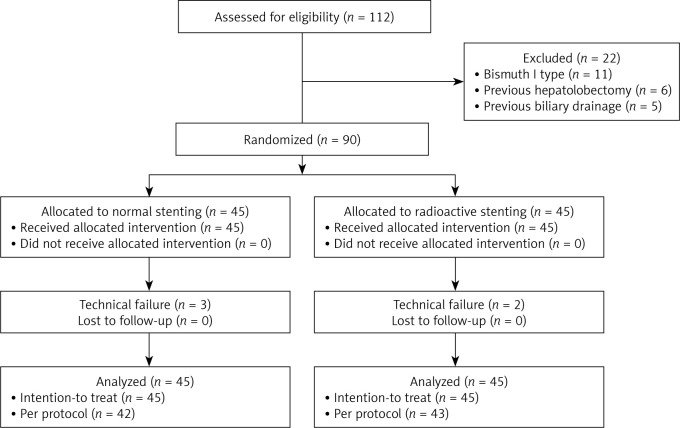
This single-center, prospective, randomized, open-label study enrolled 90 inoperable HC patients from April 2021 to March 2022 and randomly assigned them to normal or radioactive stent groups (n = 45/group), with clinical data then being compared between these groups.
Technical success rates in the normal and radioactive stent insertion groups were 93.3% and 97.9%, respectively (p = 1.000), and clinical success rates were similarly consistent in both groups (95.3% vs. 97.7%, p = 0.983). Individuals in the radioactive stent group exhibited significantly longer median stent patency as compared to the normal stent group (195 days vs. 115 days, p < 0.001), and median overall survival (OS) was also significantly increased in the normal stent group (242 days vs. 125 days, p = 0.002). In the normal stent insertion group, 6 (14.3%) and 5 (11.9%) patients experienced early and late postoperative complications, respectively. Additionally, early and late postoperative complications impacted 7 (16.3%) and 8 (18.6%) patients in the radioactive stent insertion group, respectively. Complication rates were comparable in these 2 patient groups.
Radioactive stent insertion represents a safe and effective strategy for patients with inoperable HC, potentially contributing to prolonged stent patency and OS relative to normal stent insertion.
肝门部胆管癌(HC)是肝门部胆管梗阻的主要原因。放射性支架置入已广泛应用于无法手术的HC患者。
评估接受普通或放射性支架置入的无法手术的HC患者的相对临床结局。
本单中心、前瞻性、随机、开放标签研究纳入了2021年4月至2022年3月的90例无法手术的HC患者,并将他们随机分为普通支架组或放射性支架组(每组n = 45),然后比较两组的临床数据。
普通支架置入组和放射性支架置入组的技术成功率分别为93.3%和97.9%(p = 1.000),两组的临床成功率同样一致(95.3%对97.7%,p = 0.983)。与普通支架组相比,放射性支架组患者的支架中位通畅时间显著更长(195天对115天,p < 0.001),普通支架组的中位总生存期(OS)也显著延长(242天对125天,p = 0.002)。在普通支架置入组中,分别有6例(14.3%)和5例(11.9%)患者发生早期和晚期术后并发症。此外,放射性支架置入组分别有7例(16.3%)和8例(18.6%)患者发生早期和晚期术后并发症。这两组患者的并发症发生率相当。
对于无法手术的HC患者,放射性支架置入是一种安全有效的策略,相对于普通支架置入,可能有助于延长支架通畅时间和总生存期。