
wearable 除颤器在心梗伴射血分数降低或室性心律失常患者中的应用:多中心注册研究数据
Use of the Wearable Cardioverter-Defibrillator Among Patients With Myocarditis and Reduced Ejection Fraction or Ventricular Tachyarrhythmia: Data From a Multicenter Registry.
机构信息
Department of Cardiology and Angiology Bergmannsheil University Hospital, Ruhr University of Bochum Bochum Germany.
Department of Molecular and Experimental Cardiology Institut für Forschung und Lehre (IFL), Ruhr University Bochum Bochum Germany.
出版信息
J Am Heart Assoc. 2023 Sep 19;12(18):e030615. doi: 10.1161/JAHA.123.030615. Epub 2023 Sep 8.
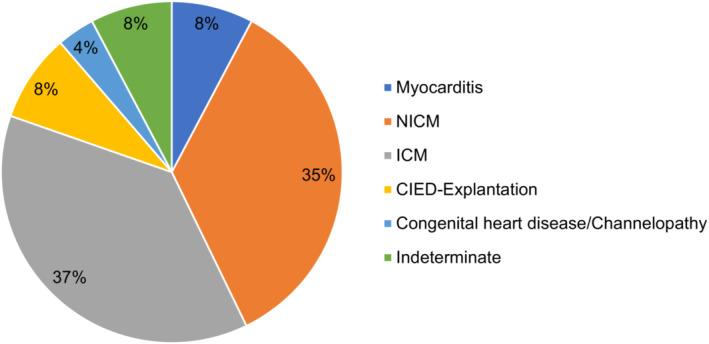
Background Data on the use of the wearable cardioverter-defibrillator (WCD) among patients with myocarditis remain sparse. Consequently, evidence for guideline recommendations in this patient population is lacking. Methods and Results In total, 1596 consecutive patients were included in a multicenter registry from 8 European centers, with 124 patients (8%) having received the WCD due to myocarditis and reduced left ventricular ejection fraction or prior ventricular tachyarrhythmia. The mean age was 51.6±16.3 years, with 74% being male. Patients were discharged after index hospitalization on heart failure medication: Angiotensin-converting enzyme inhibitors (62.5%), angiotensin-receptor-neprilysin inhibitor (22.9%), aldosterone-antagonists (51%), or beta blockers (91.4%). The initial median left ventricular ejection fraction was 30% (22%-45%) and increased to 48% (39%-55%) over long-term follow-up (<0.001). The median BNP (brain natriuretic peptide) level at baseline was 1702 pg/mL (565-3748) and decreased to 188 pg/mL (26-348) over long-term follow-up (=0.022). The mean wear time was 79.7±52.1 days and 21.0±4.9 hours per day. Arrhythmic event rates documented by the WCD were 9.7% for nonsustained ventricular tachycardia, 6.5% for sustained ventricular tachycardia, and 0% for ventricular fibrillation. Subsequently, 2.4% of patients experienced an appropriate WCD shock. The rate of inappropriate WCD shocks was 0.8%. All 3 patients with appropriate WCD shock had experienced ventricular tachycardia/ventricular fibrillation before WCD prescription, with only 1 patient showing a left ventricular ejection fraction <35%. Conclusions Patients with myocarditis and risk for occurrence of ventricular tachyarrhythmia may benefit from WCD use. Prior ventricular arrhythmia might appear as a better risk predictor than a reduced left ventricular ejection fraction <35% in this population.
背景 关于心肌炎患者使用体外除颤器(WCD)的数据仍然很少。因此,缺乏该患者人群中指南推荐的证据。
方法和结果 在一个来自 8 个欧洲中心的多中心注册研究中,共纳入了 1596 例连续患者,其中 124 例(8%)因心肌炎和左心室射血分数降低或既往室性心律失常而接受 WCD 治疗。平均年龄为 51.6±16.3 岁,74%为男性。患者在指数住院后出院,接受心力衰竭药物治疗:血管紧张素转换酶抑制剂(62.5%)、血管紧张素受体脑啡肽酶抑制剂(22.9%)、醛固酮拮抗剂(51%)或β受体阻滞剂(91.4%)。初始中位数左心室射血分数为 30%(22%-45%),长期随访时增加至 48%(39%-55%)(<0.001)。基线时脑钠肽(BNP)水平中位数为 1702pg/ml(565-3748),长期随访时降至 188pg/ml(26-348)(=0.022)。平均佩戴时间为 79.7±52.1 天,每天佩戴 21.0±4.9 小时。WCD 记录的心律失常事件发生率为非持续性室性心动过速 9.7%、持续性室性心动过速 6.5%和心室颤动 0%。随后,2.4%的患者发生了适当的 WCD 电击。不适当的 WCD 电击率为 0.8%。所有 3 例接受适当 WCD 电击的患者在 WCD 处方前均经历过室性心动过速/心室颤动,只有 1 例患者的左心室射血分数<35%。
结论 心肌炎和发生室性心律失常风险的患者可能受益于 WCD 的使用。与左心室射血分数<35%相比,既往室性心律失常可能是该人群更好的风险预测指标。

 Zotero 插件