Rosier Laurent, Zouaghi Amir, Barré Valentin, Martins Raphaël, Probst Vincent, Marijon Eloi, Sadoul Nicolas, Chauveau Samuel, Da Costa Antoine, Badoz Marc, Peyrol Michael, Barraud Jérémie, Massoullie Grégoire, Eschalier Romain, Espinosa Madeline, Lesaffre François, Garcia Rodrigue, Degand Bruno, Noël Antoine, Mansourati Jacques, Extramiana Fabrice, Algalarrondo Vincent, Devilliers Hervé, Cottin Yves, Gandjbakhch Estelle, Guenancia Charles
Cardiology Department, Dijon Bourgogne University Hospital, 21000 Dijon, France.
Cardiology Department, Hôpitaux Universitaires Pitié Salpêtrière, APHP, 75013 Paris, France.
J Clin Med. 2020 Mar 20;9(3):848. doi: 10.3390/jcm9030848.
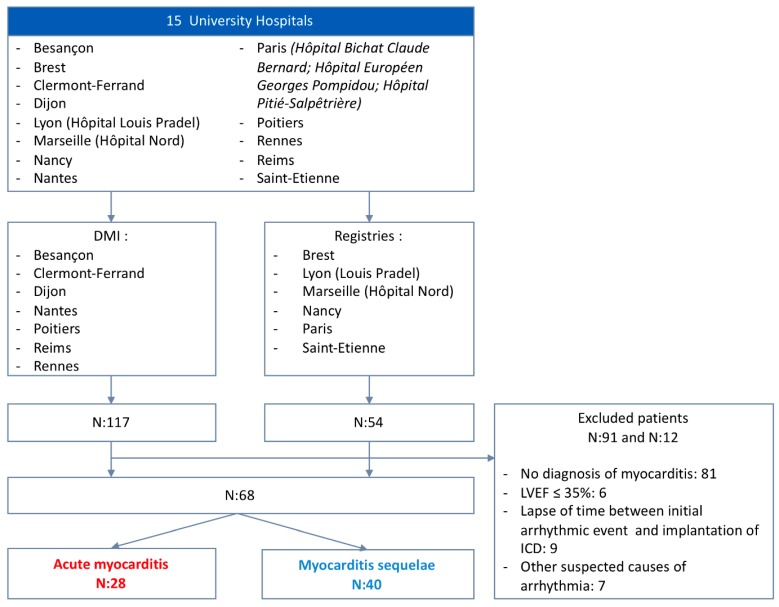
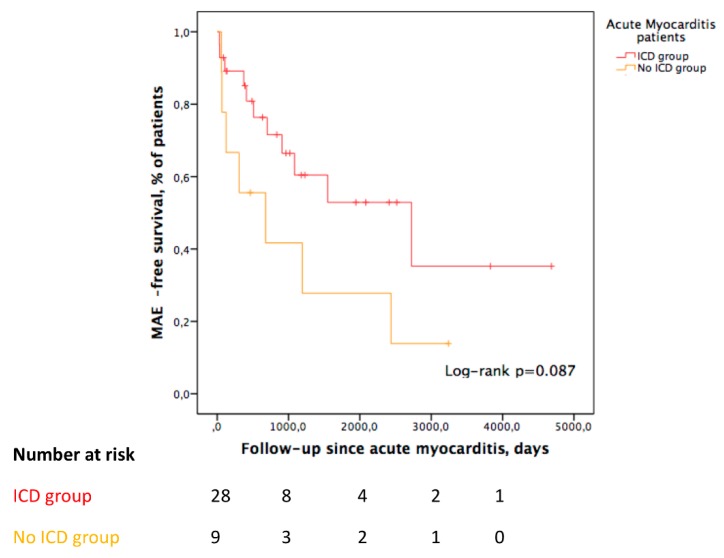
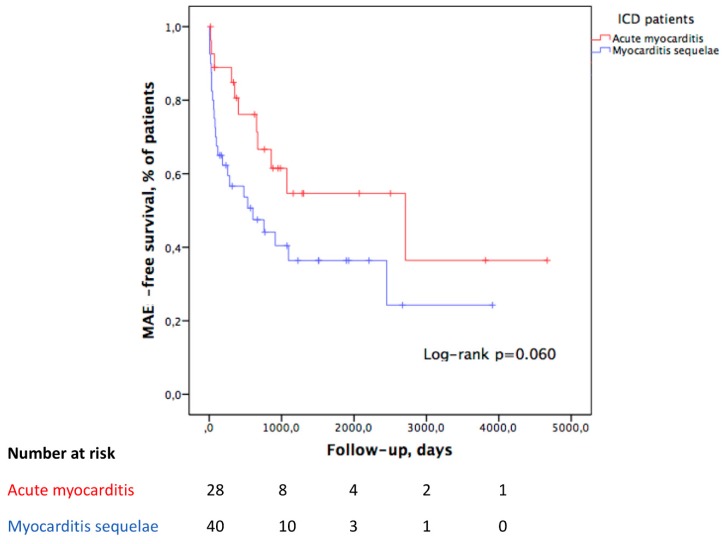
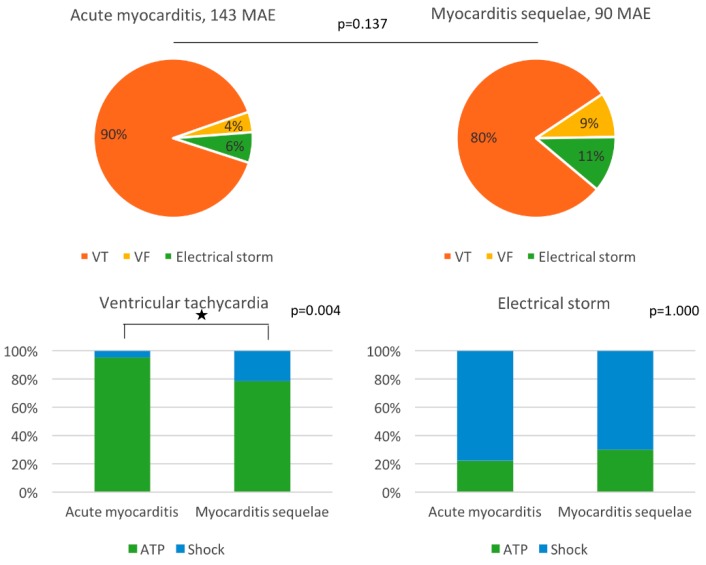
Acute myocarditis is associated with cardiac arrhythmia in 25% of cases; a third of these arrhythmias are ventricular tachycardia (VT) or ventricular fibrillation (VF). The implantation of a cardiac defibrillator (ICD) following sustained ventricular arrhythmia remains controversial in these patients. We sought to assess the risk of major arrhythmic ventricular events (MAEs) over time in patients implanted with an ICD following sustained VT/VF in the acute phase of myocarditis compared to those implanted for VT/VF occurring on myocarditis sequelae. Our retrospective observational study included patients implanted with an ICD following VT/VF during acute myocarditis or VT/VF on myocarditis sequelae, from 2007 to 2017, in 15 French university hospitals. Over a median follow-up period of 3 years, MAE occurred in 11 (39%) patients of the acute myocarditis group and 24 (60%) patients of the myocarditis sequelae group. Kaplan-Meier MAE rate estimates at one and three years of follow-up were 19% and 45% in the acute group, and 43% and 64% in the sequelae group. Patients who experienced sustained ventricular arrhythmias during acute myocarditis had a very high risk of VT/VF recurrence during follow-up. These results show that the risk of MAE recurrence remains high after resolution of the acute episode.
25%的急性心肌炎病例伴有心律失常;其中三分之一的心律失常为室性心动过速(VT)或室性颤动(VF)。对于这些患者,在持续性室性心律失常后植入心脏除颤器(ICD)仍存在争议。我们试图评估与因心肌炎后遗症发生的VT/VF而植入ICD的患者相比,在心肌炎急性期因持续性VT/VF植入ICD的患者随时间发生主要心律失常性室性事件(MAE)的风险。我们的回顾性观察研究纳入了2007年至2017年期间在15家法国大学医院因急性心肌炎期间的VT/VF或心肌炎后遗症的VT/VF而植入ICD的患者。在中位随访期3年中,急性心肌炎组11例(39%)患者和心肌炎后遗症组24例(60%)患者发生了MAE。随访1年和3年时,急性组的Kaplan-Meier MAE发生率估计分别为19%和45%,后遗症组分别为43%和64%。在急性心肌炎期间经历持续性室性心律失常的患者在随访期间VT/VF复发风险非常高。这些结果表明,急性发作缓解后MAE复发风险仍然很高。