González-García Diego, Boulesteix Thomas, Klügel Andreas, Holtz François
Institut für Mineralogie, Leibniz Universität Hannover, Hannover, Germany.
Volcanology Research Group, Instituto de Productos Naturales y Agrobiología (IPNA-CSIC), La Laguna, Tenerife, Spain.
Sci Rep. 2023 Sep 8;13(1):14839. doi: 10.1038/s41598-023-41595-3.
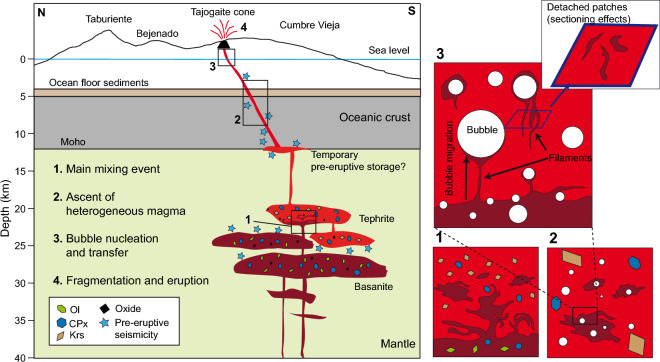
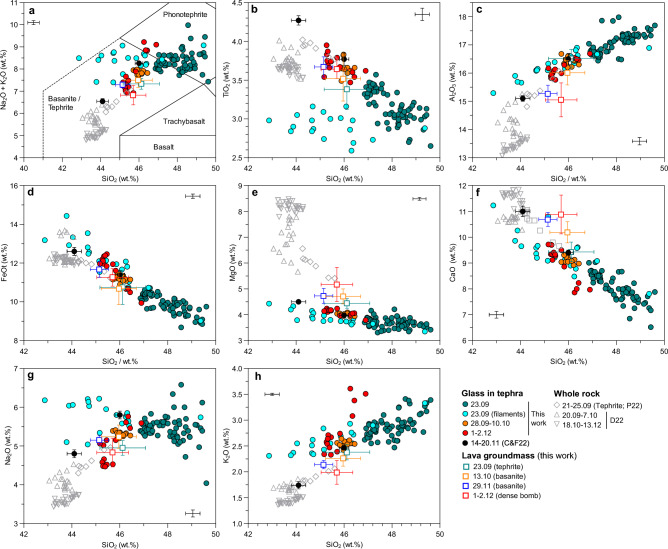
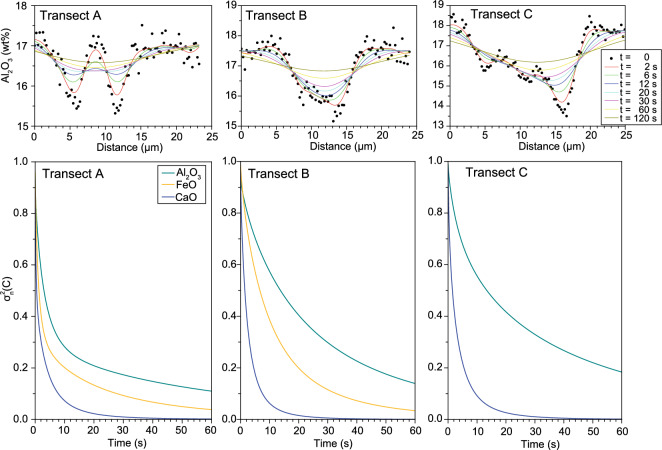
Syneruptive magma mixing is widespread in volcanic eruptions, affecting explosivity and composition of products, but its evidence in basaltic systems is usually cryptic. Here we report direct evidence of mixing between basanitic and tephritic magmas in the first days of the 2021 Tajogaite eruption of Cumbre Vieja, La Palma. Groundmass glass in tephritic tephra from the fifth day of the eruption is locally inhomogeneous, showing micron-scale filamentary structures of Si-poor and Fe-, Mg-rich melt, forming complex filaments attached to bubbles. Their compositional distribution attests the presence of primitive basanitic magma, with compositions similar to late-erupted melts, interacting with an evolved tephritic melt during the first week of the event. From filament morphology, we suggest their generation by dragging and folding of basanitic melt during bubble migration through melt interfaces. Semi-quantitative diffusion modelling indicates that the filamentary structures are short-lived, dissipating in timescales of tens of seconds. In combination with thermobarometric constraints, we suggest a mixing onset by sub-Moho remobilization of a tephritic reservoir by basanite input, followed by turbulent ascent of a mingled magma. In the shallow conduit or lava fountain, bubble nucleation and migration triggered further mingling of the distinct melt-phases. This phenomenon might have enhanced the explosive behaviour of the eruption in such period, where violent strombolian explosions were common.
岩浆混合喷发在火山喷发中很常见,它会影响喷发产物的爆炸性和成分,但在玄武岩系统中的证据通常很隐晦。在此,我们报告了2021年拉帕尔马岛坎布雷维耶哈火山塔霍加伊特火山喷发初期碧玄岩和碱玄质岩浆混合的直接证据。喷发第五天的碱玄质火山灰中的基质玻璃局部不均匀,呈现出微米级的贫硅和富铁、镁熔体的丝状结构,形成附着在气泡上的复杂细丝。它们的成分分布证明了原始碧玄岩岩浆的存在,其成分与后期喷发的熔体相似,在事件的第一周与演化的碱玄质熔体相互作用。从细丝形态来看,我们认为它们是在气泡通过熔体界面迁移过程中,由碧玄岩熔体的拖拽和折叠形成的。半定量扩散模拟表明,丝状结构是短暂存在的,在几十秒的时间尺度内消散。结合热压约束条件,我们认为混合开始于碱玄岩输入导致碱玄质储层在莫霍面以下重新活动,随后混合岩浆发生湍流上升。在浅部管道或熔岩喷泉中,气泡成核和迁移引发了不同熔体相的进一步混合。这种现象可能增强了喷发在该时期的爆炸行为,当时剧烈的斯特龙博利式爆炸很常见。