Department of Food Science, Aarhus University, Agro Food Park 48, 8200, Aarhus N, Denmark.
Department of Vegetables, College of Horticulture, China Agricultural University, Beijing, 100193, China.
BMC Plant Biol. 2023 Sep 9;23(1):416. doi: 10.1186/s12870-023-04414-5.
Beetroot is a model crop for studying root competition in intercropping systems because its red-coloured roots facilitate non-destructive visual discrimination with other root systems of intercropped plants. However, beetroot also has white roots, which could alter how root competition is interpreted. Here we investigated the quantity of white versus red roots in beetroot to quantify the effect of this phenomenon.
Beetroot was mono-cropped or inter-cropped with white cabbage in a field trial. The distribution of beetroot roots was recorded to 2.5 m soil depth on three dates following the minirhizotron method. Roots in each 0.5 m soil layer were counted and categorised into groups based on colour (white roots, coloured roots, and white roots traced back to be coloured) to investigate the influence of white roots on accuracy of root registration. A pot experiment was conducted with three cultivars to verify if white roots are a general characteristic of beetroot.
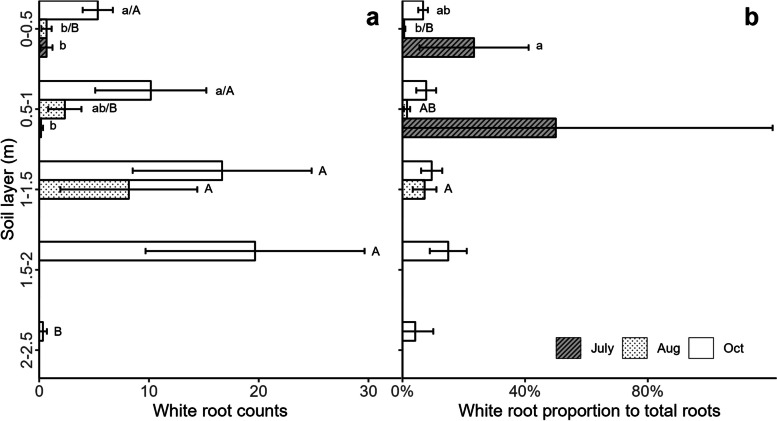
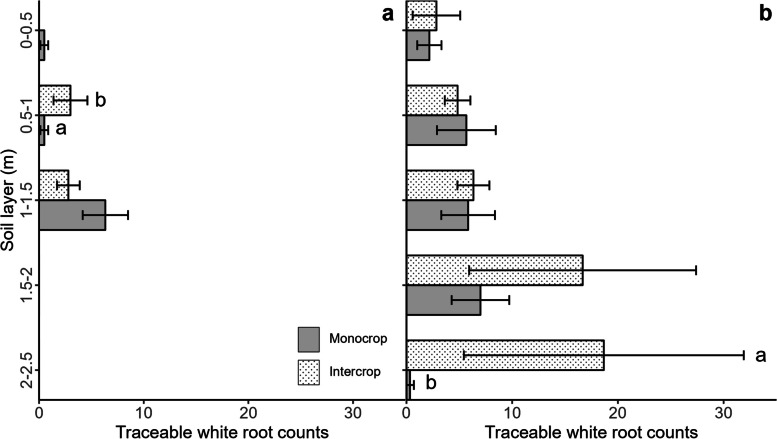
White roots in mono-cropped beetroot represented 2.5-4.8% of total roots, on average, across the rooted soil profile. However, white roots represented 6.9% and 11.6% of total roots in the deepest soil layer during August and October, respectively. White roots caused mono-cropped beetroot roots to be underestimated by 1-22% based on root colour discrimination. However, tracing white roots backwards and forwards to coloured parts of roots reduced underestimates to 0.5-15%. Intercropping did not influence the traceability of white roots compared to monocropping. The highest occurrence of white roots appeared during the early growth period and in the deepest soil layers, indicating a linkage to younger roots or higher root proliferation rates.
Beetroot represents a model crop for visual studies linking eco-physiology and root proliferation. The white roots of beetroot must be incorporated by studies of root competition in intercropping systems that use colour as a criterion.
甜菜是研究间作系统中根系竞争的模式作物,因为其红色根部便于与间作植物的其他根系进行无损的视觉区分。然而,甜菜也有白色的根,这可能会改变对根系竞争的解释。在这里,我们调查了甜菜中白色和红色根系的数量,以量化这种现象的影响。
在田间试验中,甜菜单作或与白菜间作。采用微根窗法,在三个日期记录甜菜根系的分布,直至 2.5 m 土壤深度。在每 0.5 m 的土壤层中对根进行计数,并根据颜色(白色根、有色根和白色根追溯为有色根)进行分类,以调查白色根对根注册准确性的影响。进行了一项盆栽试验,使用三个品种来验证白色根是否是甜菜的普遍特征。
在单作甜菜的根系中,白色根平均占整个根系的 2.5-4.8%,在整个有根土壤剖面中。然而,在 8 月和 10 月,白色根分别占最深土壤层总根的 6.9%和 11.6%。白色根导致单作甜菜根系根据颜色识别被低估了 1-22%。然而,将白色根前后追踪到有色根的部分可以将低估减少到 0.5-15%。与单作相比,间作并没有影响白色根的可追踪性。白色根的最高出现频率是在早期生长期间和最深的土壤层中,这表明与较年轻的根或更高的根增殖率有关。
甜菜是一种用于视觉研究的模式作物,可以将生态生理学和根系增殖联系起来。在使用颜色作为标准的间作系统中,必须将甜菜的白色根纳入根系竞争的研究中。