Department of Human Life Design and Science, Faculty of Design, Kyushu University, 4-9-1, Shiobaru, Minami-Ku, Fukuoka, 815-8540, Japan.
Physiological Anthropology Research Center, Faculty of Design, Kyushu University, 4-9-1, Shiobaru, Minami-Ku, Fukuoka, 815-8540, Japan.
J Physiol Anthropol. 2023 Sep 8;42(1):20. doi: 10.1186/s40101-023-00337-0.
Passive body heating before sleep is well known to lead to improved sleep. However, the effects of the degree of change in body temperature by bathing on sleep quality are unclear. The present study aimed to clarify the effects on sleep of bathing-induced changes in body temperature.
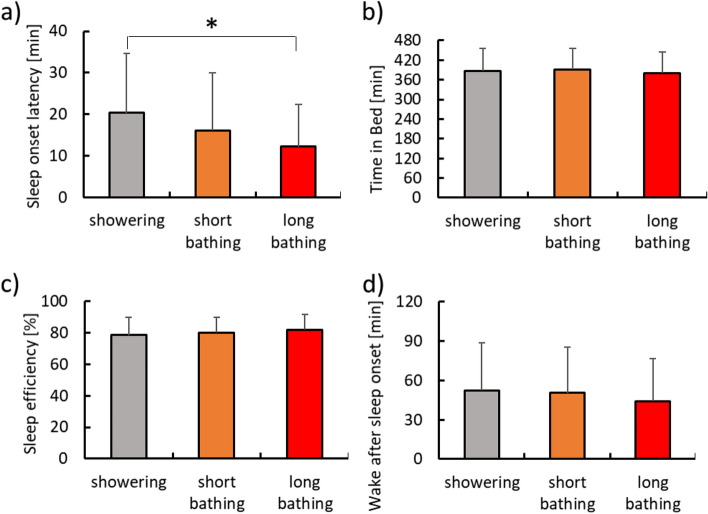
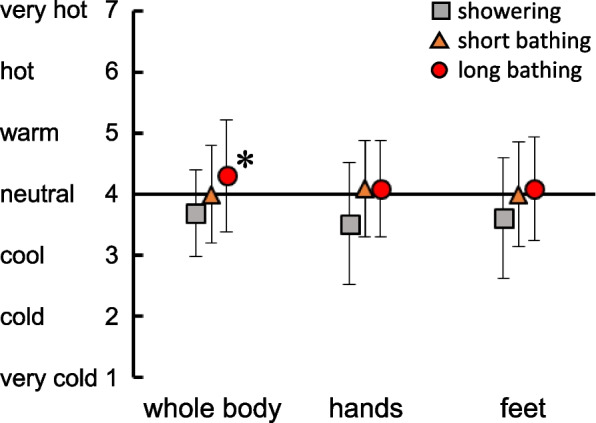
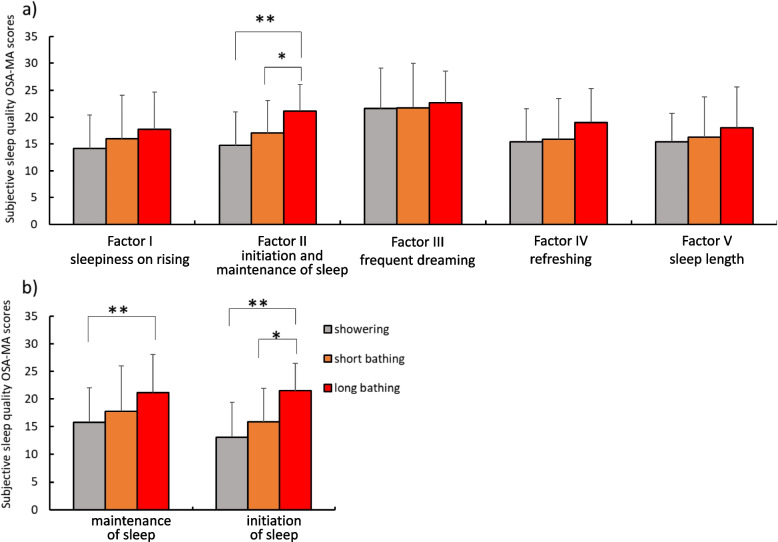
Twenty-three healthy males and females in their 20 s to 50 s bathed in their homes 1.5-2 h before bedtime under three bathing conditions: showering only; short bathing in a bathtub; and long bathing in a bathtub. Sublingual and skin temperatures and thermal sensation before and after bathing, sleep indices such as sleep onset latency, time in bed, sleep efficiency, and wake after sleep onset, all of which were evaluated using an actimeter, and subjective evaluations of sleep were compared among conditions.
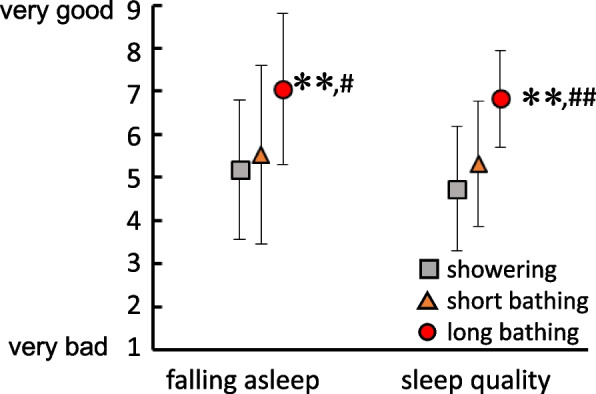
Sublingual temperature just after bathing was significantly higher with long bathing than with other conditions, and the fall in sublingual temperature from after bathing to before sleep was significantly larger with long bathing than with short bathing. Sleep onset latency by actimeter was significantly reduced with long bathing compared to showering. In addition, subjective evaluations of falling asleep and sleep quality were better with long bathing than with showering or short bathing.
In conclusion, bathing conditions that produce a 0.9 °C increase in sublingual temperature appear effective for falling asleep and sleep quality, because core temperature shows a greater drop to before sleep than those producing an increase of about 0.3 °C increase in sublingual temperature.
众所周知,睡前被动身体加热可改善睡眠。然而,洗澡引起的体温变化对睡眠质量的影响尚不清楚。本研究旨在阐明洗澡引起的体温变化对睡眠的影响。
23 名 20 至 50 多岁的健康男女在家中在睡前 1.5-2 小时洗澡,有三种洗澡条件:仅淋浴;短时间浴缸浴;长时间浴缸浴。比较了三种条件下洗澡前后舌下温度和皮肤温度以及热感觉、睡眠指标(如入睡潜伏期、卧床时间、睡眠效率和睡眠后觉醒时间),并使用活动记录仪进行评估,以及对睡眠的主观评价。
长时间洗澡后舌下温度明显高于其他两种条件,且长时间洗澡后舌下温度从洗澡后到睡前的下降幅度明显大于短时间洗澡。与淋浴相比,活动记录仪测量的入睡潜伏期显著缩短。此外,与淋浴或短时间浴缸浴相比,长时间浴缸浴对入睡和睡眠质量的主观评价更好。
总之,舌下温度升高 0.9°C 的沐浴条件似乎对入睡和睡眠质量有效,因为核心体温的下降幅度比升高约 0.3°C 时更大。