McDonough Daniel J, Mathew Mahesh, Pope Zachary C, Schreiner Pamela J, Jacobs David R, VanWagner Lisa B, Carr John Jeffrey, Terry James G, Gabriel Kelley Pettee, Reis Jared P, Pereira Mark A
Division of Epidemiology & Community Health, University of Minnesota-Twin Cities, Minneapolis, MN 55455, USA.
Well Living Lab, Rochester, NY 55902, USA.
J Clin Med. 2023 Aug 28;12(17):5603. doi: 10.3390/jcm12175603.
The prevalence of non-alcoholic fatty liver disease (NAFLD) in U.S. adults is over 30%, yet the role of lifestyle factors in the etiology of NAFLD remains understudied. We examined the associations of physical activity, by intensity and type, and television viewing with prevalent NAFLD.
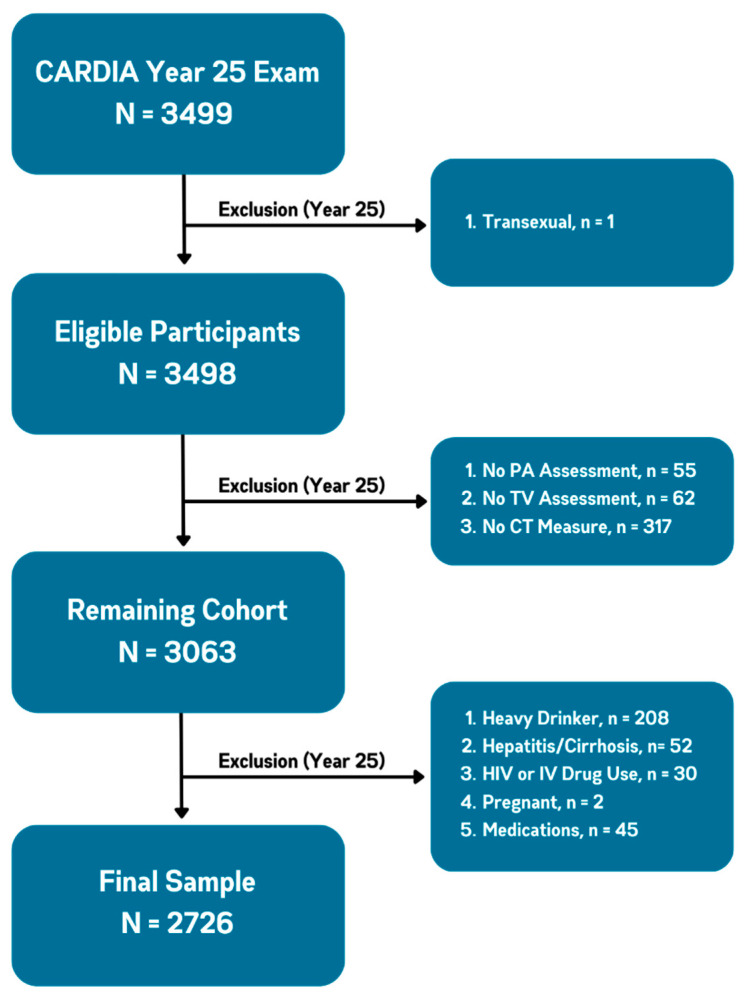
Cross-sectional analysis of a population-based sample of 2726 Black (49%) and White (51%) adults (Mean (SD) age, 50 (3.6) years; 57.3% female) from the CARDIA study. Exposures were aerobic activity by intensity (moderate, vigorous; hours/week); activity type (aerobic, muscle-strengthening; hours/week); and television viewing (hours/week), examined concurrently in all models and assessed by validated questionnaires. Our outcome was NAFLD (liver attenuation < 51 Hounsfield Units), measured by non-contrast computed tomography, after exclusions for other causes of liver fat. Covariates were sex, age, race, study center, education, diet quality, smoking status, alcohol consumption, and body mass index or waist circumference.
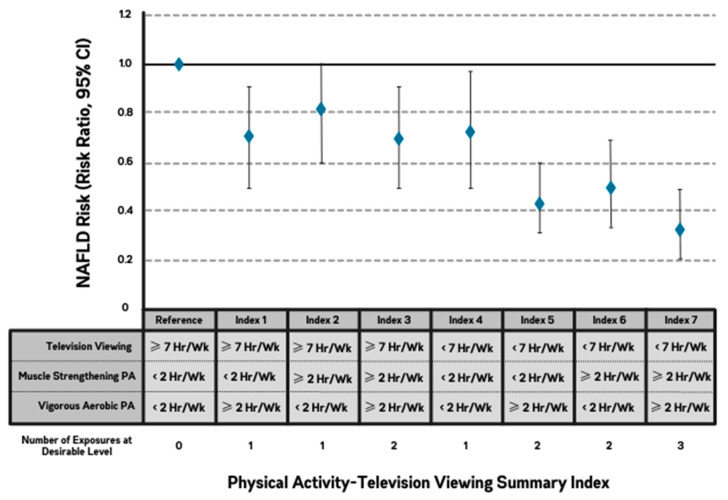
648 participants had NAFLD. In the fully adjusted modified Poisson regression model, the risk ratios per interquartile range of each exposure were moderate-intensity aerobic activity, 1.10 (95% CI, 0.97-1.26); vigorous-intensity aerobic activity, 0.72 (0.63-0.82); muscle-strengthening activity, 0.89 (0.80-1.01); and television viewing, 1.20 (1.10-1.32). Relative to less active participants with higher levels of television viewing, those who participated in ≥2 h/week of both vigorous-intensity aerobic and muscle-strengthening activity and <7 h/week of television viewing had 65% lower risk of NAFLD (risk ratio = 0.35, 95% CI = 0.23-0.51).
Adults who follow public health recommendations for vigorous-aerobic and muscle-strengthening activity, as well as minimize television viewing, are considerably less likely to have NAFLD than those who do not follow the recommendations and who have relatively high levels of television viewing.
美国成年人中非酒精性脂肪性肝病(NAFLD)的患病率超过30%,然而生活方式因素在NAFLD病因学中的作用仍未得到充分研究。我们研究了不同强度和类型的体育活动以及看电视与NAFLD患病率之间的关联。
对来自CARDIA研究的2726名黑人(49%)和白人(51%)成年人(平均(标准差)年龄为50(3.6)岁;57.3%为女性)的基于人群的样本进行横断面分析。暴露因素包括按强度划分的有氧运动(中等强度、高强度;每周小时数)、活动类型(有氧运动、肌肉强化运动;每周小时数)以及看电视时间(每周小时数),在所有模型中同时进行研究,并通过经过验证的问卷进行评估。我们的结局指标是排除其他肝脏脂肪原因后,通过非增强计算机断层扫描测量的NAFLD(肝脏衰减<51亨氏单位)。协变量包括性别、年龄、种族、研究中心、教育程度、饮食质量、吸烟状况、饮酒量以及体重指数或腰围。
648名参与者患有NAFLD。在完全调整的修正泊松回归模型中,每种暴露因素每四分位数间距的风险比分别为:中等强度有氧运动,1.10(95%置信区间,0.97 - 1.26);高强度有氧运动,0.72(0.63 - 0.82);肌肉强化运动,0.89(0.80 - 1.01);以及看电视,1.20(1.10 - 1.32)。与体育活动较少且看电视时间较多的参与者相比,那些每周进行≥2小时高强度有氧运动和肌肉强化运动且每周看电视时间<7小时的参与者患NAFLD的风险降低65%(风险比 = 0.35,95%置信区间 = 0.23 - 0.51)。
遵循公共卫生建议进行高强度有氧运动和肌肉强化运动以及尽量减少看电视时间的成年人,与不遵循这些建议且看电视时间相对较长的成年人相比,患NAFLD的可能性要小得多。