Department of Pharmacology, Teikyo University School of Medicine, 2-11-1 Kaga, Itabashi, Tokyo 173-8605, Japan.
Int J Mol Sci. 2023 Aug 22;24(17):13067. doi: 10.3390/ijms241713067.
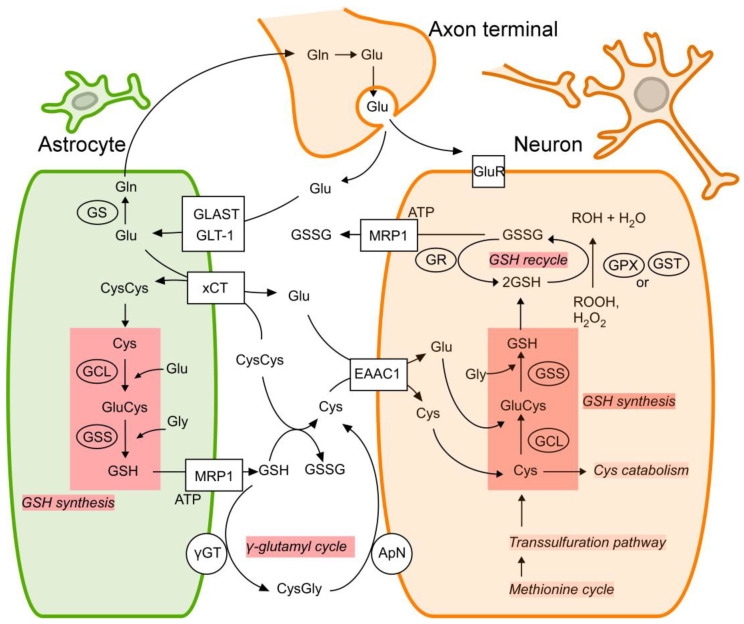
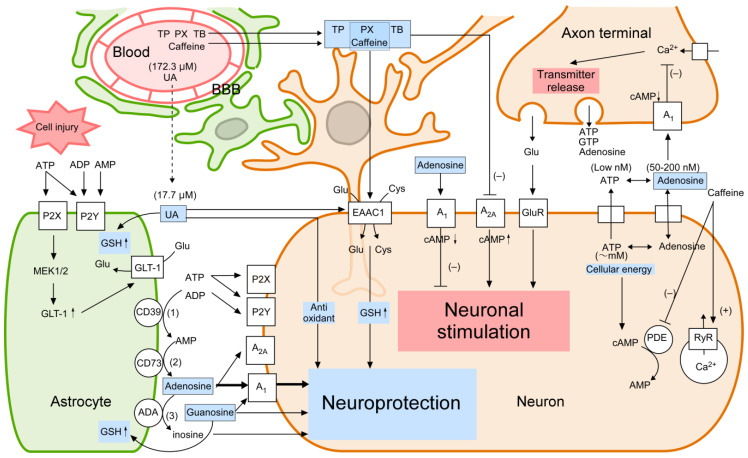
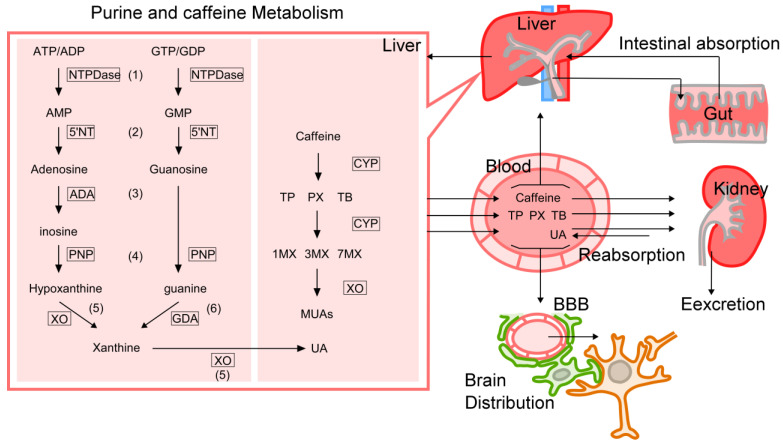
Numerous basic studies have reported on the neuroprotective properties of several purine derivatives such as caffeine and uric acid (UA). Epidemiological studies have also shown the inverse association of appropriate caffeine intake or serum urate levels with neurodegenerative diseases such as Alzheimer disease (AD) and Parkinson's disease (PD). The well-established neuroprotective mechanisms of caffeine and UA involve adenosine A receptor antagonism and antioxidant activity, respectively. Our recent study found that another purine derivative, paraxanthine, has neuroprotective effects similar to those of caffeine and UA. These purine derivatives can promote neuronal cysteine uptake through excitatory amino acid carrier protein 1 (EAAC1) to increase neuronal glutathione (GSH) levels in the brain. This review summarizes the GSH-mediated neuroprotective effects of purine derivatives. Considering the fact that GSH depletion is a manifestation in the brains of AD and PD patients, administration of purine derivatives may be a new therapeutic approach to prevent or delay the onset of these neurodegenerative diseases.
大量基础研究报告了几种嘌呤衍生物如咖啡因和尿酸 (UA) 的神经保护特性。 流行病学研究也表明,适当的咖啡因摄入或血清尿酸水平与阿尔茨海默病 (AD) 和帕金森病 (PD) 等神经退行性疾病呈负相关。 咖啡因和 UA 的既定神经保护机制分别涉及腺苷 A 受体拮抗作用和抗氧化活性。 我们最近的研究发现,另一种嘌呤衍生物,即黄嘌呤,具有与咖啡因和 UA 相似的神经保护作用。 这些嘌呤衍生物可以通过兴奋性氨基酸载体蛋白 1 (EAAC1) 促进神经元半胱氨酸摄取,从而增加大脑中的神经谷胱甘肽 (GSH) 水平。 本综述总结了嘌呤衍生物的 GSH 介导的神经保护作用。 鉴于 GSH 耗竭是 AD 和 PD 患者大脑中的一种表现,嘌呤衍生物的给药可能是预防或延迟这些神经退行性疾病发生的一种新的治疗方法。