Danevitch Nina, Frankenberger Roland, Lücker Susanne, Gärtner Ulrich, Krämer Norbert
Department of Pediatric Dentistry, Medical Center for Dentistry, University Medical Center Giessen and Marburg, 35392 Giessen, Germany.
Department of Operative Dentistry, Endodontics, and Pediatric Dentistry, Medical Center for Dentistry, University Medical Center Giessen and Marburg, 35039 Marburg, Germany.
Materials (Basel). 2023 Aug 30;16(17):5948. doi: 10.3390/ma16175948.
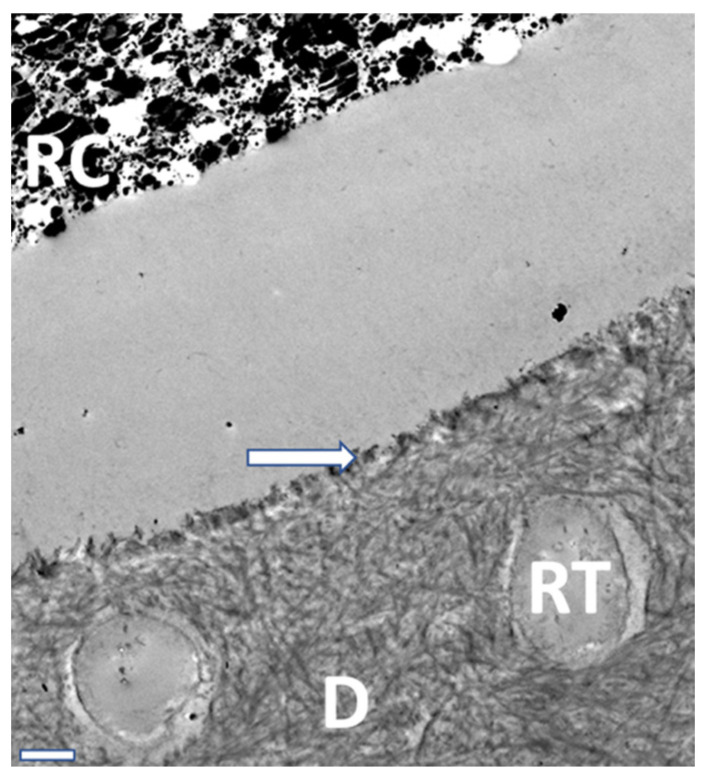
(1) Background: The aim of this in vitro study was to evaluate the micro-tensile bond strength (µ-TBS) of universal adhesives to primary tooth dentin after different storage periods. (2) Methods: Dentin of 100 extracted primary molars was exposed. Dentin surfaces were bonded with six universal adhesives (AdheseUniversal [AU], All-Bond Universal [ABU], G-Premio Bond [GPB], iBondUniversal [IBU], Prime&Bond active™ [PBa], and Prime&BondNT as control [PBN]) and restored with a resin composite build-up (Filtek™ Z250). After 24 h, 6 months, and 12 months of water storage, specimens were cut into sticks, and µ-TBS was measured and analyzed using one-way ANOVA ( < 0.05) for normal distributions and the Mann-Whitney U-test ( < 0.05) for non-normal distribution. Pretesting failures were recorded as 0 MPa. Fracture modes were analyzed under a fluorescence microscope; interfaces were visualized with SEM/TEM. (3) Results: Compared with the reference group (PBN: 32.5/31.2 MPa after 6/12 months), two adhesives showed a significantly higher bond strength after 6 months (AU: 44.1 MPa, ABU: 40.9 MPa; < 0.05) and one adhesive after 12 months (AU: 42.9 MPa, < 0.05). GPB revealed significantly lower bond strengths in all storage groups (16.9/15.5/10.9 MPa after 24 h/6 months/12 months; < 0.05). AU and IBU did not suffer pre-test-failures [PTF]. (4) Conclusions: After 12 months, PBN, IBU, AU, and GPB showed significantly lower results compared ithw initial µ-TBS, whereas AU revealed the highest µ-TBS and no PTF.
(1) 背景:本体外研究的目的是评估通用型粘结剂在不同储存期后与乳牙牙本质的微拉伸粘结强度(µ-TBS)。(2) 方法:暴露100颗拔除的乳磨牙的牙本质。牙本质表面用六种通用型粘结剂(AdheseUniversal [AU]、All-Bond Universal [ABU]、G-Premio Bond [GPB]、iBondUniversal [IBU]、Prime&Bond active™ [PBa],以及作为对照的Prime&BondNT [PBN])进行粘结,并用树脂复合材料(Filtek™ Z250)进行修复。在水储存24小时、6个月和12个月后,将标本切成小棒,使用单因素方差分析(对于正态分布,<0.05)和曼-惠特尼U检验(对于非正态分布,<0.05)测量并分析µ-TBS。预测试失败记录为0 MPa。在荧光显微镜下分析断裂模式;用扫描电子显微镜/透射电子显微镜观察界面。(3) 结果:与参照组(PBN:6/12个月后为32.5/31.2 MPa)相比,两种粘结剂在6个月后显示出显著更高的粘结强度(AU:44.1 MPa,ABU:40.9 MPa;<0.05),一种粘结剂在12个月后显示出显著更高的粘结强度(AU:42.9 MPa,<0.05)。GPB在所有储存组中显示出显著更低的粘结强度(24小时/6个月/12个月后分别为16.9/15.5/10.9 MPa;<0.05)。AU和IBU未出现预测试失败 [PTF]。(4) 结论:12个月后,PBN、IBU、AU和GPB与初始µ-TBS相比结果显著更低,而AU显示出最高的µ-TBS且无预测试失败。