
基于表面肌电图的协同收缩指数用于监测脑卒中后康复上肢功能的改善:一项基于二次分析的随机对照试验。
Surface-Electromyography-Based Co-Contraction Index for Monitoring Upper Limb Improvements in Post-Stroke Rehabilitation: A Pilot Randomized Controlled Trial Secondary Analysis.
机构信息
IRCCS Fondazione Don Carlo Gnocchi Onlus, Via Capecelatro 66, 20148 Milan, Italy.
Department of Electronics, Information and Bioengineering (DEIB), Politecnico di Milano, Piazza Leonardo da Vinci 32, 20133 Milan, Italy.
出版信息
Sensors (Basel). 2023 Aug 22;23(17):7320. doi: 10.3390/s23177320.
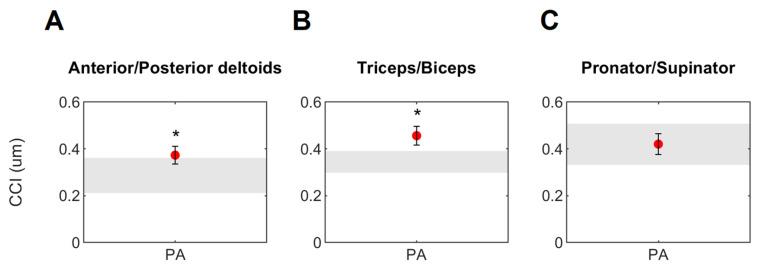
Persons post-stroke experience excessive muscle co-contraction, and consequently the arm functions are compromised during the activities of daily living. Therefore, identifying instrumental outcome measures able to detect the motor strategy adopted after a stroke is a primary clinical goal. Accordingly, this study aims at verifying whether the surface electromyography (sEMG)-based co-contraction index () could be a new clinically feasible approach for assessing and monitoring patients' motor performance. Thirty-four persons post-stroke underwent clinical assessment and upper extremity kinematic analysis, including sEMG recordings. The participants were randomized into two treatment groups (robot and usual care groups). Ten healthy subjects provided a normative reference (NR). Frost's was used to quantify the muscle co-contraction of three different agonist/antagonist muscle pairs during an object-placing task. Persons post-stroke showed excessive muscle co-contraction (mean (95% CI): anterior/posterior deltoid : 0.38 (0.34-0.41) = 0.03; triceps/biceps : 0.46 (0.41-0.50) = 0.01) compared to NR (anterior/posterior deltoid : 0.29 (0.21-0.36); triceps/biceps : 0.34 (0.30-0.39)). After robot therapy, persons post-stroke exhibited a greater improvement (i.e., reduced ) in proximal motor control (anterior/posterior deltoid change score of : -0.02 (-0.07-0.02) = 0.05) compared to usual care therapy (0.04 (0.00-0.09)). Finally, the findings of the present study indicate that the sEMG-based could be a valuable tool in clinical practice.
脑卒中患者会出现过度的肌肉协同收缩,进而导致日常生活活动中的手臂功能受损。因此,确定能够检测到卒中后运动策略的仪器化结果测量指标是主要的临床目标。因此,本研究旨在验证基于表面肌电图(sEMG)的协同收缩指数()是否可以作为一种新的临床可行方法来评估和监测患者的运动表现。34 名脑卒中患者接受了临床评估和上肢运动学分析,包括 sEMG 记录。参与者被随机分为两组(机器人组和常规护理组)。10 名健康受试者提供了一个正常参考值(NR)。Frost's 用于量化在放置物体任务中三个不同的主动肌/拮抗肌对的肌肉协同收缩。脑卒中患者表现出过度的肌肉协同收缩(平均值(95%置信区间):前/后三角肌:0.38(0.34-0.41)= 0.03;三头肌/二头肌:0.46(0.41-0.50)= 0.01)与 NR(前/后三角肌:0.29(0.21-0.36);三头肌/二头肌:0.34(0.30-0.39))相比。在机器人治疗后,脑卒中患者在近端运动控制方面表现出更大的改善(即,协同收缩减少)(前/后三角肌变化得分:-0.02(-0.07-0.02)= 0.05)与常规护理治疗相比(0.04(0.00-0.09))。最后,本研究的结果表明,基于 sEMG 的可能是临床实践中的一种有价值的工具。


 Zotero 插件