• 文献检索
  • 文档翻译
  • 深度研究
  • 学术资讯
  • Suppr Zotero 插件Zotero 插件
  • 邀请有礼
  • 套餐&价格
  • 历史记录
应用&插件
Suppr Zotero 插件Zotero 插件浏览器插件Mac 客户端Windows 客户端微信小程序
定价
高级版会员购买积分包购买API积分包
服务
文献检索文档翻译深度研究API 文档MCP 服务
关于我们
关于 Suppr公司介绍联系我们用户协议隐私条款
关注我们

Suppr 超能文献

核心技术专利:CN118964589B侵权必究
粤ICP备2023148730 号-1Suppr @ 2026

文献检索

告别复杂PubMed语法,用中文像聊天一样搜索,搜遍4000万医学文献。AI智能推荐,让科研检索更轻松。

立即免费搜索

文件翻译

保留排版,准确专业,支持PDF/Word/PPT等文件格式,支持 12+语言互译。

免费翻译文档

深度研究

AI帮你快速写综述,25分钟生成高质量综述,智能提取关键信息,辅助科研写作。

立即免费体验

使用多模态卷积神经网络在倒车摄像头中检测行人

Detection of Pedestrians in Reverse Camera Using Multimodal Convolutional Neural Networks.

作者信息

Reveles-Gómez Luis C, Luna-García Huizilopoztli, Celaya-Padilla José M, Barría-Huidobro Cristian, Gamboa-Rosales Hamurabi, Solís-Robles Roberto, Arceo-Olague José G, Galván-Tejada Jorge I, Galván-Tejada Carlos E, Rondon David, Villalba-Condori Klinge O

机构信息

Unidad Académica de Ingeniería Eléctrica, Universidad Autónoma de Zacatecas, Jardín Juarez 147, Centro, Zacatecas 98000, Mexico.

Centro de Investigación en Ciberseguridad, Universidad Mayor de Chile, Manuel Montt 367, Providencia 7500628, Chile.

出版信息

Sensors (Basel). 2023 Aug 31;23(17):7559. doi: 10.3390/s23177559.

DOI:10.3390/s23177559
PMID:37688015
原文链接:https://pmc.ncbi.nlm.nih.gov/articles/PMC10490826/
Abstract

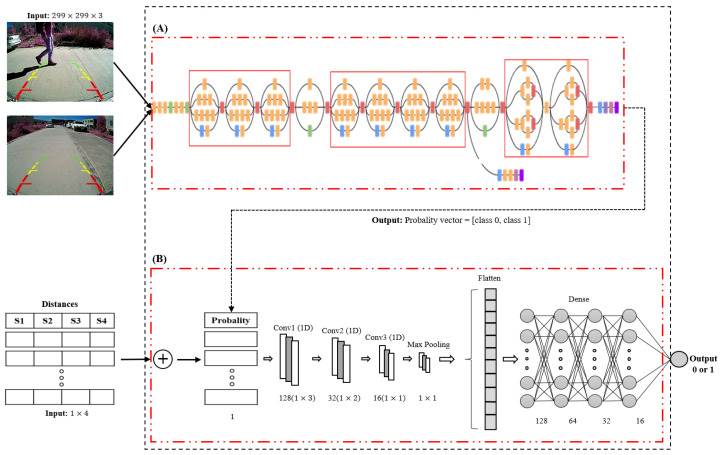
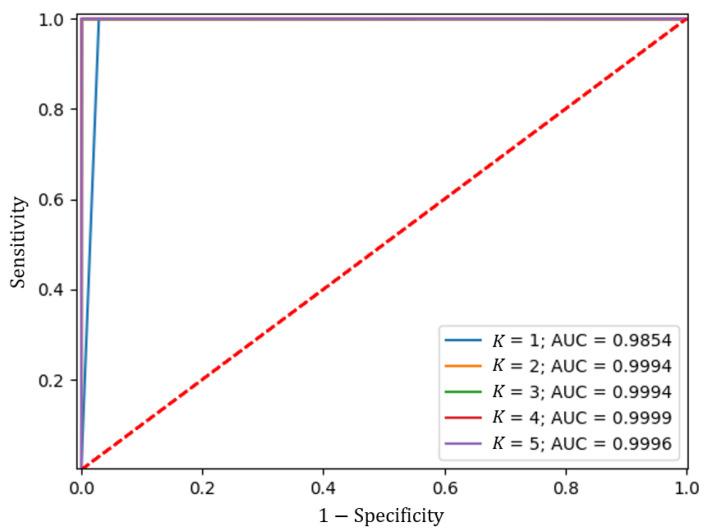
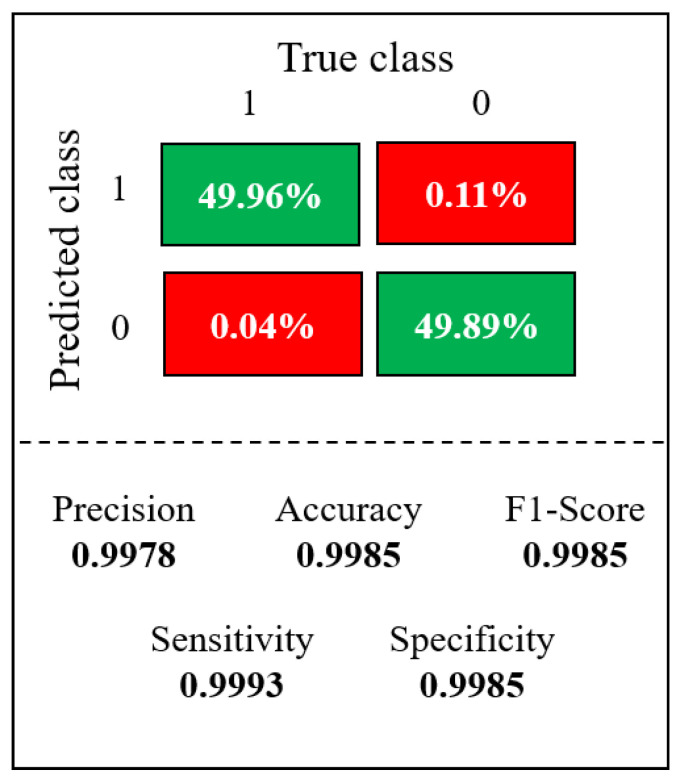
In recent years, the application of artificial intelligence (AI) in the automotive industry has led to the development of intelligent systems focused on road safety, aiming to improve protection for drivers and pedestrians worldwide to reduce the number of accidents yearly. One of the most critical functions of these systems is pedestrian detection, as it is crucial for the safety of everyone involved in road traffic. However, pedestrian detection goes beyond the front of the vehicle; it is also essential to consider the vehicle's rear since pedestrian collisions occur when the car is in reverse drive. To contribute to the solution of this problem, this research proposes a model based on convolutional neural networks (CNN) using a proposed one-dimensional architecture and the Inception V3 architecture to fuse the information from the backup camera and the distance measured by the ultrasonic sensors, to detect pedestrians when the vehicle is reversing. In addition, specific data collection was performed to build a database for the research. The proposed model showed outstanding results with 99.85% accuracy and 99.86% correct classification performance, demonstrating that it is possible to achieve the goal of pedestrian detection using CNN by fusing two types of data.

摘要

近年来,人工智能(AI)在汽车行业的应用推动了专注于道路安全的智能系统的发展,旨在提高全球范围内对驾驶员和行人的保护,以减少每年的事故数量。这些系统最关键的功能之一是行人检测,因为这对道路交通中所有相关人员的安全至关重要。然而,行人检测不仅限于车辆前方;考虑车辆后方也很重要,因为当汽车倒车时会发生行人碰撞。为了有助于解决这个问题,本研究提出了一种基于卷积神经网络(CNN)的模型,该模型使用一种提议的一维架构和Inception V3架构来融合来自倒车摄像头和超声波传感器测量距离的信息,以便在车辆倒车时检测行人。此外,还进行了特定的数据收集以构建用于该研究的数据库。所提出的模型显示出出色的结果,准确率为99.85%,正确分类性能为99.86%,表明通过融合两种类型的数据,使用CNN实现行人检测的目标是可行的。

https://cdn.ncbi.nlm.nih.gov/pmc/blobs/f040/10490826/5211d9fafc8a/sensors-23-07559-g017.jpg
https://cdn.ncbi.nlm.nih.gov/pmc/blobs/f040/10490826/7e2957904082/sensors-23-07559-g001.jpg
https://cdn.ncbi.nlm.nih.gov/pmc/blobs/f040/10490826/240be08173ed/sensors-23-07559-g002.jpg
https://cdn.ncbi.nlm.nih.gov/pmc/blobs/f040/10490826/b1610be45967/sensors-23-07559-g003.jpg
https://cdn.ncbi.nlm.nih.gov/pmc/blobs/f040/10490826/31250f639f5c/sensors-23-07559-g004.jpg
https://cdn.ncbi.nlm.nih.gov/pmc/blobs/f040/10490826/cb69627607b8/sensors-23-07559-g005.jpg
https://cdn.ncbi.nlm.nih.gov/pmc/blobs/f040/10490826/76610ac248a8/sensors-23-07559-g006.jpg
https://cdn.ncbi.nlm.nih.gov/pmc/blobs/f040/10490826/a877a6e479e3/sensors-23-07559-g007.jpg
https://cdn.ncbi.nlm.nih.gov/pmc/blobs/f040/10490826/492cda8234b1/sensors-23-07559-g008.jpg
https://cdn.ncbi.nlm.nih.gov/pmc/blobs/f040/10490826/fe364c13f60e/sensors-23-07559-g009.jpg
https://cdn.ncbi.nlm.nih.gov/pmc/blobs/f040/10490826/db2c81a41ab6/sensors-23-07559-g010.jpg
https://cdn.ncbi.nlm.nih.gov/pmc/blobs/f040/10490826/a1aab0472196/sensors-23-07559-g011.jpg
https://cdn.ncbi.nlm.nih.gov/pmc/blobs/f040/10490826/244f64ed12ba/sensors-23-07559-g012.jpg
https://cdn.ncbi.nlm.nih.gov/pmc/blobs/f040/10490826/ae264dd46b91/sensors-23-07559-g013.jpg
https://cdn.ncbi.nlm.nih.gov/pmc/blobs/f040/10490826/6de0b51eebc4/sensors-23-07559-g014.jpg
https://cdn.ncbi.nlm.nih.gov/pmc/blobs/f040/10490826/f19b14400ced/sensors-23-07559-g015.jpg
https://cdn.ncbi.nlm.nih.gov/pmc/blobs/f040/10490826/634adc3034d4/sensors-23-07559-g016.jpg
https://cdn.ncbi.nlm.nih.gov/pmc/blobs/f040/10490826/5211d9fafc8a/sensors-23-07559-g017.jpg
https://cdn.ncbi.nlm.nih.gov/pmc/blobs/f040/10490826/7e2957904082/sensors-23-07559-g001.jpg
https://cdn.ncbi.nlm.nih.gov/pmc/blobs/f040/10490826/240be08173ed/sensors-23-07559-g002.jpg
https://cdn.ncbi.nlm.nih.gov/pmc/blobs/f040/10490826/b1610be45967/sensors-23-07559-g003.jpg
https://cdn.ncbi.nlm.nih.gov/pmc/blobs/f040/10490826/31250f639f5c/sensors-23-07559-g004.jpg
https://cdn.ncbi.nlm.nih.gov/pmc/blobs/f040/10490826/cb69627607b8/sensors-23-07559-g005.jpg
https://cdn.ncbi.nlm.nih.gov/pmc/blobs/f040/10490826/76610ac248a8/sensors-23-07559-g006.jpg
https://cdn.ncbi.nlm.nih.gov/pmc/blobs/f040/10490826/a877a6e479e3/sensors-23-07559-g007.jpg
https://cdn.ncbi.nlm.nih.gov/pmc/blobs/f040/10490826/492cda8234b1/sensors-23-07559-g008.jpg
https://cdn.ncbi.nlm.nih.gov/pmc/blobs/f040/10490826/fe364c13f60e/sensors-23-07559-g009.jpg
https://cdn.ncbi.nlm.nih.gov/pmc/blobs/f040/10490826/db2c81a41ab6/sensors-23-07559-g010.jpg
https://cdn.ncbi.nlm.nih.gov/pmc/blobs/f040/10490826/a1aab0472196/sensors-23-07559-g011.jpg
https://cdn.ncbi.nlm.nih.gov/pmc/blobs/f040/10490826/244f64ed12ba/sensors-23-07559-g012.jpg
https://cdn.ncbi.nlm.nih.gov/pmc/blobs/f040/10490826/ae264dd46b91/sensors-23-07559-g013.jpg
https://cdn.ncbi.nlm.nih.gov/pmc/blobs/f040/10490826/6de0b51eebc4/sensors-23-07559-g014.jpg
https://cdn.ncbi.nlm.nih.gov/pmc/blobs/f040/10490826/f19b14400ced/sensors-23-07559-g015.jpg
https://cdn.ncbi.nlm.nih.gov/pmc/blobs/f040/10490826/634adc3034d4/sensors-23-07559-g016.jpg
https://cdn.ncbi.nlm.nih.gov/pmc/blobs/f040/10490826/5211d9fafc8a/sensors-23-07559-g017.jpg

相似文献

1
Detection of Pedestrians in Reverse Camera Using Multimodal Convolutional Neural Networks.使用多模态卷积神经网络在倒车摄像头中检测行人
Sensors (Basel). 2023 Aug 31;23(17):7559. doi: 10.3390/s23177559.
2
Predicting pedestrian crosswalk behavior using Convolutional Neural Networks.使用卷积神经网络预测行人在人行横道的行为。
Traffic Inj Prev. 2023;24(4):338-343. doi: 10.1080/15389588.2023.2186734. Epub 2023 Mar 13.
3
Performance of collision damage mitigation braking systems and their effects on human injury in the event of car-to-pedestrian accidents.碰撞损伤减轻制动系统的性能及其在汽车与行人事故中对人员伤害的影响。
Stapp Car Crash J. 2011 Nov;55:461-78. doi: 10.4271/2011-22-0017.
4
Pedestrian Detection Based on Adaptive Selection of Visible Light or Far-Infrared Light Camera Image by Fuzzy Inference System and Convolutional Neural Network-Based Verification.基于模糊推理系统和卷积神经网络验证的可见光或远红外光相机图像自适应选择的行人检测
Sensors (Basel). 2017 Jul 8;17(7):1598. doi: 10.3390/s17071598.
5
Relationship between pedestrian detection specifications of parking sensor and potential safety benefits.停车传感器行人检测规范与潜在安全效益之间的关系。
Accid Anal Prev. 2021 Mar;151:105951. doi: 10.1016/j.aap.2020.105951. Epub 2020 Dec 24.
6
Have pedestrian subsystem tests improved passenger car front shape?行人子系统测试是否改善了乘用车前部形状?
Accid Anal Prev. 2018 Jun;115:143-150. doi: 10.1016/j.aap.2018.03.014. Epub 2018 Mar 20.
7
Pedestrian Detection Using Multispectral Images and a Deep Neural Network.基于多光谱图像和深度神经网络的行人检测。
Sensors (Basel). 2021 Apr 4;21(7):2536. doi: 10.3390/s21072536.
8
Pedestrian Detection During Vehicle Backing Maneuvers Using Ultrasonic Parking Sensors.使用超声波停车传感器在车辆倒车操作期间进行行人检测
Stapp Car Crash J. 2019 Nov;63:343-358. doi: 10.4271/2019-22-0015.
9
Communication Network Architectures for Driver Assistance Systems.驾驶员辅助系统的通信网络架构。
Sensors (Basel). 2021 Oct 16;21(20):6867. doi: 10.3390/s21206867.
10
Impact of improving vehicle front design on the burden of pedestrian injuries in Germany, the United States, and India.改进车辆前部设计对德国、美国和印度行人受伤负担的影响。
Traffic Inj Prev. 2017 Nov 17;18(8):832-838. doi: 10.1080/15389588.2017.1324200. Epub 2017 May 1.

引用本文的文献

1
Research on concept generation design of automobile seats based on human-machine co-creation.基于人机共创的汽车座椅概念生成设计研究
Sci Rep. 2025 Sep 1;15(1):32223. doi: 10.1038/s41598-025-17164-1.
2
Multimodal driver emotion recognition using motor activity and facial expressions.利用运动活动和面部表情的多模态驾驶员情绪识别
Front Artif Intell. 2024 Nov 27;7:1467051. doi: 10.3389/frai.2024.1467051. eCollection 2024.

本文引用的文献

1
A Novel Algorithm for Detecting Pedestrians on Rainy Image.一种用于检测雨天图像中行人的新型算法。
Sensors (Basel). 2020 Dec 27;21(1):112. doi: 10.3390/s21010112.
2
Pedestrian Detection During Vehicle Backing Maneuvers Using Ultrasonic Parking Sensors.使用超声波停车传感器在车辆倒车操作期间进行行人检测
Stapp Car Crash J. 2019 Nov;63:343-358. doi: 10.4271/2019-22-0015.
3
Research on Longitudinal Active Collision Avoidance of Autonomous Emergency Braking Pedestrian System (AEB-P).自动驾驶紧急制动行人系统(AEB-P)纵向主动避撞研究。
Sensors (Basel). 2019 Oct 28;19(21):4671. doi: 10.3390/s19214671.
4
Efficient Pedestrian Detection at Nighttime Using a Thermal Camera.利用热成像相机在夜间进行高效行人检测
Sensors (Basel). 2017 Aug 10;17(8):1850. doi: 10.3390/s17081850.
5
Real-world evaluation of the effectiveness of reversing camera and parking sensor technologies in preventing backover pedestrian injuries.倒车摄像头和停车传感器技术在预防倒车行人受伤方面有效性的真实世界评估。
Accid Anal Prev. 2017 Feb;99(Pt A):39-43. doi: 10.1016/j.aap.2016.11.007. Epub 2016 Nov 16.
6
Deep learning.深度学习。
Nature. 2015 May 28;521(7553):436-44. doi: 10.1038/nature14539.
7
A vision based top-view transformation model for a vehicle parking assistant.基于视觉的车辆泊车辅助顶视图变换模型。
Sensors (Basel). 2012;12(4):4431-46. doi: 10.3390/s120404431. Epub 2012 Mar 30.
8
Estimation of the area under the ROC curve.ROC曲线下面积的估计。
Stat Med. 2002 Oct 30;21(20):3093-106. doi: 10.1002/sim.1228.
9
The meaning and use of the area under a receiver operating characteristic (ROC) curve.接受者操作特征(ROC)曲线下面积的意义及应用。
Radiology. 1982 Apr;143(1):29-36. doi: 10.1148/radiology.143.1.7063747.