Umaefulam Valerie, Wilson Mackenzie, Boucher Marie Carole, Brent Michael H, Dogba Maman Joyce, Drescher Olivia, Grimshaw Jeremy M, Ivers Noah M, Lawrenson John G, Lorencatto Fabiana, Maberley David, McCleary Nicola, McHugh Sheena, Sutakovic Olivera, Thavorn Kednapa, Witteman Holly O, Yu Catherine, Cheng Hao, Han Wei, Hong Yu, Idrissa Balkissa, Leech Tina, Malette Joffré, Mongeon Isabelle, Mugisho Zawadi, Nguebou Marlyse Mbakop, Pabla Sara, Rahman Siffan, Samandoulougou Azaratou, Visram Hasina, You Richard, Zhao Junqiang, Presseau Justin
Clinical Epidemiology Program, Ottawa Hospital Research Institute, Ottawa, Canada.
Department of Ophthalmology, Maisonneuve-Rosemont Ophthalmology University Center, Université de Montréal, Montreal, QC, Canada.
Pilot Feasibility Stud. 2023 Sep 9;9(1):158. doi: 10.1186/s40814-023-01372-5.
Diabetic retinopathy is a leading cause of preventable blindness in Canada. Clinical guidelines recommend annual diabetic retinopathy screening for people living with diabetes to reduce the risk and progression of vision loss. However, many Canadians with diabetes do not attend screening. Screening rates are even lower in immigrants to Canada including people from China, Africa, and the Caribbean, and these groups are also at higher risk of developing diabetes complications. We aim to assess the feasibility, acceptability, and fidelity of a co-developed, linguistically and culturally tailored tele-retinopathy screening intervention for Mandarin-speaking immigrants from China and French-speaking immigrants from African-Caribbean countries living with diabetes in Ottawa, Canada, and identify how many from each population group attend screening during the pilot period.
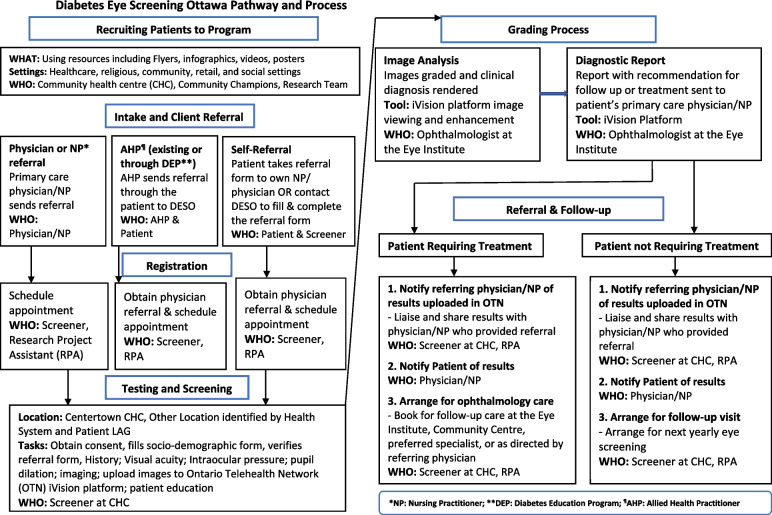
We will work with our health system and patient partners to conduct a 6-month feasibility pilot of a tele-retinopathy screening intervention in a Community Health Centre in Ottawa. We anticipate recruiting 50-150 patients and 5-10 health care providers involved in delivering the intervention for the pilot. Acceptability will be assessed via a Theoretical Framework of Acceptability-informed survey with patients and health care providers. To assess feasibility, we will use a Theoretical Domains Framework-informed interview guide and to assess fidelity, and we will use a survey informed by the National Institutes of Health framework from the perspective of health care providers. We will also collect patient demographics (i.e., age, gender, ethnicity, health insurance status, and immigration information), screening outcomes (i.e., patients with retinopathy identified, patients requiring specialist care), patient costs, and other intervention-related variables such as preferred language. Survey data will be descriptively analyzed and qualitative data will undergo content analysis.
This feasibility pilot study will capture how many people living with diabetes from each group attend the diabetic retinopathy screening, costs, and implementation processes for the tele-retinopathy screening intervention. The study will indicate the practicability and suitability of the intervention in increasing screening attendance in the target population groups. The study results will inform a patient-randomized trial, provide evidence to conduct an economic evaluation of the intervention, and optimize the community-based intervention.
糖尿病视网膜病变是加拿大可预防失明的主要原因。临床指南建议糖尿病患者每年进行糖尿病视网膜病变筛查,以降低视力丧失的风险和病情进展。然而,许多加拿大糖尿病患者未参加筛查。在包括来自中国、非洲和加勒比地区的移民在内的加拿大移民中,筛查率更低,而且这些群体发生糖尿病并发症的风险也更高。我们旨在评估一项为居住在加拿大渥太华的中国普通话移民和非洲 - 加勒比国家的法语移民糖尿病患者共同开发的、语言和文化上量身定制的远程视网膜病变筛查干预措施的可行性、可接受性和保真度,并确定在试点期间每个群体中有多少人参加筛查。
我们将与我们的卫生系统和患者合作伙伴合作,在渥太华的一个社区卫生中心对远程视网膜病变筛查干预措施进行为期6个月的可行性试点。我们预计招募50 - 150名患者以及5 - 10名参与试点干预实施的医疗保健提供者。将通过基于可接受性理论框架的调查对患者和医疗保健提供者评估可接受性。为评估可行性,我们将使用基于理论领域框架的访谈指南,为评估保真度,我们将从医疗保健提供者的角度使用基于美国国立卫生研究院框架的调查。我们还将收集患者人口统计学信息(即年龄、性别、种族、健康保险状况和移民信息)、筛查结果(即确诊患有视网膜病变的患者、需要专科护理的患者)、患者费用以及其他与干预相关的变量,如首选语言。将对调查数据进行描述性分析,对定性数据进行内容分析。
这项可行性试点研究将了解每个群体中有多少糖尿病患者参加糖尿病视网膜病变筛查、费用以及远程视网膜病变筛查干预措施的实施过程。该研究将表明该干预措施在提高目标人群筛查参与率方面的实用性和适用性。研究结果将为患者随机试验提供信息,为对该干预措施进行经济评估提供证据,并优化基于社区的干预措施。