Ko Joo Hwan, Park Jin-Hwi, Yoo Young Jin, Chang Sehui, Kang Jiwon, Wu Aiguo, Yang Fang, Kim Sejeong, Jeon Hae-Gon, Song Young Min
School of Electrical Engineering and Computer Science, Gwangju Institute of Science and Technology, Gwangju, 61005, Republic of Korea.
Artificial Intelligence Graduate School, Gwangju Institute of Science and Technology, Gwangju, 61005, Republic of Korea.
Adv Sci (Weinh). 2023 Nov;10(32):e2304310. doi: 10.1002/advs.202304310. Epub 2023 Sep 10.
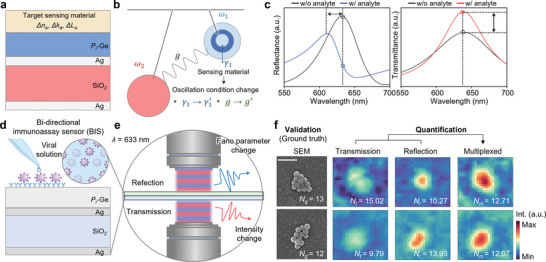
Fano resonance, known for its unique asymmetric line shape, has gained significant attention in photonics, particularly in sensing applications. However, it remains difficult to achieve controllable Fano parameters with a simple geometric structure. Here, a novel approach of using a thin-film optical Fano resonator with a porous layer to generate entire spectral shapes from quasi-Lorentzian to Lorentzian to Fano is proposed and experimentally demonstrated. The glancing angle deposition technique is utilized to create a polarization-dependent Fano resonator. By altering the linear polarization between s- and p-polarization, a switchable Fano device between quasi-Lorentz state and negative Fano state is demonstrated. This change in spectral shape is advantageous for detecting materials with a low-refractive index. A bio-particle sensing experiment is conducted that demonstrates an enhanced signal-to-noise ratio and prediction accuracy. Finally, the challenge of optimizing the film-based Fano resonator due to intricate interplay among numerous parameters, including layer thicknesses, porosity, and materials selection, is addressed. The inverse design tool is developed based on a multilayer perceptron model that allows fast computation for all ranges of Fano parameters. The method provides improved accuracy of the mean validation factor (MVF = 0.07, q-q') compared to the conventional exhaustive enumeration method (MVF = 0.37).
法诺共振以其独特的不对称线形而闻名,在光子学领域,尤其是传感应用中受到了广泛关注。然而,利用简单的几何结构实现可控的法诺参数仍然具有挑战性。在此,我们提出并通过实验证明了一种新颖的方法,即使用带有多孔层的薄膜光学法诺谐振器来产生从准洛伦兹到洛伦兹再到法诺的整个光谱形状。利用掠角沉积技术制作了一种偏振依赖的法诺谐振器。通过改变s偏振和p偏振之间的线性偏振,展示了一种在准洛伦兹状态和负法诺状态之间可切换的法诺器件。这种光谱形状的变化有利于检测低折射率材料。进行了生物粒子传感实验,结果表明该方法具有更高的信噪比和预测精度。最后,解决了由于包括层厚度、孔隙率和材料选择在内的众多参数之间复杂的相互作用而导致的基于薄膜的法诺谐振器优化难题。基于多层感知器模型开发了逆向设计工具,该工具能够对所有法诺参数范围进行快速计算。与传统的穷举枚举方法(平均验证因子MVF = 0.37)相比,该方法提高了平均验证因子的精度(MVF = 0.07,q - q')。