Shenoy Nisha, Srinivasan Siddharth, Menon Girish, Kurupath Radhakrishnan
Department of Neurology, Kasturba Medical College, Manipal Academy of Higher Education, Udupi, Karnataka, India.
Department of Neurosurgery, Kasturba Medical College, Manipal Academy of Higher Education, Udupi, Karnataka, India.
J Neurosci Rural Pract. 2023 Jul-Sep;14(3):488-494. doi: 10.25259/JNRP_116_2023. Epub 2023 Jun 16.
The objectives of this study were to share our initial experience with epilepsy surgery and provide an overview on the surgical treatments of epilepsies.
This was a retrospective analysis of the demographics and clinical and investigative features of patients who underwent epilepsy surgery between January 2016 and August 2021. Postoperative seizure outcome was categorized according to modified Engel's classification, and the minimum period of follow-up was 1 year.
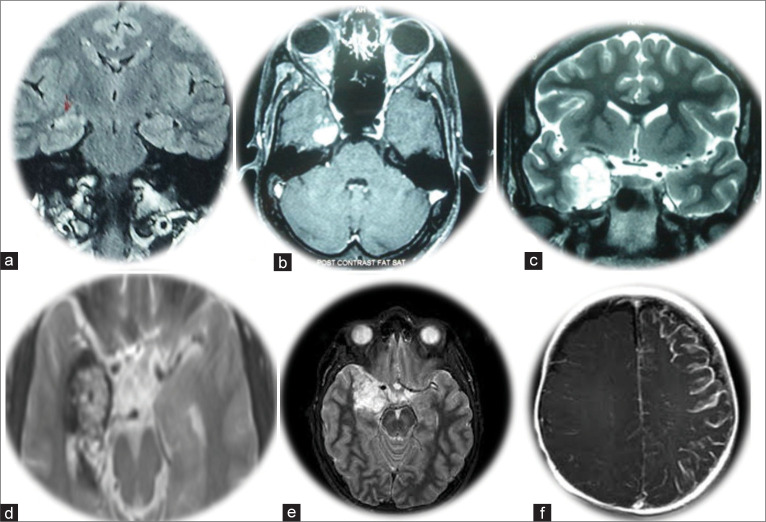
The study group included 30 patients with an age ranging from 6 years to 45 years (mean: 22.28 years, median: 20 years) and a male: female ratio of 20:10. The epilepsy duration before surgery ranged from 3 years to 32 years (median: 7 years). Majority of our patients underwent resective surgeries (28/30 = 93.3%), and disconnection procedures were done in two patients. This included one functional hemispherotomy and one posterior quadrantic disconnection. Temporal lobe resective surgery was the most common procedure (16/30 = 53.3%), followed by eight frontal lobe and two parietal lobe surgeries. Among resective surgeries, majority were lesional surgeries and the pathologies included mesial temporal sclerosis (4), dysembryoplastic neuroepithelial tumor (8), ganglioglioma (6), cavernoma (4), focal cortical dysplasia (2), gliosis (1), and one case of hypothalamic hamartoma. Intraoperative electrocorticography was used in all cases for optimizing surgical resection/disconnection. Nearly two-thirds of our patients (66.6%) had an Engel's Class I outcome, five patients had Engel's Class II outcome, three patients had Class III outcome, and one patient did not have any worthwhile improvement. Temporal lobe surgery patients had a better seizure outcome compared to extratemporal surgeries (84% vs. 74%). Overall, complications were minimal and short lasting, and comprised meningitis in three patients (5.6%) and transient worsening of hemiparesis following hemispherotomy in two patients. There was no mortality or long-lasting major morbidity in our patients.
In carefully selected patients with drug-resistant epilepsy, surgery offers an excellent chance of becoming seizure-free with significant improvement in overall quality of life. Majority of the common epilepsy surgery procedures can be performed through a multidisciplinary approach even in centers with limited resources.
本研究的目的是分享我们在癫痫手术方面的初步经验,并概述癫痫的外科治疗方法。
这是一项对2016年1月至2021年8月期间接受癫痫手术患者的人口统计学、临床和检查特征的回顾性分析。术后癫痫发作结果根据改良的恩格尔分类进行分类,最短随访期为1年。
研究组包括30例患者,年龄从6岁到45岁(平均:22.28岁,中位数:20岁),男女比例为20:10。术前癫痫病程从3年到32年不等(中位数:7年)。我们的大多数患者接受了切除手术(28/30 = 93.3%),两名患者进行了离断手术,包括一例功能性大脑半球切除术和一例后象限离断术。颞叶切除手术是最常见的手术(16/30 = 53.3%),其次是8例额叶手术和2例顶叶手术。在切除手术中,大多数是病灶性手术,病理包括内侧颞叶硬化(4例)、胚胎发育不良性神经上皮肿瘤(8例)、神经节胶质瘤(6例)、海绵状血管瘤(4例)、局灶性皮质发育不良(2例)、胶质增生(1例),以及1例下丘脑错构瘤。所有病例均使用术中皮质脑电图来优化手术切除/离断。近三分之二的患者(66.6%)达到恩格尔I级结果,5例患者达到恩格尔II级结果,3例患者达到III级结果,1例患者没有任何有价值的改善。与颞叶外手术相比,颞叶手术患者的癫痫发作结果更好(84%对74%)。总体而言,并发症轻微且持续时间短,包括3例患者(5.6%)发生脑膜炎,2例患者在大脑半球切除术后偏瘫短暂加重。我们的患者中没有死亡或长期严重并发症。
在精心挑选的药物难治性癫痫患者中,手术提供了实现无癫痫发作并显著改善总体生活质量的绝佳机会。即使在资源有限的中心,大多数常见的癫痫手术程序也可以通过多学科方法进行。