Jhan Jyun-Yan, Wang Wei-En, Chu Sung-Chao, Cheng Chiu-Hsuan, Chang Chung-Hsing
Skin Institute, Department of Dermatology, Hualien Tzu Chi Hospital, Buddhist Tzu Chi Medical Foundation, Hualien, Taiwan.
Department of Hematology-Oncology, Buddhist Tzu Chi General Hospital, Hualien, Taiwan.
Front Oncol. 2023 Aug 24;13:1184738. doi: 10.3389/fonc.2023.1184738. eCollection 2023.
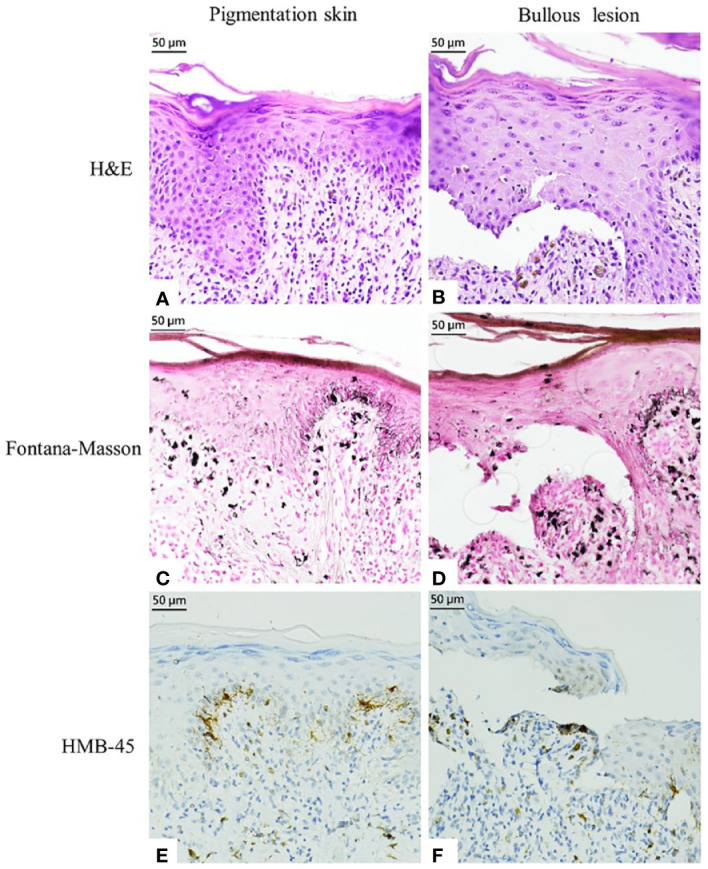
Ribociclib, a cyclin-dependent kinase 4/6 inhibitor, is a novel targeted therapy for advanced-stage breast cancer. Although ribociclib-induced cutaneous side effects have been previously noted, they have not been well documented. Herein, we present a case of ribociclib-induced phototoxicity, which manifested as dyschromia over sun-exposed forearms and neck initially and as bullae formation subsequently. A 71-year-old woman with metastatic breast cancer developed dyschromia after daily treatment with ribociclib (600 mg) for 7 months. Skin biopsy of the pigmented lesion revealed interface dermatitis with melanin incontinence and dyskeratotic cells and ballooning keratinocytes with loss of melanocytes in the basal layer. Further, clefting at the basal layer of epidermis was noted in a more hyperpigmented field. Fontana-Masson staining revealed melanophages in the dermis. Human Melanoma Black-45 staining revealed decreased melanocyte numbers in the epidermis above the cleft. Immunohistochemical analyses revealed activated CD1a+ epidermal Langerhans cells and infiltrating CD4+ and CD8+ T cells in the epidermis and dermis, thereby indicating type IV hypersensitivity that was associated with damage to keratinocytes and melanocytes. To prevent progression of bullous dermatitis, we advised the patient to discontinue ribociclib and prescribed oral and topical prednisolone. Due to the risk of phototoxicity, we educated the patient on sun-protection strategies. The patient's skin lesions subsided during the 2 months of treatment. Phototoxicity with dyschromia is a rare but significant ribociclib-induced cutaneous side effect. Early diagnosis, rapid ribociclib withdrawal, protection from sunlight, and prompt treatment are critical for preventing subsequent severe bullous dermatosis.
瑞博西尼是一种细胞周期蛋白依赖性激酶4/6抑制剂,是晚期乳腺癌的一种新型靶向治疗药物。虽然之前已经注意到瑞博西尼引起的皮肤副作用,但相关记录并不完善。在此,我们报告一例瑞博西尼引起的光毒性病例,最初,最初表现为暴露于阳光下的前臂和颈部色素沉着异常,随后出现大疱形成。一名71岁的转移性乳腺癌女性在每日服用瑞博西尼(600毫克)治疗7个月后出现色素沉着异常。色素沉着病变的皮肤活检显示界面性皮炎,伴有黑素失禁、角化不良细胞以及基底层黑素细胞缺失的气球样角质形成细胞。此外,在色素沉着更明显的区域,表皮基底层出现裂隙。Fontana-Masson染色显示真皮中有噬黑素细胞。Human Melanoma Black-45染色显示裂隙上方表皮中的黑素细胞数量减少。免疫组织化学分析显示表皮和真皮中有活化的CD1a+表皮朗格汉斯细胞以及浸润的CD4+和CD8+ T细胞,从而表明与角质形成细胞和黑素细胞损伤相关的IV型超敏反应。为防止大疱性皮炎进展,我们建议患者停用瑞博西尼,并开具了口服和外用泼尼松龙。鉴于存在光毒性风险,我们对患者进行了防晒策略的教育。在治疗的2个月期间,患者的皮肤病变消退。伴有色素沉着异常的光毒性是一种罕见但显著的瑞博西尼引起的皮肤副作用。早期诊断、迅速停用瑞博西尼、避免阳光照射以及及时治疗对于预防随后的严重大疱性皮肤病至关重要。