Tan Can, Kurup Shreya, Dyakiv Yaryna, Kume Tsutomu
Feinberg Cardiovascular and Renal Research Institute, Department of Medicine, Feinberg School of Medicine, Northwestern University, Chicago, Illinois, USA.
Honors College, University of Illinois at Chicago, Chicago, Illinois, USA.
bioRxiv. 2023 Aug 30:2023.08.30.555455. doi: 10.1101/2023.08.30.555455.
Mitral valve (MV) disease including myxomatous degeneration is the most common form of valvular heart disease with an age-dependent frequency. Genetic evidence indicates mutations of the transcription factor are associated with MV defects, including mitral valve regurgitation. In this study, we sought to determine whether murine and its closely related factor, , are required in valvular endothelial cells (VECs) for the maintenance of MV leaflets, including VEC junctions and the stratified trilaminar extracellular matrix (ECM).
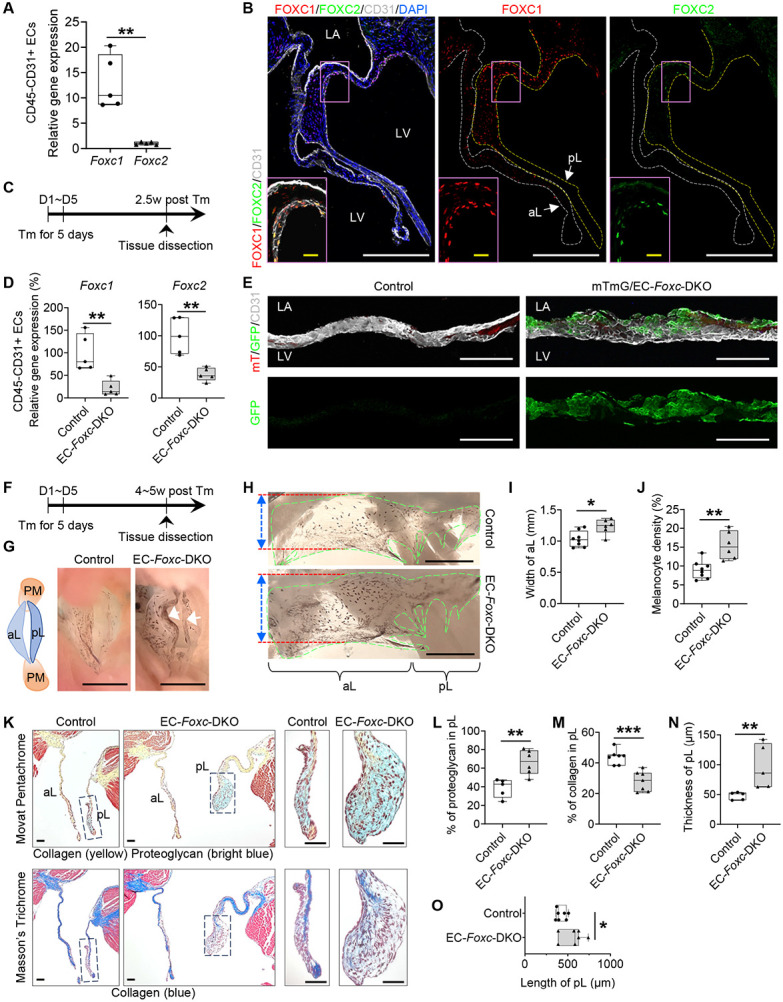
Adult mice carrying tamoxifen-inducible, endothelial cell (EC)-specific, compound mutations (i.e., EC--DKO mice) were used to study the function of and in the maintenance of mitral valves. The EC-mutations of were induced at 7 - 8 weeks of age by tamoxifen treatment, and abnormalities in the MVs of EC--DKO mice were assessed via whole-mount immunostaining, immunohistochemistry, and Movat pentachrome/Masson's Trichrome staining.
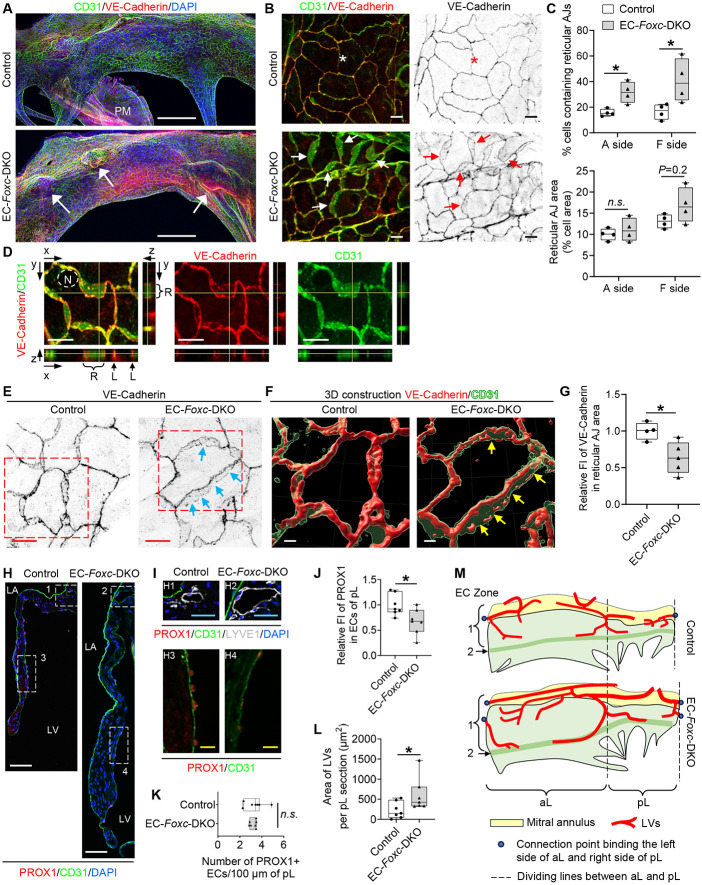
EC-deletions of and in mice resulted in abnormally extended and thicker mitral valves by causing defects in regulation of ECM organization with increased proteoglycan and decreased collagen. Notably, reticular adherens junctions were found in VECs of control MV leaflets, and these reticular structures were severely disrupted in EC- mutant mice. PROX1, a key regulator in a subset of VECs on the fibrosa side of MVs, was downregulated in EC- mutant VECs. Furthermore, we determined the precise location of lymphatic vessels in murine MVs, and these lymphatic vessels were aberrantly expanded in EC- mutant mitral valves.
Our results indicate that and are required for maintaining the integrity of the MV, including VEC junctions, ECM organization, and lymphatic vessels to prevent myxomatous mitral valve degeneration.
二尖瓣(MV)疾病,包括黏液瘤样变性,是最常见的心脏瓣膜病形式,其发病率与年龄相关。遗传学证据表明转录因子的突变与MV缺陷有关,包括二尖瓣反流。在本研究中,我们试图确定在瓣膜内皮细胞(VECs)中,小鼠的和与其密切相关的因子是否是维持MV瓣叶所必需的,包括VEC连接和分层的三层细胞外基质(ECM)。
携带他莫昔芬诱导的、内皮细胞(EC)特异性、复合突变(即EC--DKO小鼠)的成年小鼠用于研究和在维持二尖瓣中的功能。通过他莫昔芬治疗在7 - 8周龄时诱导的EC突变,通过全层免疫染色、免疫组织化学和Movat五色染色/ Masson三色染色评估EC--DKO小鼠MV的异常情况。
小鼠中EC缺失和导致二尖瓣异常延长和增厚,这是由于ECM组织调节缺陷导致蛋白聚糖增加和胶原蛋白减少。值得注意的是,在对照MV瓣叶的VEC中发现了网状黏附连接,而这些网状结构在EC突变小鼠中严重破坏。PROX1是MV纤维侧VEC子集中的关键调节因子,在EC突变的VEC中下调。此外,我们确定了小鼠MV中淋巴管的精确位置,并且这些淋巴管在EC突变的二尖瓣中异常扩张。
我们的结果表明,和是维持MV完整性所必需的,包括VEC连接、ECM组织和淋巴管,以防止黏液瘤样二尖瓣变性。