Gómez-Bañuelos Eduardo, Goldman Daniel W, Andrade Victoria, Darrah Erika, Petri Michelle, Andrade Felipe
Division of Rheumatology, The Johns Hopkins University School of Medicine, Baltimore, MD, 21224.
medRxiv. 2023 Aug 28:2023.08.28.23294734. doi: 10.1101/2023.08.28.23294734.
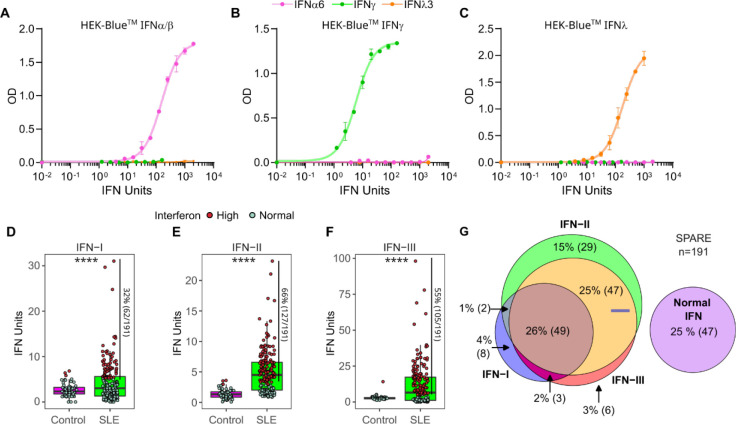
Interferons (IFN) are thought to be key players in systemic lupus erythematosus (SLE). The unique and interactive roles of the different IFN families in SLE pathogenesis, however, remain poorly understood. Using reporter cells engineered to precisely quantify IFN-I, IFN-II and IFN-III activity levels in serum/plasma, we found that while IFNs play essential role in SLE pathogenesis and disease activity, they are only significant in specific subsets of patients. Interestingly, whereas IFN-I is the main IFN that governs disease activity in SLE, clinical subsets are defined by the co-elevation of IFN-II and IFN-III. Thus, increased IFN-I alone was only associated with cutaneous lupus. In contrast, systemic features, such as nephritis, were linked to co-elevation of IFN-I plus IFN-II and IFN-III, implying a synergistic effect of IFNs in severe SLE. Intriguingly, while increased IFN-I levels were strongly associated with IFN-induced gene expression (93.5%), in up to 64% of cases, the IFN signature was not associated with IFN-I. Importantly, neither IFN-II nor IFN-III explained IFN-induced gene expression in patients with normal IFN-I levels, and not every feature in SLE was associated with elevated IFNs, suggesting IFN-independent subsets in SLE. Together, the data suggest that, unlike the IFN signature, direct quantification of bioactive IFNs can identify pathogenic and clinically relevant SLE subsets amenable for precise anti-IFN therapies. Since IFN-I is only elevated in a subset of SLE patients expressing the IFN signature, this study explains the heterogeneous response in clinical trials targeting IFN-I, where patients were selected based on IFN-induced gene expression rather than IFN-I levels.
干扰素(IFN)被认为是系统性红斑狼疮(SLE)的关键因素。然而,不同干扰素家族在SLE发病机制中的独特和相互作用的作用仍知之甚少。我们使用经过基因工程改造的报告细胞来精确量化血清/血浆中的I型、II型和III型干扰素活性水平,发现虽然干扰素在SLE发病机制和疾病活动中起重要作用,但它们仅在特定患者亚组中具有显著意义。有趣的是,虽然I型干扰素是控制SLE疾病活动的主要干扰素,但临床亚组是由II型和III型干扰素的共同升高来定义的。因此,仅I型干扰素升高仅与皮肤型狼疮相关。相比之下,肾炎等全身特征与I型干扰素加II型和III型干扰素的共同升高有关,这意味着干扰素在严重SLE中具有协同作用。有趣的是,虽然I型干扰素水平升高与干扰素诱导的基因表达密切相关(93.5%),但在高达64%的病例中,干扰素特征与I型干扰素无关。重要的是,II型和III型干扰素均不能解释I型干扰素水平正常的患者中干扰素诱导的基因表达,并且SLE中的并非每个特征都与干扰素升高相关,这表明SLE中存在不依赖干扰素的亚组。总之,数据表明,与干扰素特征不同,生物活性干扰素的直接定量可以识别适合精确抗干扰素治疗的致病性和临床相关SLE亚组。由于I型干扰素仅在表达干扰素特征的一部分SLE患者中升高,本研究解释了针对I型干扰素的临床试验中的异质性反应,在这些试验中,患者是根据干扰素诱导的基因表达而不是I型干扰素水平选择的。