
不同轮班规律工人的职业倦怠:睡眠、抑郁和工作环境的交互因素。
Job burnout among workers with different shift regularity: interactive factors between sleep, depression, and work environment.
机构信息
Department of Psychiatry, Sungkyunkwan University College of Medicine, Samsung Medical Center, Seoul, Republic of Korea.
Seoul Garden Clinic, Seoul, Republic of Korea.
出版信息
Front Public Health. 2023 Aug 24;11:1131048. doi: 10.3389/fpubh.2023.1131048. eCollection 2023.
OBJECT
We investigated burnout and associated factors in non-shift workers (NSWs), shift workers with regular rotating shifts (RRSWs), and shift workers with irregular or unpredictable rotating shifts (IRSWs).
METHODS
In total, 5,125 adult workers (1,966 NSWs, 1,936 RRSWs, and 1,223 IRSWs) participated in an online self-reported survey. Job burnout and three dimensions thereof (exhaustion, cynicism, and professional efficacy) were assessed using the Maslach Burnout Inventory-General Survey (MBI-GS). The Center for Epidemiological Studies Depression Scale (CES-D) (depressive symptoms), Pittsburgh Sleep Quality Index (PSQI) (subjective sleep quality), and Korean Occupational Stress Scale (KOSS) (stressful job environment) were also used.
RESULTS
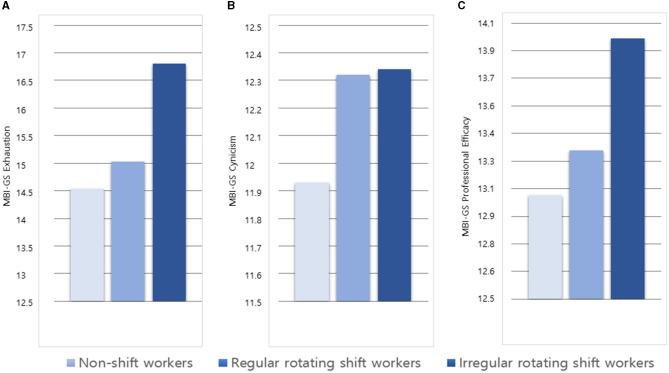
Both types of shift workers scored higher in terms of exhaustion, cynicism, and poor professional efficacy on the MBI-GS compared with NSWs after controlling for age and gender. IRSWs exhibited higher scores on the exhaustion and professional efficacy dimensions of the MBI-GS compared with RRSWs. After controlling for the CES-D and PSQI scores, we found no significant difference in cynicism among the groups. After controlling for the KOSS score, we found no significant difference in professional efficacy. All MBI-GS dimensional scores were correlated significantly with the CES-D, PSQI, and KOSS scores in all three groups.
CONCLUSION
The job burnout level of rotating shift workers, especially those with irregular shifts, was higher than that of other workers. Cynicism in shift workers may be largely attributable to poor sleep or depression; the poor efficacy of shift workers may be explained by their stressful work environment.
目的
本研究旨在调查非轮班工人(NSWs)、有规律轮班的轮班工人(RRSWs)和不规律或不可预测轮班的轮班工人(IRSWs)中的倦怠及其相关因素。
方法
共有 5125 名成年工人(1966 名 NSWs、1936 名 RRSWs 和 1223 名 IRSWs)参与了一项在线自我报告调查。使用 Maslach 倦怠量表-一般量表(MBI-GS)评估职业倦怠及其三个维度(疲惫、玩世不恭和职业效能)。还使用了流行病学研究抑郁量表(CES-D)(抑郁症状)、匹兹堡睡眠质量指数(PSQI)(主观睡眠质量)和韩国职业压力量表(KOSS)(紧张的工作环境)。
结果
在控制年龄和性别后,与 NSWs 相比,两种类型的轮班工人在 MBI-GS 上的疲惫、玩世不恭和职业效能评分均较高。与 RRSWs 相比,IRSWs 在 MBI-GS 的疲惫和职业效能维度上的得分更高。在控制 CES-D 和 PSQI 评分后,我们发现各组之间在玩世不恭方面没有显著差异。在控制 KOSS 评分后,我们发现职业效能没有差异。在所有三组中,MBI-GS 各维度评分均与 CES-D、PSQI 和 KOSS 评分显著相关。
结论
轮班工人的工作倦怠水平较高,尤其是不规则轮班的工人。轮班工人的玩世不恭可能在很大程度上归因于睡眠质量差或抑郁;轮班工人的工作效能差可能是由其紧张的工作环境造成的。
 Zotero 插件