Department of Occupational Health, School of Health, Kashan University of Medical Sciences, Kashan, Iran.
Department of Mechanical and Industrial Engineering, College of Engineering and Computers in Al-Qunfudah, Umm Al-Qura University, 21955, Makkah, Saudi Arabia.
Sci Rep. 2024 Feb 26;14(1):4649. doi: 10.1038/s41598-024-55468-w.
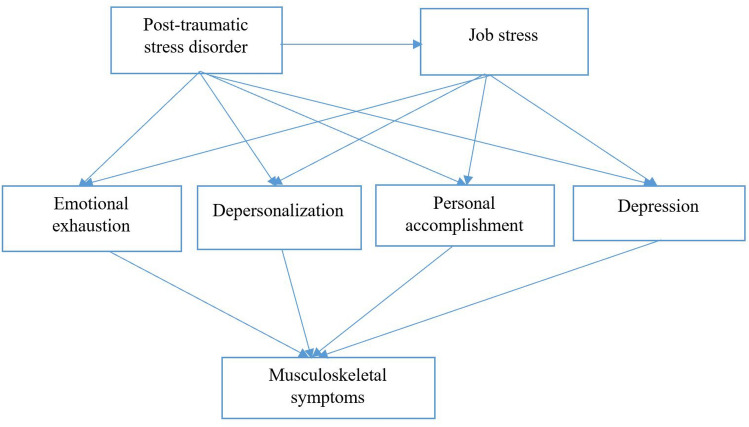
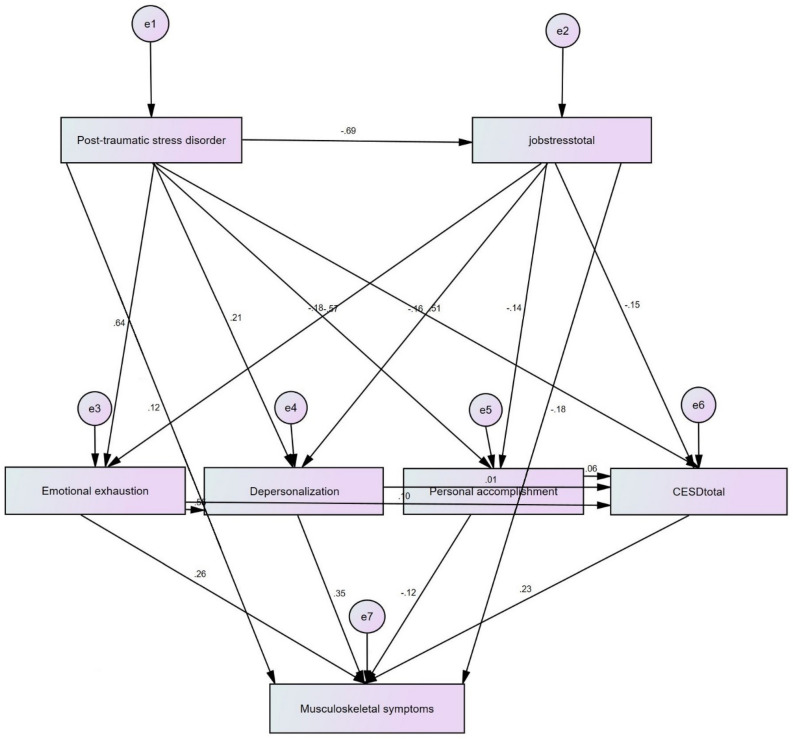
The firefighting profession carries a heightened risk of musculoskeletal disorders. A firefighter's job is physically demanding and includes activities such as running, climbing, dragging, and lifting. Often, these tasks are unpredictable, performed in harsh environments, and have been found to cause psychological stress. The purpose of this study was to investigate the effects of occupational stress on work-related musculoskeletal disorders (WRMSD) in firefighters. In addition, the mediating effects of depression and job burnout on proposed relationships were examined. Data informing this study were collected using a survey questionnaire. The survey questionnaire included the Beck Depression Inventory, the Center for Epidemiological Studies Depression Scale (CES-D), the Maslach Burnout Inventory, the Post Traumatic Stress Disorder Inventory (PCL), and the Nordic Musculoskeletal Questionnaire. Collected data were analyzed using structural equation modeling approach in AMOS. The results of the 2339 responding firefighters suggest that work related stress is positively related to WRMSDs in firefighters and can lead to musculoskeletal symptoms through four paths, being emotional exhaustion, personal accomplishment, CES-D total score, and depersonalization. Through depersonalization, job stress had the most significant impact on musculoskeletal symptoms (coefficient = 0.053). Furthermore, the results showed that post-traumatic stress disorders (PTSD) can affect musculoskeletal symptoms through ten paths, again through depersonalization, PTSD had the most significant impact on musculoskeletal symptoms (coefficient = 0.141). The results of this study suggest that organizations should design interventions and policies to prevent and manage occupational stress, depression, and job burnout to negate its undesired consequences on firefighters' health (i.e. WRMSD).
消防职业存在较高的肌肉骨骼失调风险。消防员的工作体力要求很高,包括跑步、攀爬、拖拉和举升等活动。通常,这些任务是不可预测的,在恶劣的环境中进行,并已被发现会造成心理压力。本研究的目的是调查职业压力对消防员与工作相关的肌肉骨骼疾病(WRMSD)的影响。此外,还研究了抑郁和工作倦怠对拟议关系的中介作用。本研究的数据是通过问卷调查收集的。调查问卷包括贝克抑郁量表、流行病学研究中心抑郁量表(CES-D)、马斯拉赫倦怠量表、创伤后应激障碍量表(PCL)和北欧肌肉骨骼问卷。使用 AMOS 中的结构方程建模方法对收集到的数据进行了分析。2339 名回应消防员的结果表明,工作相关压力与消防员的 WRMSD 呈正相关,并可通过四种途径导致肌肉骨骼症状,即情绪衰竭、个人成就感、CES-D 总分和去人性化。通过去人性化,工作压力对肌肉骨骼症状的影响最大(系数=0.053)。此外,结果表明,创伤后应激障碍(PTSD)可通过十种途径影响肌肉骨骼症状,同样通过去人性化,PTSD 对肌肉骨骼症状的影响最大(系数=0.141)。本研究结果表明,组织应设计干预措施和政策,以预防和管理职业压力、抑郁和工作倦怠,以消除其对消防员健康(即 WRMSD)的不良后果。