Countouris Malamo E, Koczo Agnes, Reynolds Harmony R, Hausvater Anais, Mann Harnoor, Wang Yisi, Sharbaugh Danielle, Thoma Floyd W, Mulukutla Suresh R, Catov Janet M
Division of Cardiology, Department of Medicine, University of Pittsburgh Medical Center, Pittsburgh, Pennsylvania, USA.
Leon H. Charney Division of Cardiology, Department of Medicine, Sarah Ross Soter Center for Women's Cardiovascular Research, NYU Grossman School of Medicine, New York, New York, USA.
JACC Adv. 2023 Jul;2(5). doi: 10.1016/j.jacadv.2023.100411. Epub 2023 Jul 19.
Adverse pregnancy outcomes (APOs), hypertensive disorders of pregnancy, gestational diabetes mellitus, and preterm birth are associated with ischemic heart disease in later life.
The authors aimed to study the features of premature myocardial infarction (MI) among women with and without prior APOs.
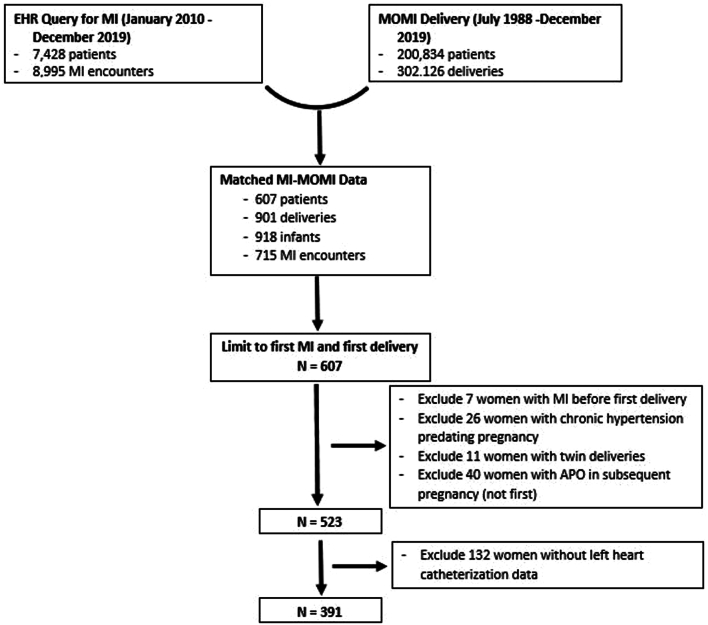
We performed a retrospective analysis of women with premature MI (<65 years of age) referred for left heart catheterization matched with a database of abstracted pregnancy data. We compared MI characteristics and epicardial coronary anatomy between women with and without APOs during their index pregnancy and evaluated time from delivery to MI.
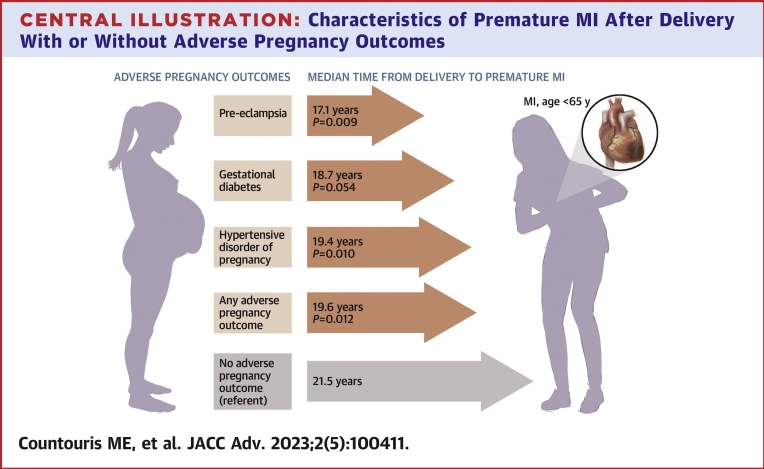
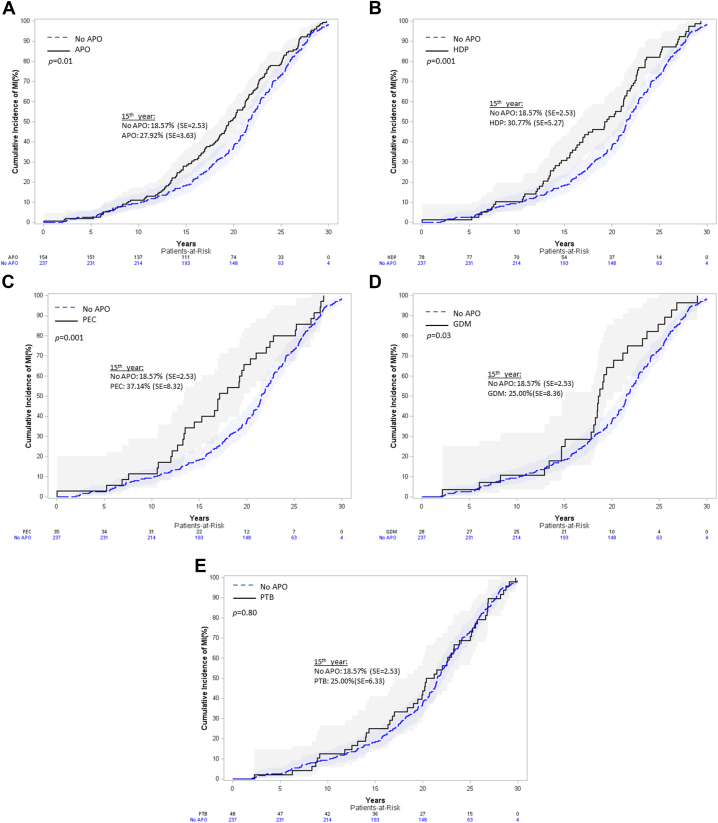
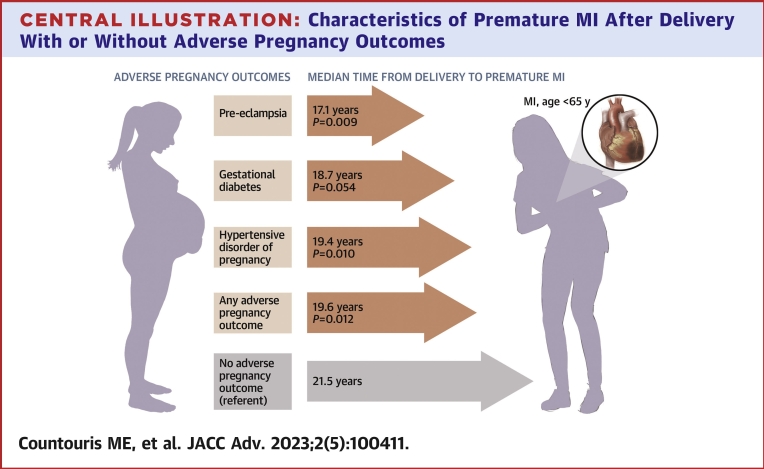
Of 391 women with premature MI and associated coronary angiography (age: 49 ± 8 years), 154 (39%) had a prior APO (hypertensive disorders of pregnancy n = 78, preeclampsia n = 35, gestational diabetes mellitus n = 28, and preterm birth n = 48). Women with APO history had a higher prevalence of diabetes (33% vs 16% without APO; = 0.001) and presented earlier with MI following delivery (19.6 [IQR: 14.3-23.5] years vs those without APO 21.5 [IQR: 17.0-25.4] years; = 0.012), driven by preeclampsia (17.1 [IQR: 12.7-22.4] years, = 0.010). Women with and without APOs had similar MI features including rates of ST-segment elevation MI, obstructive and multi-vessel coronary artery disease, percutaneous coronary intervention, and shock.
Among women with premature MIs, 39% had a history of an APO. Women with APO history presented sooner after pregnancy but had similar MI characteristics vs those without APOs. Pregnancy history may identify women who warrant early, aggressive cardiovascular disease prevention.
不良妊娠结局(APO)、妊娠高血压疾病、妊娠期糖尿病和早产与晚年缺血性心脏病相关。
作者旨在研究有和没有既往APO的女性中过早心肌梗死(MI)的特征。
我们对因左心导管插入术就诊的过早MI(<65岁)女性进行了回顾性分析,并与一个提取的妊娠数据数据库进行匹配。我们比较了在其索引妊娠期间有和没有APO的女性之间的MI特征和心外膜冠状动脉解剖结构,并评估了从分娩到MI的时间。
在391例过早MI并接受相关冠状动脉造影的女性中(年龄:49±8岁),154例(39%)有既往APO(妊娠高血压疾病n = 78,先兆子痫n = 35,妊娠期糖尿病n = 28,早产n = 48)。有APO病史的女性糖尿病患病率更高(33%对无APO者的16%;P = 0.001),并且在分娩后更早出现MI(19.6 [四分位间距:14.3 - 23.5]年,而无APO者为21.5 [四分位间距:17.0 - 25.4]年;P = 0.012),这是由先兆子痫驱动的(17.1 [四分位间距:12.7 - 22.4]年,P = 0.010)。有和没有APO的女性具有相似的MI特征,包括ST段抬高型MI的发生率、阻塞性和多支冠状动脉疾病、经皮冠状动脉介入治疗以及休克发生率。
在过早发生MI的女性中,39%有APO病史。有APO病史的女性在妊娠后更早出现症状,但与无APO病史的女性具有相似的MI特征。妊娠史可能有助于识别那些需要早期积极预防心血管疾病的女性。