Department of Psychiatry, University of Utah, Salt Lake City, UT, USA.
Huntsman Mental Health Institute, University of Utah, Salt Lake City, UT, USA.
J Alzheimers Dis. 2023;95(3):1233-1252. doi: 10.3233/JAD-221297.
Despite reports of gross motor problems in mild cognitive impairment (MCI) and Alzheimer's disease (AD), fine motor function has been relatively understudied.
We examined if finger tapping is affected in AD, related to AD biomarkers, and able to classify MCI or AD.
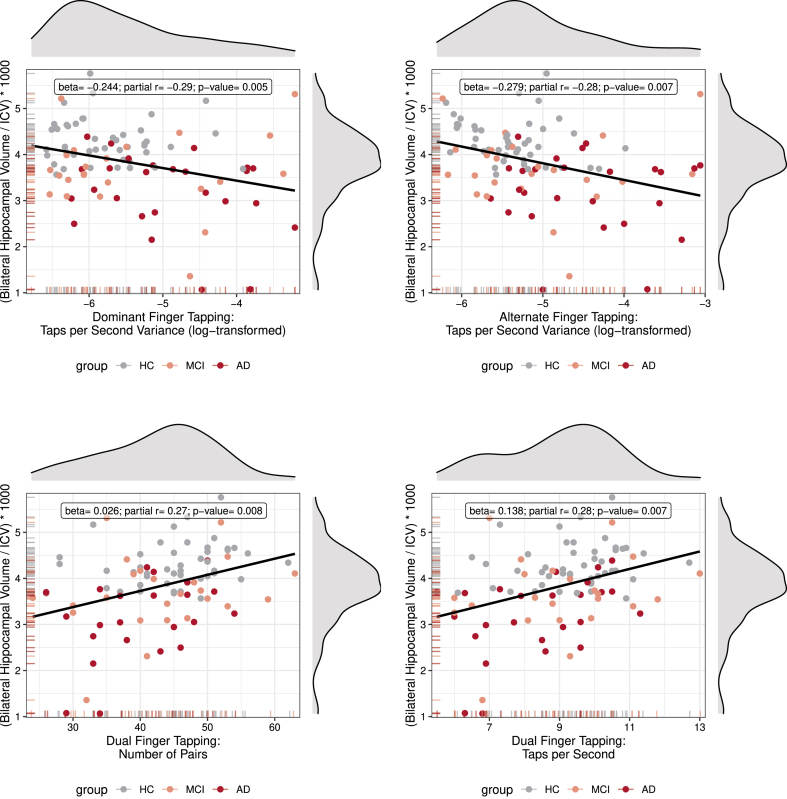
Forty-seven cognitively normal, 27 amnestic MCI, and 26 AD subjects completed unimanual and bimanual computerized tapping tests. We tested 1) group differences in tapping with permutation models; 2) associations between tapping and biomarkers (PET amyloid-β, hippocampal volume, and APOEɛ4 alleles) with linear regression; and 3) the predictive value of tapping for group classification using machine learning.
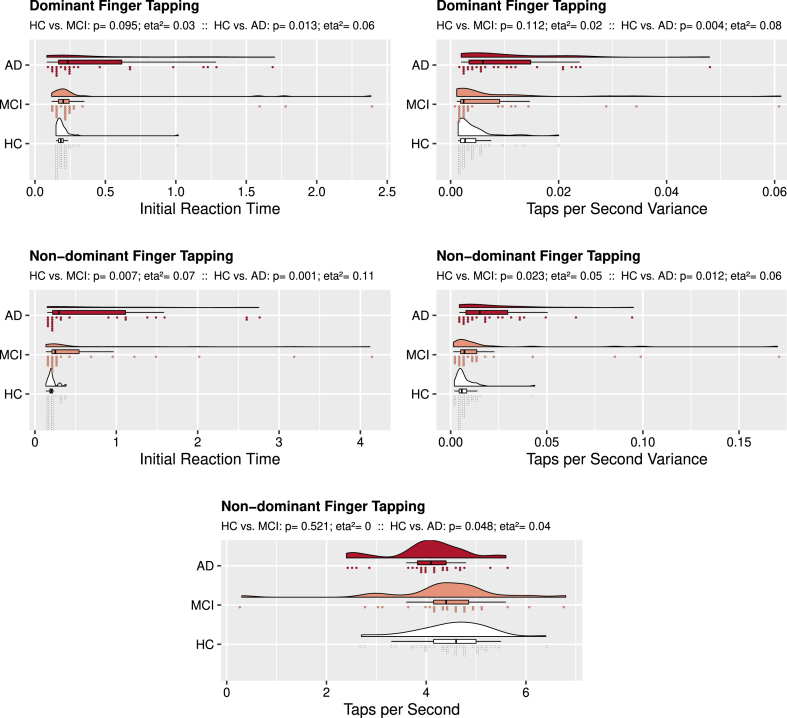
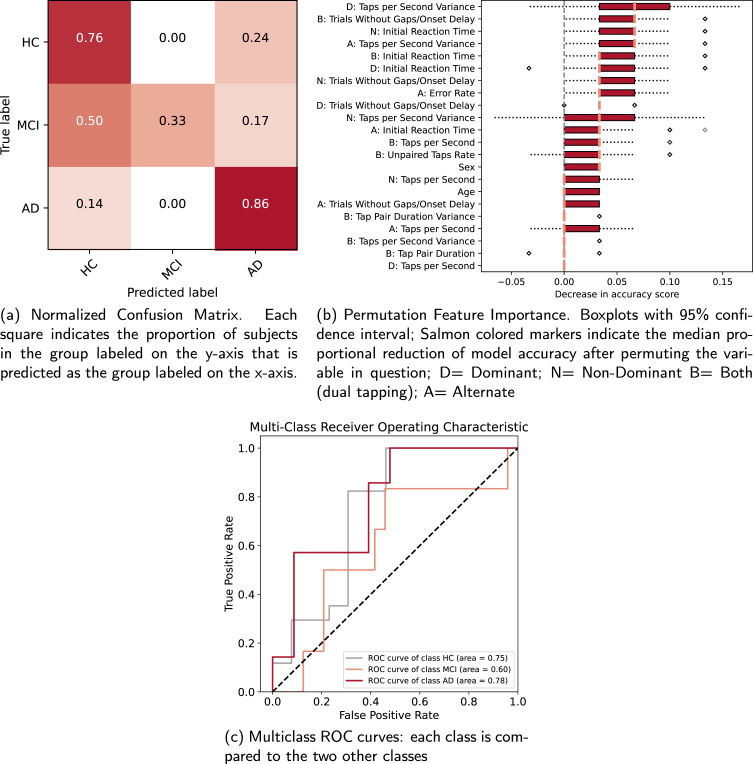
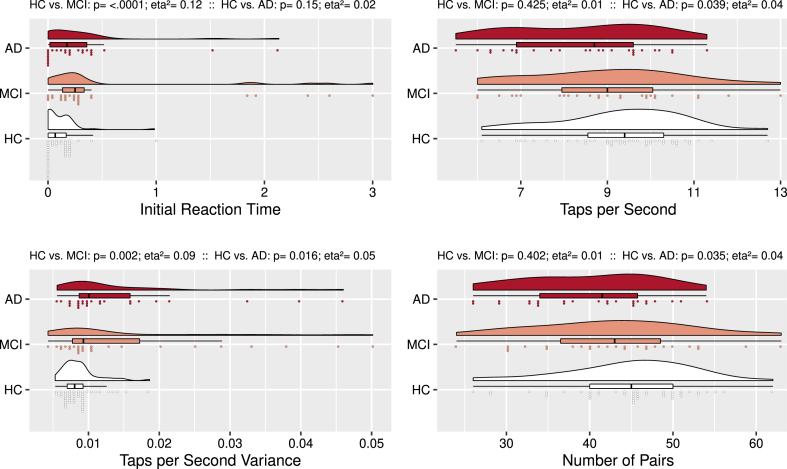
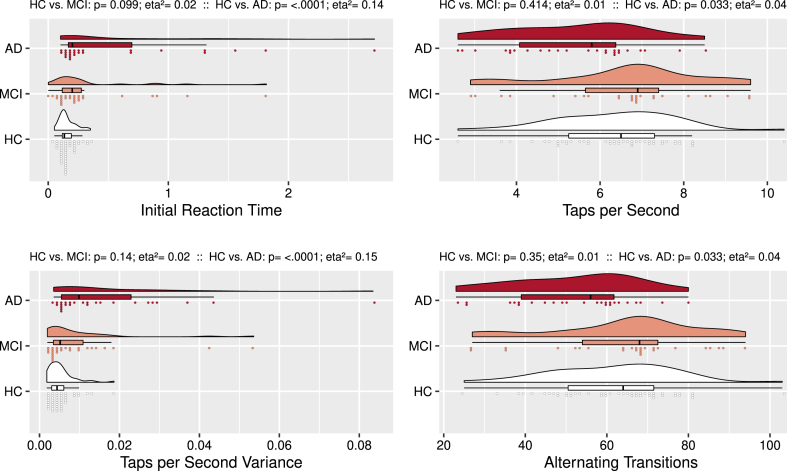
AD subjects had slower reaction time and larger speed variability than controls during all tapping conditions, except for dual tapping. MCI subjects performed worse than controls on reaction time and speed variability for dual and non-dominant hand tapping. Tapping speed and variability were related to hippocampal volume, but not to amyloid-β deposition or APOEɛ4 alleles. Random forest classification (overall accuracy = 70%) discriminated control and AD subjects, but poorly discriminated MCI from controls or AD.
MCI and AD are linked to more variable finger tapping with slower reaction time. Associations between finger tapping and hippocampal volume, but not amyloidosis, suggest that tapping deficits are related to neuropathology that presents later during the disease. Considering that tapping performance is able to differentiate between control and AD subjects, it can offer a cost-efficient tool for augmenting existing AD biomarkers.
尽管轻度认知障碍(MCI)和阿尔茨海默病(AD)都有运动功能障碍的报道,但精细运动功能仍相对较少被研究。
我们研究了 AD 患者的手指叩击是否受到影响,以及与 AD 生物标志物的关系,能否用于区分 MCI 或 AD。
47 名认知正常者、27 名遗忘型 MCI 患者和 26 名 AD 患者完成了单手和双手计算机叩击测试。我们测试了 1)通过置换模型比较叩击组间差异;2)通过线性回归分析叩击与生物标志物(PET 淀粉样蛋白-β、海马体积和 APOEɛ4 等位基因)之间的关系;3)使用机器学习分析叩击对组分类的预测价值。
除了双手叩击外,AD 患者在所有叩击条件下的反应时间都比对照组慢,速度变异性也更大。MCI 患者在双手和非优势手叩击时的反应时间和速度变异性均差于对照组。叩击速度和变异性与海马体积有关,但与淀粉样蛋白-β沉积或 APOEɛ4 等位基因无关。随机森林分类(总体准确率为 70%)能够区分对照组和 AD 患者,但对 MCI 与对照组或 AD 的区分效果较差。
MCI 和 AD 与手指叩击时反应时间较慢且变异性较大有关。叩击与海马体积的关联,而不是淀粉样蛋白沉积,表明叩击缺陷与疾病后期出现的神经病理学有关。考虑到叩击表现能够区分对照组和 AD 患者,它可以作为一种成本效益高的工具,用于增强现有的 AD 生物标志物。