Programa de Pós-Graduação em Farmacologia, Universidade Federal de Santa Maria (UFSM), Avenida Roraima, 97105-900 Santa Maria (RS), Brazil.
Curr Neuropharmacol. 2024;22(1):72-87. doi: 10.2174/1570159X21666230908094159.
Musculoskeletal pain is a condition that affects bones, muscles, and tendons and is present in various diseases and/or clinical conditions. This type of pain represents a growing problem with enormous socioeconomic impacts, highlighting the importance of developing treatments tailored to the patient's needs. TRP is a large family of non-selective cation channels involved in pain perception. Vanilloid (TRPV1 and TRPV4), ankyrin (TRPA1), and melastatin (TRPM8) are involved in physiological functions, including nociception, mediation of neuropeptide release, heat/cold sensing, and mechanical sensation.
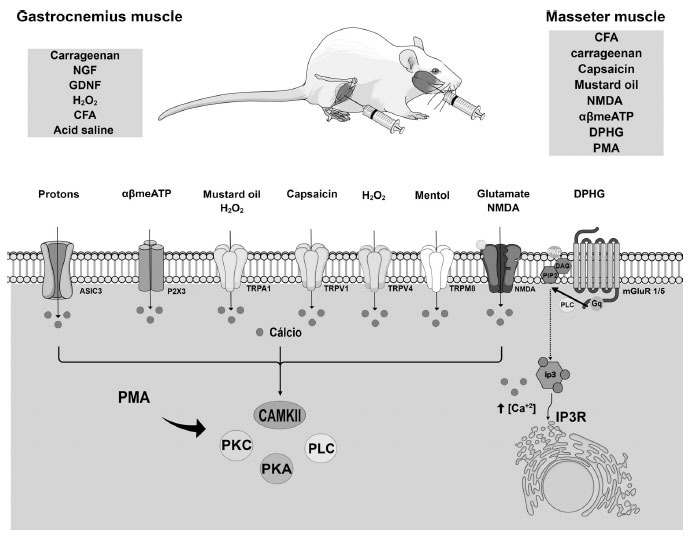
In this context, we provide an updated view of the most studied preclinical models of muscle hyperalgesia and the role of transient receptor potential (TRP) in these models.
This review describes preclinical models of muscle hyperalgesia induced by intramuscular administration of algogenic substances and/or induction of muscle damage by physical exercise in the masseter, gastrocnemius, and tibial muscles.
The participation of TRPV1, TRPA1, and TRPV4 in different models of musculoskeletal pain was evaluated using pharmacological and genetic tools. All the studies detected the antinociceptive effect of respective antagonists or reduced nociception in knockout mice.
Hence, TRPV1, TRPV4, and TRPA1 blockers could potentially be utilized in the future for inducing analgesia in muscle hypersensitivity pathologies.
肌肉骨骼疼痛是一种影响骨骼、肌肉和肌腱的疾病,存在于各种疾病和/或临床病症中。这种类型的疼痛是一个日益严重的问题,具有巨大的社会经济影响,突出了开发针对患者需求的治疗方法的重要性。TRP 是一个涉及疼痛感知的非选择性阳离子通道大家族。香草素(TRPV1 和 TRPV4)、锚蛋白(TRPA1)和 melastatin(TRPM8)参与生理功能,包括伤害感受、神经肽释放的介导、冷热感知和机械感觉。
在这方面,我们提供了对肌肉痛觉过敏的最广泛研究的临床前模型以及瞬时受体电位(TRP)在这些模型中的作用的最新观点。
这篇综述描述了通过肌肉内给予致痛物质和/或通过物理运动诱导咀嚼肌、腓肠肌和胫骨肌肉损伤来诱导肌肉痛觉过敏的临床前模型。
使用药理学和遗传学工具评估了 TRPV1、TRPA1 和 TRPV4 在不同的肌肉骨骼疼痛模型中的参与情况。所有研究都检测到了各自拮抗剂的镇痛作用或敲除小鼠的疼痛减轻。
因此,TRPV1、TRPV4 和 TRPA1 阻滞剂可能在未来用于诱导肌肉高敏性病理中的镇痛作用。