Department of Neurobiology, Care Sciences and Society, Center for Alzheimer Research, Division of Clinical Geriatrics, Karolinska Institutet, Stockholm, Sweden.
Department of Neurology, Karolinska University Hospital, Stockholm, Sweden.
Mol Neurodegener. 2023 Sep 12;18(1):60. doi: 10.1186/s13024-023-00647-y.
Plasma assays for the detection of Alzheimer's disease neuropathological changes are receiving ever increasing interest. The concentration of plasma glial fibrillary acidic protein (GFAP) has been suggested as a potential marker of astrocytes or recently, amyloid-β burden, although this hypothesis remains unproven. We compared plasma GFAP levels with the astrocyte tracer C-Deuterium-L-Deprenyl (C-DED) in a multi-modal PET design in participants with sporadic and Autosomal Dominant Alzheimer's disease.
Twenty-four individuals from families with known Autosomal Dominant Alzheimer's Disease mutations (mutation carriers = 10; non-carriers = 14) and fifteen patients with sporadic Alzheimer's disease were included. The individuals underwent PET imaging with C-DED, C-PIB and F-FDG, as markers of reactive astrogliosis, amyloid-β deposition, and glucose metabolism, respectively, and plasma sampling for measuring GFAP concentrations. Twenty-one participants from the Autosomal Dominant Alzheimer's Disease group underwent follow-up plasma sampling and ten of these participants underwent follow-up PET imaging.
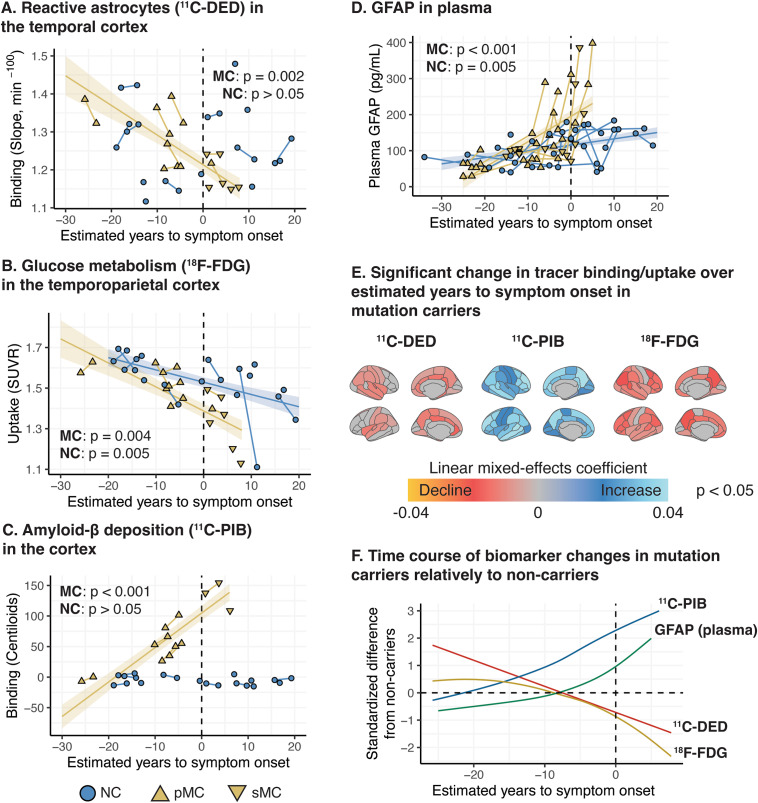
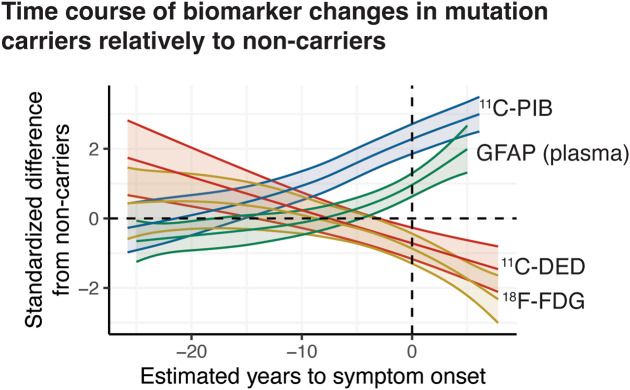
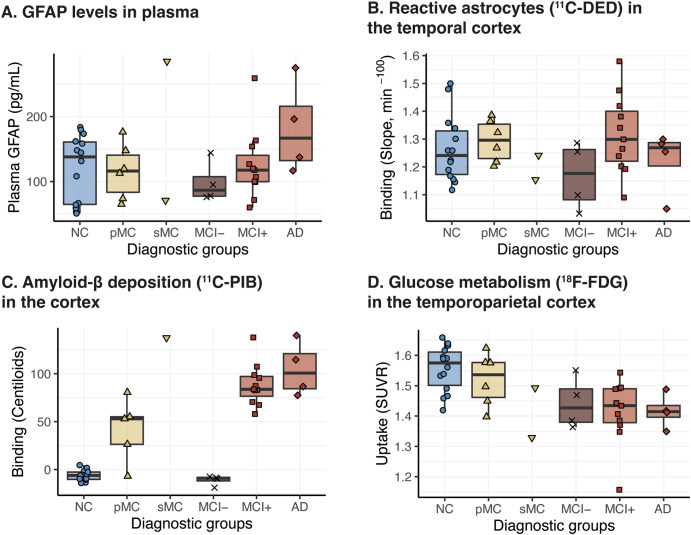
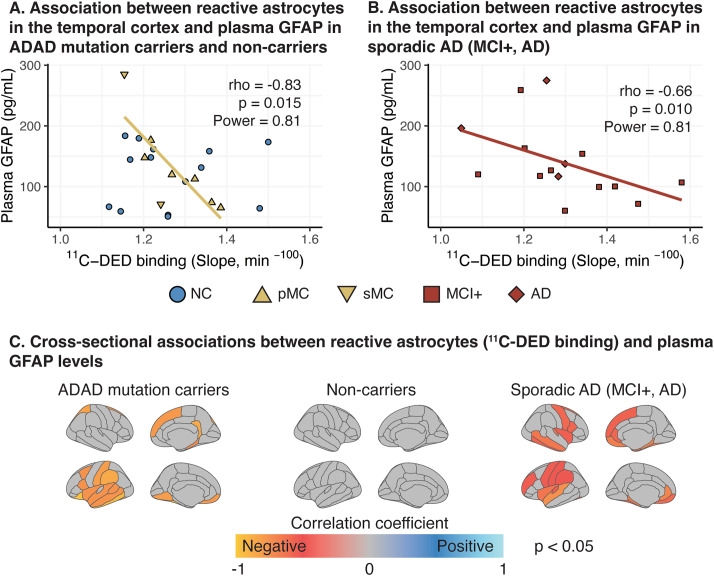
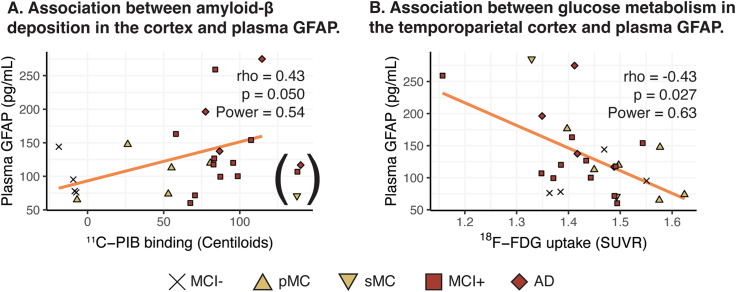
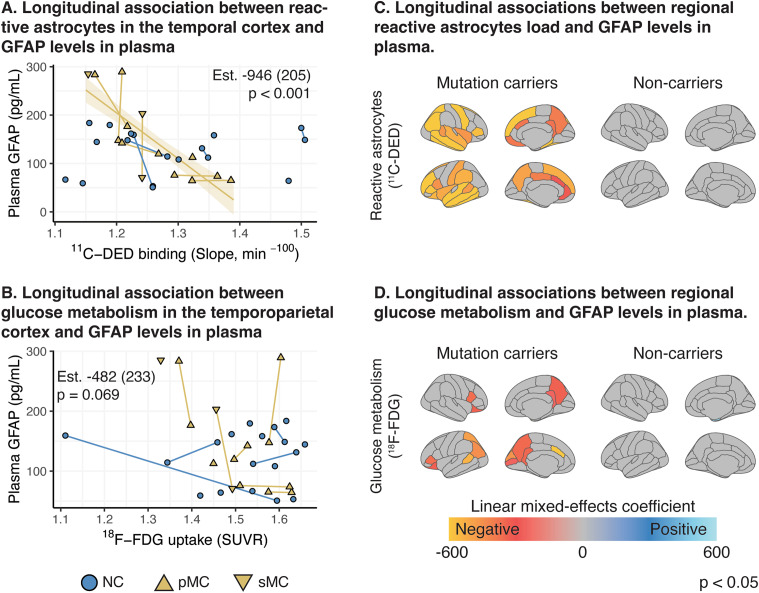
In mutation carriers, plasma GFAP levels and C-PIB binding increased, while C-DED binding and F-FDG uptake significantly decreased across the estimated years to symptom onset. Cross-sectionally, plasma GFAP demonstrated a negative correlation with C-DED binding in both mutation carriers and patients with sporadic disease. Plasma GFAP indicated cross-sectionally a significant positive correlation with C-PIB binding and a significant negative correlation with F-FDG in the whole sample. The longitudinal levels of C-DED binding showed a significant negative correlation with longitudinal plasma GFAP concentrations over the follow-up interval.
Plasma GFAP concentration and astrocyte C-DED brain binding levels followed divergent trajectories and may reflect different underlying processes. The strong negative association between plasma GFAP and C-DED binding in Autosomal Dominant and sporadic Alzheimer's disease brains may indicate that if both are markers of reactive astrogliosis, they may detect different states or subtypes of astrogliosis. Increased C-DED brain binding seems to be an earlier phenomenon in Alzheimer's disease progression than increased plasma GFAP concentration.
检测阿尔茨海默病神经病理变化的血浆检测越来越受到关注。血浆神经胶质纤维酸性蛋白(GFAP)的浓度已被提议作为星形胶质细胞的潜在标志物,或者最近被提议作为淀粉样β负担的标志物,尽管这一假设尚未得到证实。我们在具有散发性和常染色体显性阿尔茨海默病的多模态 PET 设计中比较了血浆 GFAP 水平与星形胶质细胞示踪剂 C-氘-L-Deprenyl(C-DED)。
24 名来自常染色体显性阿尔茨海默病突变家族的个体(突变携带者=10;非携带者=14)和 15 名散发性阿尔茨海默病患者被纳入研究。个体接受 C-DED、C-PIB 和 F-FDG 的 PET 成像,分别作为反应性星形胶质增生、淀粉样β沉积和葡萄糖代谢的标志物,以及血浆取样以测量 GFAP 浓度。常染色体显性阿尔茨海默病组的 21 名参与者接受了随访血浆取样,其中 10 名参与者接受了随访 PET 成像。
在突变携带者中,血浆 GFAP 水平和 C-PIB 结合增加,而 C-DED 结合和 F-FDG 摄取在估计的发病前数年显著降低。在横断面上,突变携带者和散发性疾病患者的血浆 GFAP 与 C-DED 结合呈负相关。在整个样本中,血浆 GFAP 与 C-PIB 结合呈显著正相关,与 F-FDG 呈显著负相关。在随访期间,C-DED 结合的纵向水平与纵向血浆 GFAP 浓度呈显著负相关。
血浆 GFAP 浓度和星形胶质细胞 C-DED 脑结合水平呈现不同的轨迹,可能反映了不同的潜在过程。在常染色体显性和散发性阿尔茨海默病大脑中,血浆 GFAP 与 C-DED 结合之间的强烈负相关可能表明,如果两者都是反应性星形胶质增生的标志物,它们可能检测到不同的星形胶质增生状态或亚型。与增加的血浆 GFAP 浓度相比,C-DED 脑结合似乎是阿尔茨海默病进展中更早的现象。