Barcelonaβeta Brain Research Center (BBRC), Pasqual Maragall Foundation, C/ Wellington, 30, 08005, Barcelona, Spain.
IMIM (Hospital del Mar Medical Research Institute), Barcelona, Spain.
Eur J Nucl Med Mol Imaging. 2022 Nov;49(13):4567-4579. doi: 10.1007/s00259-022-05897-4. Epub 2022 Jul 18.
Glial activation is one of the earliest mechanisms to be altered in Alzheimer's disease (AD). Glial fibrillary acidic protein (GFAP) relates to reactive astrogliosis and can be measured in both cerebrospinal fluid (CSF) and blood. Plasma GFAP has been suggested to become altered earlier in AD than its CSF counterpart. Although astrocytes consume approximately half of the glucose-derived energy in the brain, the relationship between reactive astrogliosis and cerebral glucose metabolism is poorly understood. Here, we aimed to investigate the association between fluorodeoxyglucose ([F]FDG) uptake and reactive astrogliosis, by means of GFAP quantified in both plasma and CSF for the same participants.
We included 314 cognitively unimpaired participants from the ALFA + cohort, 112 of whom were amyloid-β (Aβ) positive. Associations between GFAP markers and [F]FDG uptake were studied. We also investigated whether these associations were modified by Aβ and tau status (AT stages).
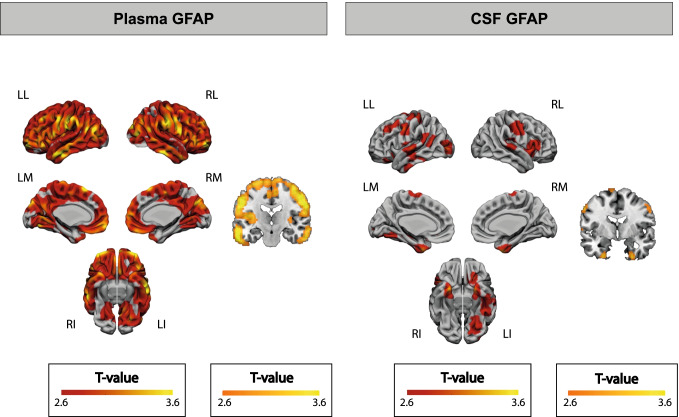
Plasma GFAP was positively associated with glucose consumption in the whole brain, while CSF GFAP associations with [F]FDG uptake were only observed in specific smaller areas like temporal pole and superior temporal lobe. These associations persisted when accounting for biomarkers of Aβ pathology but became negative in Aβ-positive and tau-positive participants (A + T +) in similar areas of AD-related hypometabolism.
Higher astrocytic reactivity, probably in response to early AD pathological changes, is related to higher glucose consumption. With the onset of tau pathology, the observed uncoupling between astrocytic biomarkers and glucose consumption might be indicative of a failure to sustain the higher energetic demands required by reactive astrocytes.
胶质细胞激活是阿尔茨海默病(AD)最早改变的机制之一。胶质纤维酸性蛋白(GFAP)与反应性星形胶质细胞有关,可在脑脊液(CSF)和血液中测量。有人提出,在 AD 中,血浆 GFAP 的改变早于其 CSF 对应物。尽管星形胶质细胞消耗大脑中大约一半的葡萄糖衍生能量,但反应性星形胶质细胞与大脑葡萄糖代谢之间的关系知之甚少。在这里,我们旨在通过对同一参与者的血浆和 CSF 中定量的 GFAP 来研究[F]FDG 摄取与反应性星形胶质细胞之间的关联。
我们纳入了来自 ALFA+队列的 314 名认知正常的参与者,其中 112 名是淀粉样蛋白-β(Aβ)阳性。研究了 GFAP 标志物与[F]FDG 摄取之间的相关性。我们还研究了这些关联是否被 Aβ 和 tau 状态(AT 阶段)所改变。
血浆 GFAP 与大脑整体葡萄糖消耗呈正相关,而 CSF GFAP 与[F]FDG 摄取的相关性仅在颞极和颞上回等特定较小区域观察到。当考虑到 Aβ 病理生物标志物时,这些相关性仍然存在,但在 Aβ 阳性和 tau 阳性(A+T+)参与者的 AD 相关低代谢的类似区域,这些相关性变为阴性。
更高的星形胶质细胞反应性,可能是对早期 AD 病理变化的反应,与更高的葡萄糖消耗有关。随着 tau 病理的发生,观察到星形胶质细胞生物标志物与葡萄糖消耗之间的脱耦可能表明无法维持反应性星形胶质细胞所需的更高能量需求。