Animal Reproduction Department, INIA, CSIC, Madrid, Spain.
IVF Spain, Madrid, Spain.
Hum Reprod. 2023 Nov 2;38(11):2187-2195. doi: 10.1093/humrep/dead181.
Is the abundance of certain biochemical compounds in human cumulus cells (CCs) related to oocyte quality?
Malonate, 5-oxyproline, and erythronate were positively associated with pregnancy potential.
CCs are removed and discarded prior to ICSI, thereby constituting an interesting biological material on which to perform molecular analysis aimed to predict oocyte developmental competence. Mitochondrial DNA content and transcriptional analyses in CC have been shown to provide a poor predictive value of oocyte competence, but the untargeted analysis of biochemical compounds (metabolomics) has been unexplored.
STUDY DESIGN, SIZE, DURATION: CCs were obtained from three groups of cumulus-oocyte complexes (COCs) of known developmental potential: oocytes not developing to blastocyst following ICSI (Bl-); oocytes developing to blastocyst but failing to establish pregnancy following embryo transfer (P-); and oocytes developing to blastocyst able to establish a pregnancy (P+). Metabolomics analyses were performed on 12 samples per group, each sample comprising the CC recovered from a single COC.
PARTICIPANTS/MATERIALS, SETTING, METHODS: Human CC samples were obtained from IVF treatments. Only unfrozen oocytes and embryos not submitted to preimplantation genetic testing were included in the analysis. Metabolomics analysis was performed by ultra-high performance liquid chromatography-tandem mass spectroscopy.
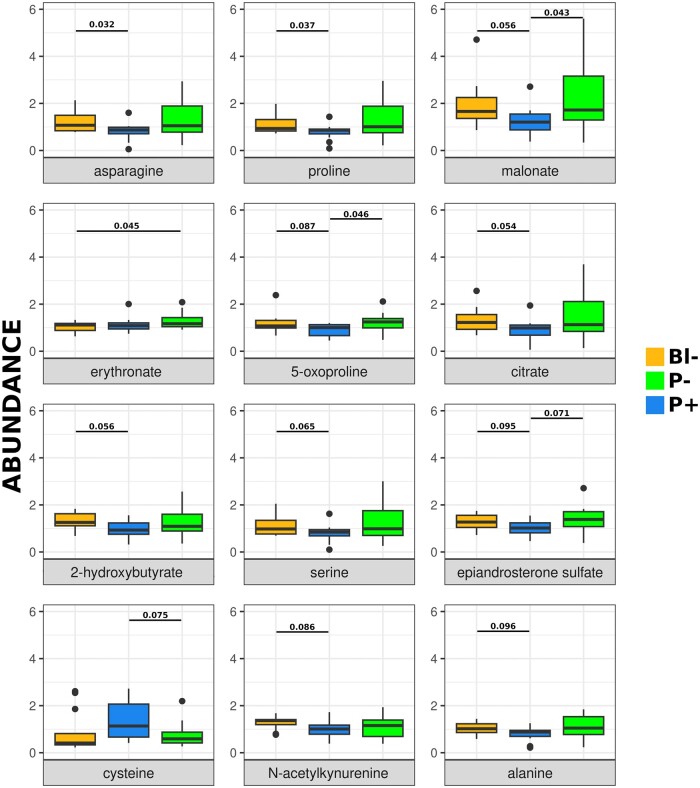
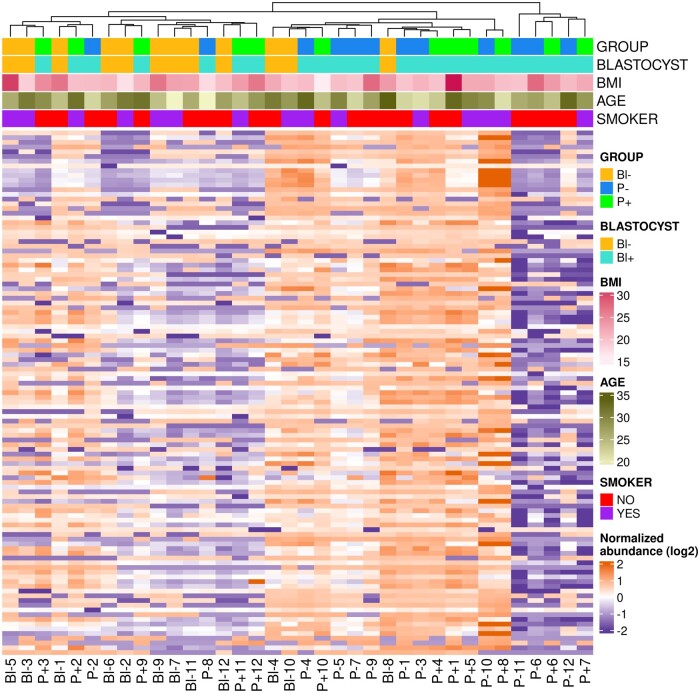
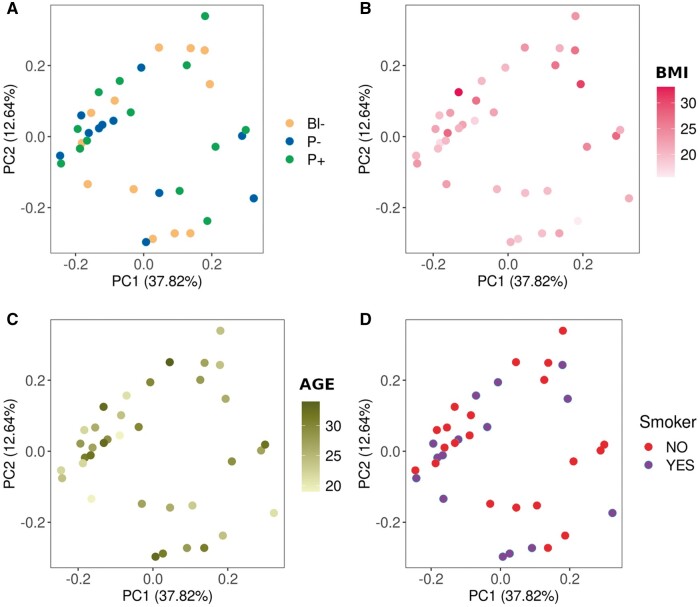
The analysis identified 98 compounds, five of which were differentially abundant (P < 0.05) between groups: asparagine, proline, and malonate were less abundant in P- compared to Bl-, malonate and 5-oxoproline were less abundant in P- group compared to P+, and erythronate was less abundant in Bl- group compared to P+. No significant association between the abundance of the compounds identified and donor age or BMI was noted.
LIMITATIONS, REASONS FOR CAUTION: Data dispersion and the lack of coherence between developmental groups preclude the direct use of metabolic markers in clinical practice, where the uterine environment plays a major role in pregnancy outcome. The abundance of other compounds not detected by the analysis may be associated with oocyte competence. As donors were lean (only two with BMI > 30 kg/m2) and young (<34 years old), a possible effect of obesity or advanced age on the CC metabolome could not be determined.
The abundance of malonate, 5-oxyproline, and erythronate in CC was significantly higher in COCs ultimately establishing pregnancy, providing clues on the pathways required for oocyte competence. The untargeted analysis uncovered the presence of compounds that were not expected in CC, such as β-citrylglutamate and the neurotransmitter N-acetyl-aspartyl-glutamate, which may play roles in chromatin remodeling and signaling, respectively.
STUDY FUNDING/COMPETING INTEREST(S): Research was supported by the Industrial Doctorate Project IND2017/BIO-7748 funded by Madrid Region Government. The authors declare no competing interest.
N/A.
人卵丘细胞(CCs)中某些生化化合物的丰度是否与卵母细胞质量有关?
丙二酸、5-羟脯氨酸和赤藓糖酸盐与妊娠潜能呈正相关。
在进行卵胞浆内单精子注射(ICSI)之前,CC 被取出并丢弃,因此构成了一种有趣的生物材料,可以对其进行分子分析,以预测卵母细胞的发育能力。已经表明 CC 中的线粒体 DNA 含量和转录分析提供了卵母细胞能力的预测价值很差,但对生化化合物(代谢组学)的非靶向分析尚未探索。
研究设计、大小、持续时间:从三组已知发育潜力的卵丘-卵母细胞复合物(COC)中获得 CC:ICSI 后未发育为胚泡的卵母细胞(Bl-); 胚胎转移后未能建立妊娠的发育胚泡的卵母细胞(P-); 和能够建立妊娠的发育胚泡的卵母细胞(P+)。对每组 12 个样本进行代谢组学分析,每个样本包含从单个 COC 回收的 CC。
参与者/材料、设置、方法:人 CC 样本来自 IVF 治疗。仅包括未冷冻的卵母细胞和未进行植入前遗传检测的胚胎进行分析。代谢组学分析通过超高效液相色谱-串联质谱法进行。
该分析确定了 98 种化合物,其中 5 种化合物丰度存在差异(P<0.05):天冬酰胺、脯氨酸和丙二酸在 P-组中比 Bl-组中含量少,丙二酸和 5-羟脯氨酸在 P-组中比 P+组中含量少,赤藓糖酸盐在 Bl-组中比 P+组中含量少。未发现鉴定化合物的丰度与供体年龄或 BMI 之间存在显著关联。
局限性、谨慎的原因:数据分散以及发育组之间缺乏一致性排除了代谢标志物在临床实践中的直接使用,因为子宫环境在妊娠结局中起着主要作用。分析未检测到的其他化合物的丰度可能与卵母细胞能力有关。由于供体较瘦(只有两名 BMI>30kg/m2)且年轻(<34 岁),因此无法确定肥胖或高龄对 CC 代谢组的可能影响。
CC 中丙二酸、5-羟脯氨酸和赤藓糖酸盐的丰度在最终建立妊娠的 COC 中显著更高,为卵母细胞能力所需的途径提供了线索。非靶向分析揭示了 CC 中存在预期之外的化合物,例如β-柠檬酸和神经递质 N-乙酰天冬氨酸-谷氨酸,它们分别可能在染色质重塑和信号转导中发挥作用。
研究资金/利益冲突:研究由马德里大区政府资助的工业博士项目 IND2017/BIO-7748 支持。作者没有利益冲突。
无。