Department of Biostatistics, Virginia Commonwealth University, Richmond, VA, USA.
Department of Internal Medicine, Division of Hematology, Oncology, and Palliative Care, Virginia Commonwealth University, Richmond, VA, USA.
Oncologist. 2024 Feb 2;29(2):e206-e212. doi: 10.1093/oncolo/oyad250.
Fatigue is common in patients undergoing radiotherapy (RT) and can significantly impact quality of life. Melatonin, a safe inexpensive natural supplement, may improve symptoms and attenuate the side effects of RT. The purpose of this randomized double-blind placebo-controlled phase III trial was to assess the effects of melatonin for preventing fatigue and other symptoms in patients with breast cancer undergoing RT.
Female early stage or Ductal carcinoma in situ patients with breast cancer ≥18 years of age with Eastern Cooperative Oncology Group (ECOG) performance status <3, hemoglobin ≥9 g/dL, planned for outpatient RT treatment with curative intent, were randomized 1:1 to melatonin 20 mg or placebo, orally, starting the night before RT initiation until 2 weeks post-RT. Randomization was stratified according to treatment duration (<3 weeks, ≥3 weeks) and prior chemotherapy. The primary endpoint was the Functional Assessment of Chronic Illness Therapy-Fatigue (FACIT-Fatigue scale), and secondary endpoints were FACIT-F subscales, Edmonton Symptom Assessment Scale (ESAS), and Patient-Reported Outcomes Measurement Information System (PROMIS) scores obtained at baseline, and 2 and 8 weeks post-RT. A 2-sided ANOVA F-test at a 4.5% significance level for the primary endpoint was used. Secondary analyses were reported using an F-test at a 5% significance level. The goal was to recruit approximately 140 patients with interim analysis planned mid-recruitment.
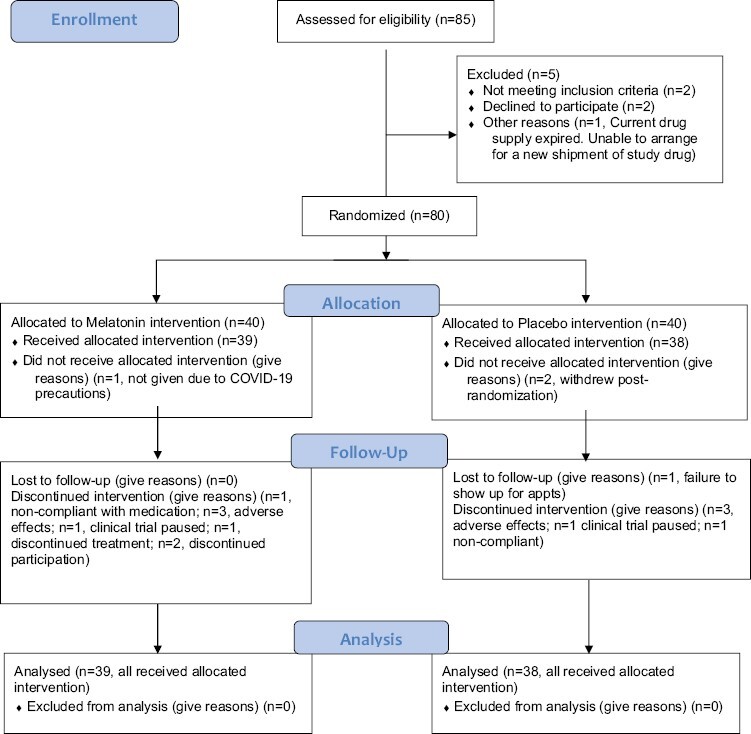
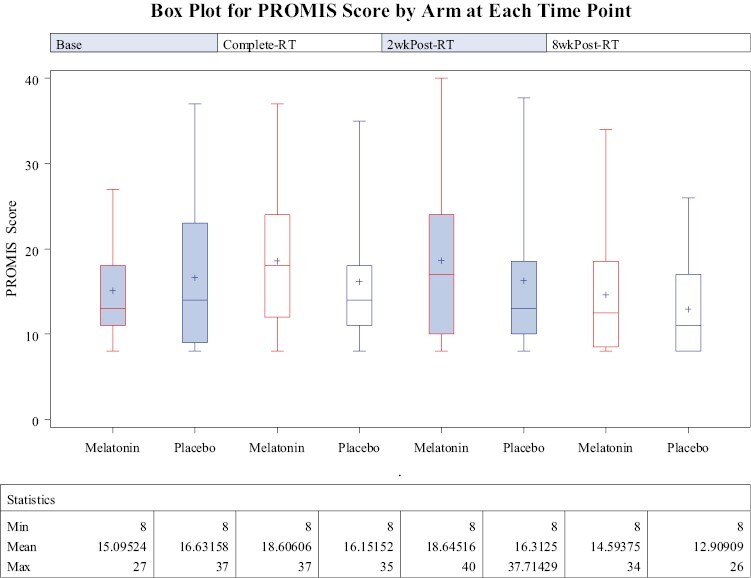
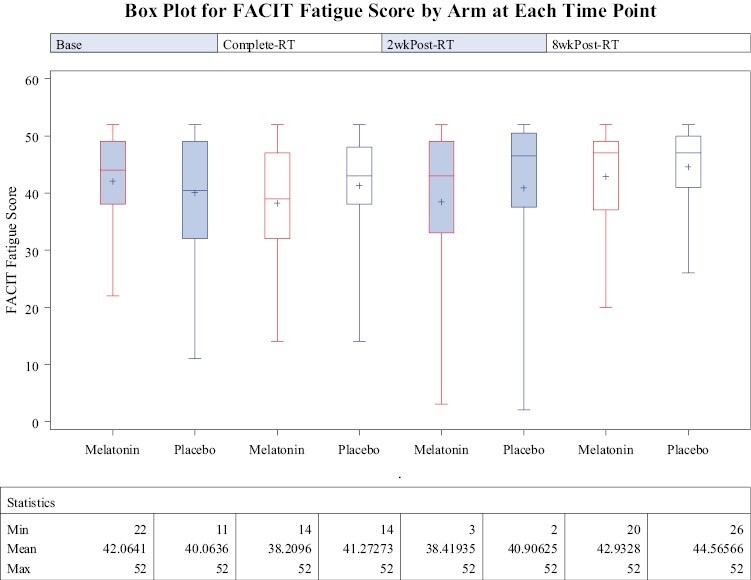
Eighty-five patients were screened for eligibility; 79 patients were randomized: 40 to melatonin and 39 to placebo; 78 patients were treated and included in the interim analysis at the mid-recruitment point. Baseline patient characteristics of age, race, and ECOG performance status were similar in both arms. The treatment effect was studied using a longitudinal mixed effects model with the effect of treatment over time (treatment × time) as the primary outcome parameter. The treatment × time for FACIT-Fatigue did not demonstrate statistical significance (P-value .83) in the melatonin group compared to placebo. In addition, secondary analyses of FACIT physical, social, emotional, and functional well-being scores did not demonstrate statistical significance (P-values of .35, .06, .62, and .71, respectively). Total PROMIS scores, collected as secondary outcome reported by patients, did not demonstrate statistically significant change over time either (P-value is .34). The other secondary scale, ESAS, was analyzed for each individual item and found to be nonsignificant, anxiety (P = .56), well-being (.82), drowsiness (.83), lack of appetite (.35), nausea (.79), pain (.50), shortness of breath (.77), sleep (.45), and tiredness (.56). Depression was the only item demonstrating statistical significance with a decrease of 0.01 unit in the placebo group, a change not considered clinically significant. Melatonin was well-tolerated with no grade 3 or 4 adverse events reported. The most common side effects were headache, somnolence, and abdominal pain. No patients died while participating in this study. Two patients died within a year of study completion from breast cancer recurrence. Sixteen patients withdrew prior to study completion for various reasons including adverse events, hospitalizations unrelated to study drug, RT discontinuation, and COVID-19 precautions.
In this double-blind placebo-controlled phase III trial, melatonin did not prevent or significantly improve fatigue and other symptoms in patients with early stage breast cancer undergoing RT. The analysis, showing little evidence of an effect, at mid-recruitment, assured early termination of the trial.
疲劳是接受放疗(RT)的患者常见的症状,会显著影响生活质量。褪黑素是一种安全且廉价的天然补充剂,可能改善症状并减轻 RT 的副作用。本随机双盲安慰剂对照 III 期试验的目的是评估褪黑素预防乳腺癌接受 RT 的患者疲劳和其他症状的效果。
≥ 18 岁、ECOG 体能状态 < 3、血红蛋白 ≥ 9 g/dL、计划接受门诊 RT 治疗的早期或原位乳腺癌患者,按 1:1 随机分配至褪黑素 20 mg 或安慰剂组,口服,从 RT 开始前的晚上开始,持续到 RT 后 2 周。随机分组根据治疗持续时间(< 3 周,≥ 3 周)和先前的化疗进行分层。主要终点是慢性疾病治疗功能评估-疲劳(FACIT-Fatigue 量表),次要终点是 FACIT-F 亚量表、埃德蒙顿症状评估量表(ESAS)和患者报告的结果测量信息系统(PROMIS)评分,在基线、RT 后 2 周和 8 周时获得。主要终点的 2 侧 ANOVA F 检验采用 4.5%的显著性水平。次要分析采用 5%的显著性水平进行 F 检验。目标是招募大约 140 名患者,中期分析计划在招募中期进行。
有 85 名患者接受了入组筛选;79 名患者被随机分配:40 名接受褪黑素治疗,39 名接受安慰剂治疗;78 名患者接受了治疗,并在中期招募点纳入了中期分析。基线时患者的年龄、种族和 ECOG 体能状态在两组中相似。使用具有治疗随时间变化的效应(治疗×时间)的纵向混合效应模型研究治疗效果。与安慰剂组相比,褪黑素组的 FACIT-Fatigue 治疗×时间没有显示出统计学意义(P 值.83)。此外,FACIT 身体、社会、情感和功能健康评分的次要分析也没有显示出统计学意义(P 值分别为.35、.06、.62 和.71)。患者报告的总 PROMIS 评分也没有显示出随时间的统计学变化(P 值为.34)。其他次要量表 ESAS 对每个单独的项目进行了分析,发现均无统计学意义,包括焦虑(P 值为.56)、幸福感(.82)、嗜睡(.83)、食欲减退(.35)、恶心(.79)、疼痛(.50)、呼吸急促(.77)、睡眠(.45)和疲劳(.56)。只有抑郁这一项显示出统计学意义,安慰剂组下降了 0.01 个单位,这一变化不被认为具有临床意义。褪黑素耐受性良好,未报告 3 级或 4 级不良事件。最常见的副作用是头痛、嗜睡和腹痛。没有患者在研究期间死亡。两名患者在研究完成后一年内死于乳腺癌复发。16 名患者因各种原因在研究完成前退出,包括不良事件、与研究药物无关的住院治疗、RT 中断和 COVID-19 预防措施。
在这项双盲安慰剂对照 III 期试验中,褪黑素并不能预防或显著改善接受 RT 的早期乳腺癌患者的疲劳和其他症状。在中期招募时的分析显示,褪黑素的效果证据不足,保证了试验的早期终止。