Department of Medicine, The University of Hong Kong Queen Mary Hospital, 102 Pokfulam Road, Pok Fu Lam, Hong Kong.
State Key Laboratory Research of Liver Research, The University of Hong Kong, Pok Fu Lam, Hong Kong.
BMC Gastroenterol. 2023 Sep 12;23(1):307. doi: 10.1186/s12876-023-02940-y.
BACKGROUND & AIMS: Although non-alcoholic fatty liver disease (NAFLD) remains an uncommon indication for liver transplantation (LT) in the Chinese, the prevalence of NAFLD is increasing. We aimed to determine the prevalence of de novo steatosis and metabolic dysfunction-associated fatty liver disease (MAFLD) after LT.
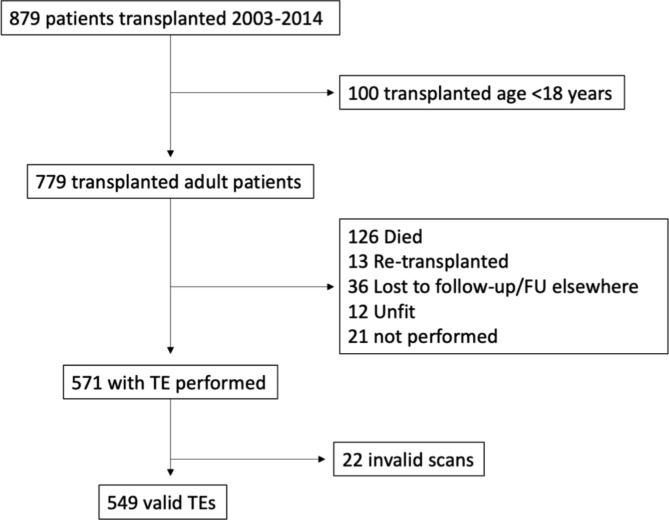
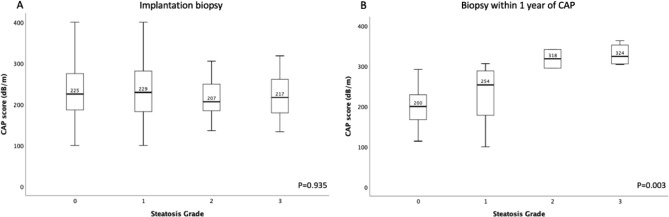
Transient elastography assessment for liver stiffness and controlled attenuation parameter (CAP) were performed after LT in 549 patients at median time of 77 months from LT. CAP was compared with implant liver biopsy, and also validated in 42 patients with post-LT liver biopsy. Longitudinal history including diabetes mellitus (DM), dyslipidemia, hypertension, and immunosuppressive regimen were recorded.
The optimal cut-off level of CAP for diagnosing at least mild (≥ S1) and moderate-to-severe steatosis (≥ S2/3) was 266 and 293 dB/m respectively, with AUROC of 0.740 and 0.954 respectively. Using this newly derived cut-off, 28.9% patients have de novo NAFLD, of which 95.6% fulfilled the criteria for MAFLD. After multivariate analysis, BMI (HR 1.34), DM (HR 2.01), hypertension (HR 2.03), HDL-cholesterol (HR 0.25), LDL-cholesterol (HR 1.5) and cryptogenic cirrhosis (HR 4.85) were associated with the development of S2/3 graft steatosis. de novo NAFLD was associated with higher incidence of new-onset hypertension (p < 0.001), graft dysfunction (defined as ALT > 40 U/L; p = 0.008), but not associated with graft fibrosis (defined as liver stiffness > 12 kPa; p = 0.761).
Although NAFLD remains an uncommon primary liver disease indication for LT in Chinese patients, post-transplant de novo graft steatosis is common and the majority is classified as MAFLD. Development of graft steatosis is not associated with an increase in graft fibrosis but was associated with worse metabolic control and graft dysfunction. Routine CAP measurement to detect de novo graft steatosis should be considered after LT regardless of the primary indication of LT.
尽管非酒精性脂肪性肝病(NAFLD)仍是中国肝移植(LT)的罕见适应证,但NAFLD 的患病率正在增加。我们旨在确定 LT 后新发生的脂肪变性和代谢相关脂肪性肝病(MAFLD)的患病率。
在 LT 后中位数时间为 77 个月时,对 549 例患者进行了瞬时弹性成像评估,以评估肝硬度和受控衰减参数(CAP)。CAP 与植入肝活检进行了比较,并在 42 例 LT 后肝活检患者中进行了验证。记录了包括糖尿病(DM)、血脂异常、高血压和免疫抑制方案在内的纵向病史。
CAP 的最佳截断值为诊断至少轻度(≥S1)和中重度脂肪变性(≥S2/3)的水平分别为 266 和 293 dB/m,AUROC 分别为 0.740 和 0.954。使用此新衍生的截断值,28.9%的患者患有新发生的 NAFLD,其中 95.6%符合 MAFLD 的标准。多变量分析后,BMI(HR 1.34)、DM(HR 2.01)、高血压(HR 2.03)、高密度脂蛋白胆固醇(HR 0.25)、低密度脂蛋白胆固醇(HR 1.5)和隐源性肝硬化(HR 4.85)与 S2/3 移植物脂肪变性的发生有关。新发生的 NAFLD 与新发高血压(p<0.001)、移植物功能障碍(定义为 ALT>40 U/L;p=0.008)的发生率较高有关,但与移植物纤维化(定义为肝硬度>12 kPa;p=0.761)无关。
尽管 NAFLD 仍是中国 LT 患者的罕见原发性肝病适应证,但 LT 后新发生的移植肝脂肪变性很常见,其中大多数为 MAFLD。移植肝脂肪变性的发展与移植肝纤维化的增加无关,但与代谢控制和移植物功能障碍的恶化有关。无论 LT 的主要适应证如何,LT 后应考虑常规 CAP 测量以检测新发生的移植肝脂肪变性。