National Centre for Epidemiology and Population Health (NCEPH), The Australian National University, Canberra, ACT, Australia.
Sydney School of Public Health, The University of Sydney, Sydney, NSW, Australia.
BMC Cancer. 2023 Sep 13;23(1):774. doi: 10.1186/s12885-023-11214-5.
Pain is a common, debilitating, and feared symptom, including among cancer survivors. However, large-scale population-based evidence on pain and its impact in cancer survivors is limited. We quantified the prevalence of pain in community-dwelling people with and without cancer, and its relation to physical functioning, psychological distress, and quality of life (QoL).
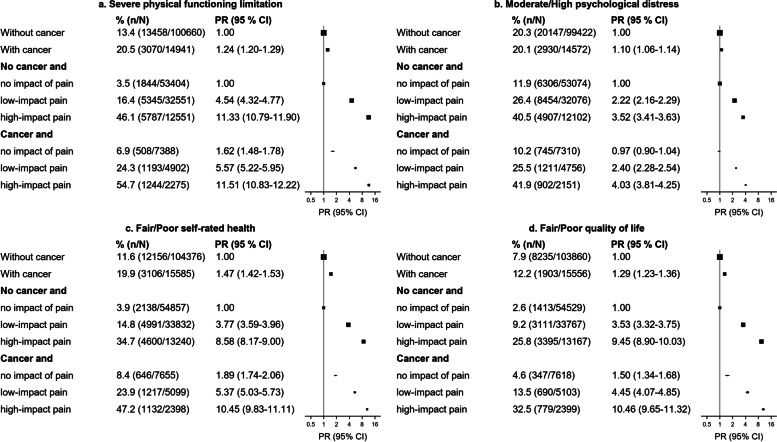
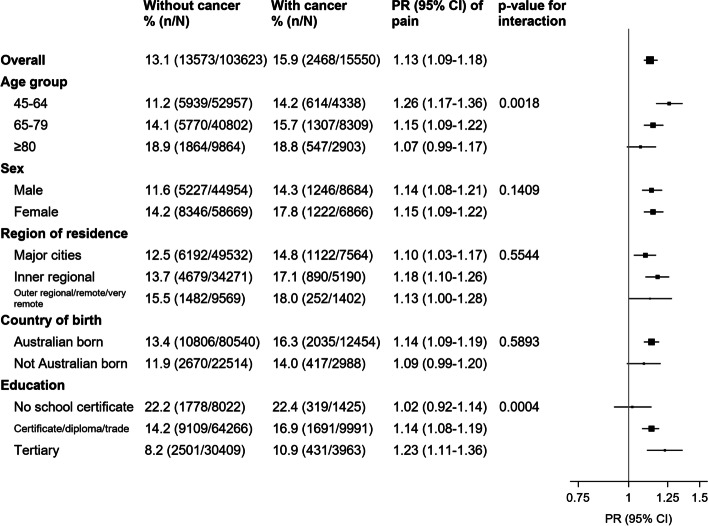
Questionnaire data from participants in the 45 and Up Study (Wave 2, n = 122,398, 2012-2015, mean age = 60.8 years), an Australian population-based cohort study, were linked to cancer registration data to ascertain prior cancer diagnoses. Modified Poisson regression estimated age- and sex-adjusted prevalence ratios (PRs) for bodily pain and pain sufficient to interfere with daily activities (high-impact pain) in people with versus without cancer, for 13 cancer types, overall and according to clinical, personal, and health characteristics. The relation of high-impact pain to physical and mental health outcomes was quantified in people with and without cancer.
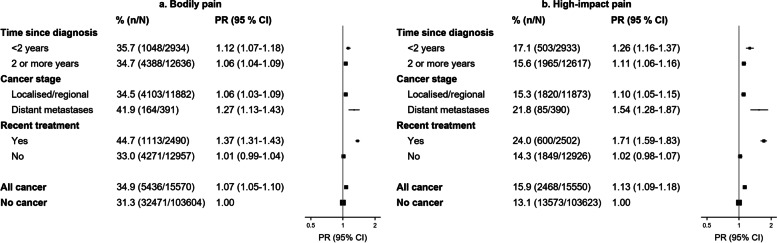
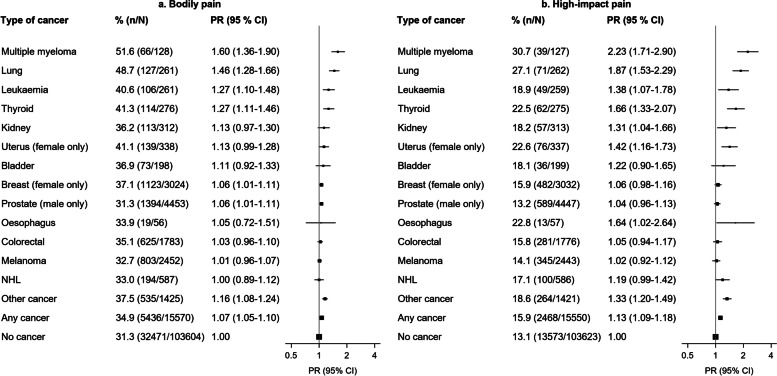
Overall, 34.9% (5,436/15,570) of cancer survivors and 31.3% (32,471/103,604) of participants without cancer reported bodily pain (PR = 1.07 [95% CI = 1.05-1.10]), and 15.9% (2,468/15,550) versus 13.1% (13,573/103,623), respectively, reported high-impact pain (PR = 1.13 [1.09-1.18]). Pain was greater with more recent cancer diagnosis, more advanced disease, and recent cancer treatment. High-impact pain varied by cancer type; compared to cancer-free participants, PRs were: 2.23 (1.71-2.90) for multiple myeloma; 1.87 (1.53-2.29) for lung cancer; 1.06 (0.98-1.16) for breast cancer; 1.05 (0.94-1.17) for colorectal cancer; 1.04 (0.96-1.13) for prostate cancer; and 1.02 (0.92-1.12) for melanoma. Regardless of cancer diagnosis, high-impact pain was strongly related to impaired physical functioning, psychological distress, and reduced QoL.
Pain is common, interfering with daily life in around one-in-eight older community-dwelling participants. Pain was elevated overall in cancer survivors, particularly for certain cancer types, around diagnosis and treatment, and with advanced disease. However, pain was comparable to population levels for many common cancers, including breast, prostate and colorectal cancer, and melanoma.
疼痛是一种常见的、使人虚弱和令人恐惧的症状,包括癌症幸存者。然而,关于癌症幸存者疼痛及其影响的大规模基于人群的证据有限。我们量化了社区居民中有无癌症的疼痛患病率,以及疼痛与身体功能、心理困扰和生活质量(QoL)的关系。
来自澳大利亚基于人群的队列研究 45 岁及以上研究(第 2 波,n=122398,2012-2015 年,平均年龄 60.8 岁)的参与者的问卷调查数据与癌症登记数据相关联,以确定先前的癌症诊断。修正泊松回归估计了有无癌症的 13 种癌症类型的身体疼痛和足以干扰日常活动的疼痛(高影响疼痛)的年龄和性别调整患病率比(PR),总体和根据临床、个人和健康特征。在有和没有癌症的人群中,量化了高影响疼痛与身心健康结果的关系。
总体而言,34.9%(5436/15570)的癌症幸存者和 31.3%(32 人/103604 人)的无癌症参与者报告身体疼痛(PR=1.07[95%CI=1.05-1.10]),分别有 15.9%(2468/15550 人)和 13.1%(13 人/103623 人)报告高影响疼痛(PR=1.13[1.09-1.18])。最近的癌症诊断、更晚期的疾病和最近的癌症治疗会导致疼痛更大。高影响疼痛因癌症类型而异;与无癌症的参与者相比,PR 为:多发性骨髓瘤 2.23(1.71-2.90);肺癌 1.87(1.53-2.29);乳腺癌 1.06(0.98-1.16);结直肠癌 1.05(0.94-1.17);前列腺癌 1.04(0.96-1.13);黑色素瘤 1.02(0.92-1.12)。无论是否诊断出癌症,高影响疼痛都与身体功能受损、心理困扰和生活质量降低密切相关。
疼痛很常见,会干扰大约八分之一的老年社区居民的日常生活。癌症幸存者的总体疼痛水平较高,尤其是在诊断和治疗前后,以及疾病进展时。然而,对于许多常见癌症,包括乳腺癌、前列腺癌和结直肠癌以及黑色素瘤,疼痛与人群水平相当。