Department of Psychological Sciences, School of Health Sciences, Swinburne University of Technology, PO Box 218, H99, Hawthorn, VIC, 3122, Australia.
Silverchain, Osborne Park, WA, Australia.
BMC Geriatr. 2023 Sep 12;23(1):555. doi: 10.1186/s12877-023-04257-7.
This protocol describes a study of the effectiveness of cognitive behaviour therapy (CBT) for reducing depressive symptoms in older adults living in residential aged care (RAC) facilities in Australia. Depressive symptoms are highly prevalent in this population, yet the benefits of CBT for reducing such symptoms in RAC facilities have not been widely investigated. Elders at Ease (ELATE) is a 16-session CBT intervention designed for implementation in RAC facilities. The intervention includes cognitive, behavioural and reminiscence strategies and is delivered by mental health trainees (MHTs) in collaboration with RAC facility staff and residents' family.
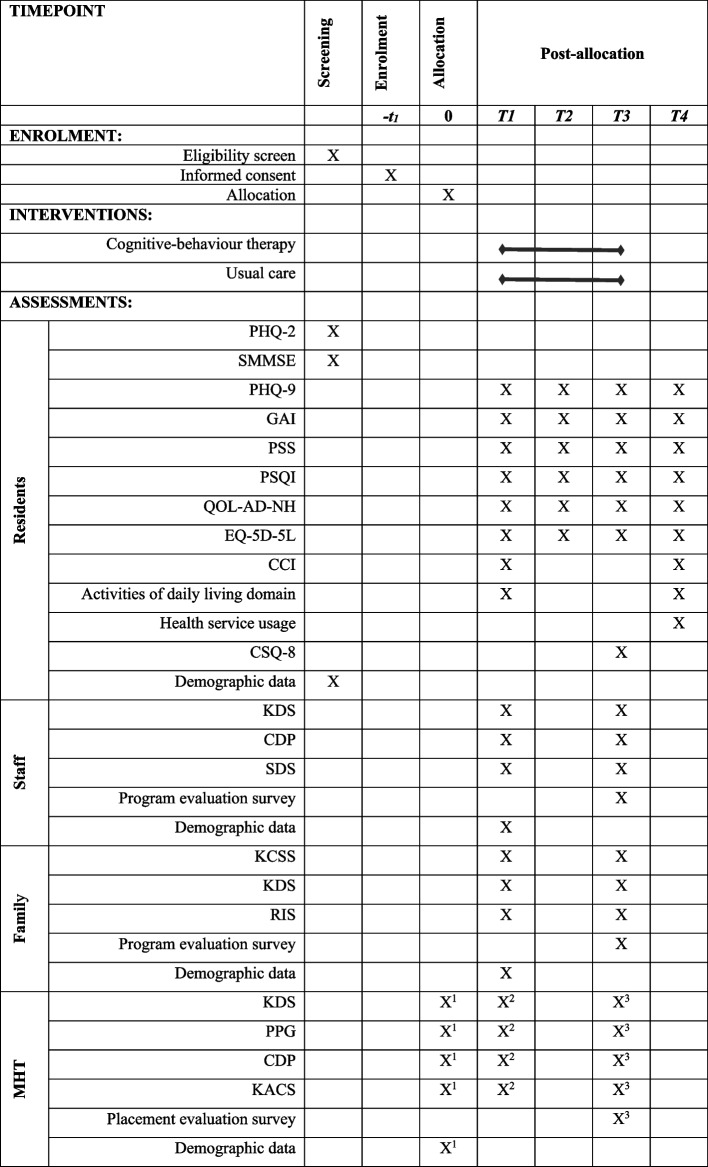
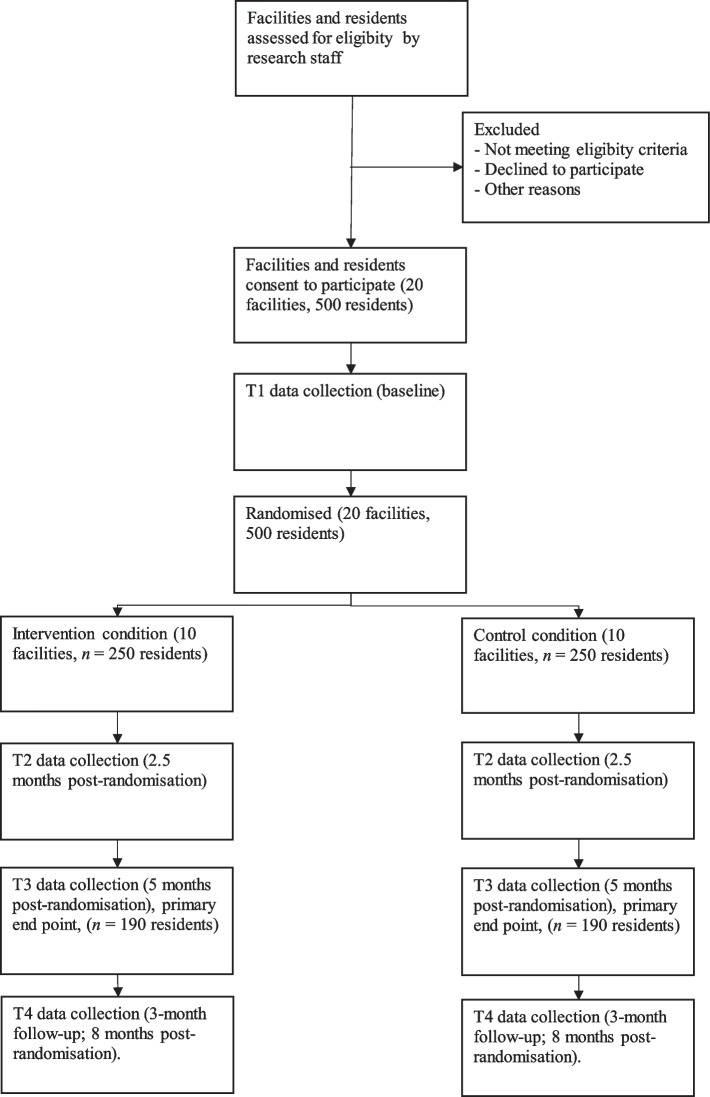
ELATE will be evaluated using a cluster randomised trial comparing outcomes for residents who participate in the intervention with those living in usual care control facilities. The participants are RAC residents aged 65 years or above, with depressive symptoms (Patient Health Questionnaire-2 ≥ 3) and normal cognition or mild cognitive impairment (Standardised Mini Mental Status Examination ≥ 21). They are assessed at four time points: baseline prior to randomisation (T1), mid-treatment (T2; 2.5 months post randomisation), post-treatment (T3; 5 months post-randomisation) and 3-month follow-up (T4; 8 months post randomisation). The primary outcome is change in depressive symptoms between T1 and T3. Secondary outcomes are depressive symptoms at T4, anxiety, suicide ideation, sleep problems, quality of life, staff and family knowledge of late-life depression, stress levels and efficacy in caring for residents, and MHT levels of geropsychology competencies. Residents receiving the intervention are hypothesised to report a greater decrease in depressive symptoms between T1 and T3 compared to residents receiving usual care. The primary analysis is a regression, clustered over site to account for correlated readings, and independent variables are condition and depressive symptoms at T1. A cost-utility analysis is also undertaken.
ELATE is a comprehensive CBT intervention for reducing depressive symptoms in RAC residents. It is designed to be implemented in collaboration with facility staff and residents' families, individually tailored to residents with normal cognition to mild cognitive impairment and delivered by trainee therapists. ELATE offers a model that may be widely applicable across the RAC sector.
Trial registered with the Australian and New Zealand Clinical Trial Registry (ANZCTR) Number ACTRN12619001037190, prospectively registered on 22 July 2019.
本方案描述了一项研究,旨在评估认知行为疗法(CBT)对减轻澳大利亚养老院(RAC)中老年人抑郁症状的有效性。该人群中抑郁症状高发,但 CBT 对减轻 RAC 设施中此类症状的益处尚未得到广泛研究。Elders at Ease(ELATE)是一种 16 节 CBT 干预措施,专为在 RAC 设施中实施而设计。该干预措施包括认知、行为和怀旧策略,并由精神卫生培训生(MHT)与 RAC 设施工作人员和居民家属合作提供。
ELATE 将通过比较参与干预的居民与接受常规护理对照设施的居民的结果,使用集群随机试验进行评估。参与者是年龄在 65 岁或以上、有抑郁症状(患者健康问卷-2≥3)且认知正常或轻度认知障碍(标准化简易精神状态检查≥21)的 RAC 居民。他们在四个时间点进行评估:随机分组前的基线(T1)、治疗中期(T2;随机分组后 2.5 个月)、治疗后(T3;随机分组后 5 个月)和 3 个月随访(T4;随机分组后 8 个月)。主要结局是 T1 和 T3 之间抑郁症状的变化。次要结局是 T4 时的抑郁症状、焦虑、自杀意念、睡眠问题、生活质量、工作人员和家属对老年抑郁症的了解、压力水平和照顾居民的效果以及 MHT 的老年精神病学能力。接受干预的居民被假设报告 T1 和 T3 之间的抑郁症状下降幅度大于接受常规护理的居民。主要分析是回归分析,按地点聚类以考虑相关读数,自变量为条件和 T1 时的抑郁症状。还进行了成本效用分析。
ELATE 是一种用于减轻 RAC 居民抑郁症状的综合 CBT 干预措施。它旨在与设施工作人员和居民家属合作实施,根据认知正常至轻度认知障碍的居民进行个体化定制,并由受训治疗师提供。ELATE 提供了一种可能广泛适用于 RAC 领域的模式。
试验在澳大利亚和新西兰临床试验注册中心(ANZCTR)注册,编号为 ACTRN12619001037190,于 2019 年 7 月 22 日前瞻性注册。