Ye Qian-Yun, Lin Qing, Hu Xue-Ling, Yang Yu-Mei, Zheng Bao-Lin, Li Ting, Zhong Wen-Qiang, Wang Hao-Yu, Zhang Zhi-Fen, Luo Bing-Jie, Xiao Ya-Wen, Wu Ai-Ling, Li Yan, Zou Zhuo-Ling, Li Ling-Yu, Li Xiao-Yun, Wang Pan-Pan, Yang Li, Zhu Xiao-Feng, Han Li, Zhang Rong-Hua
College of Traditional Chinese Medicine, Jinan University, Guangzhou, China.
First Affiliated Hospital of Jinan University, Guangzhou, China.
Front Pharmacol. 2023 Aug 28;14:1176980. doi: 10.3389/fphar.2023.1176980. eCollection 2023.
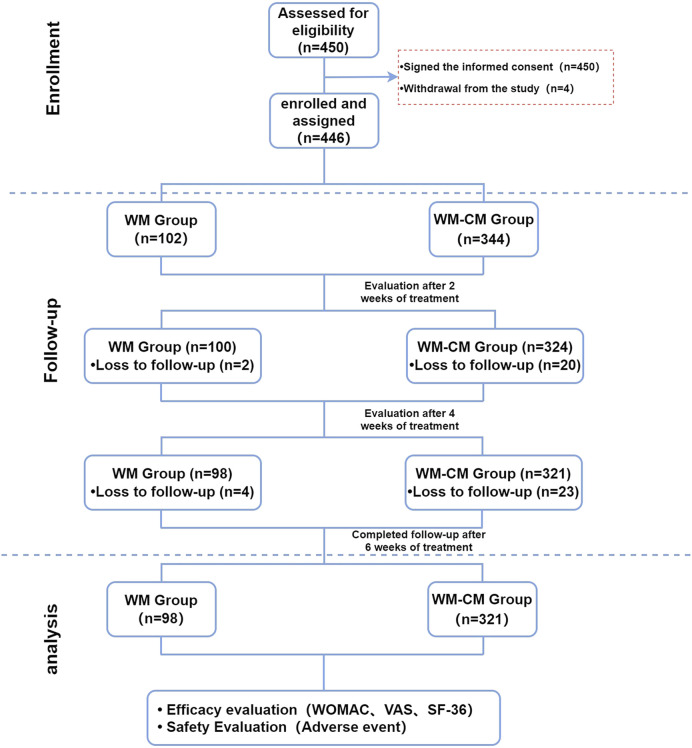
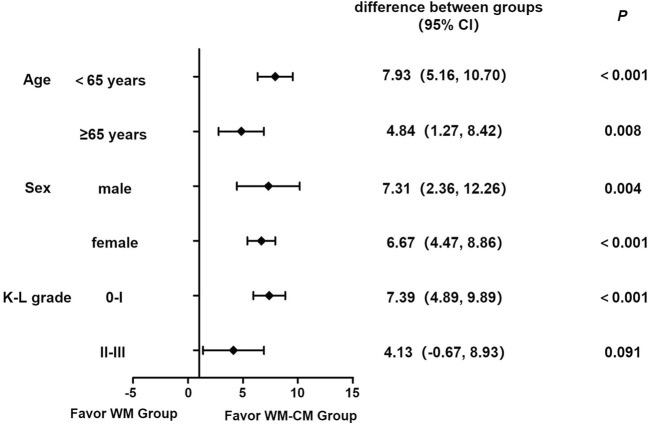
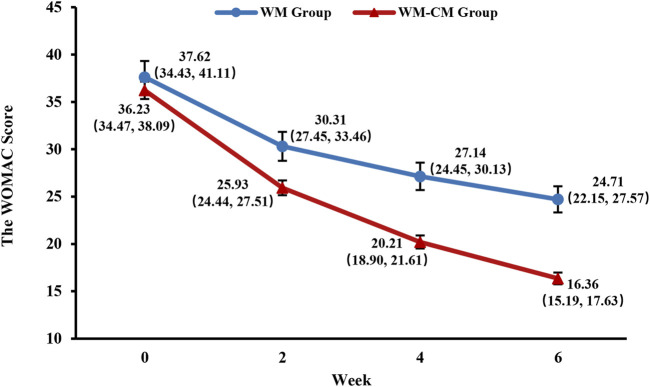
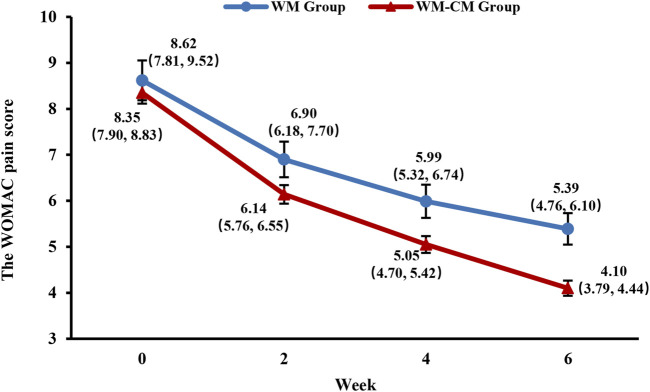
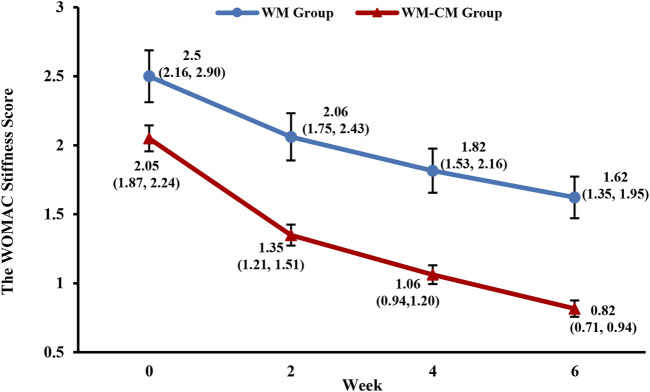
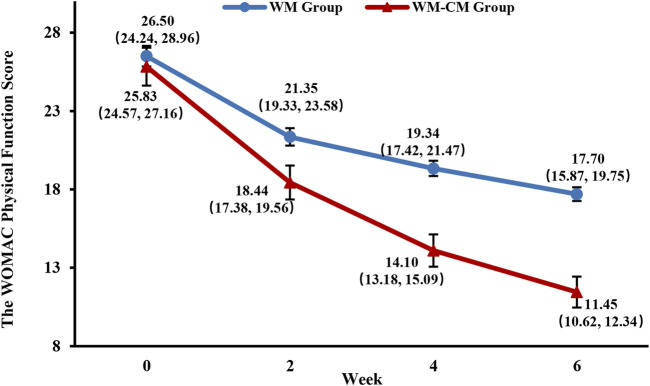
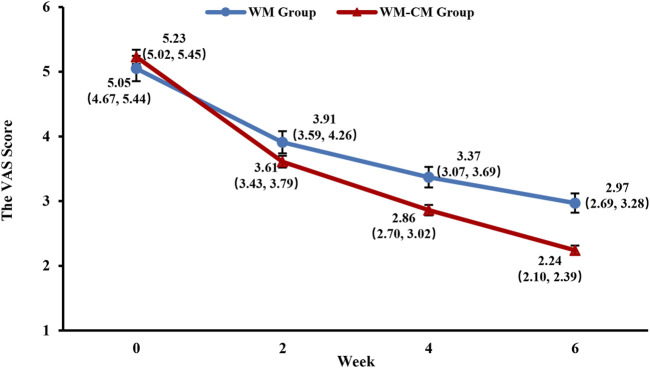
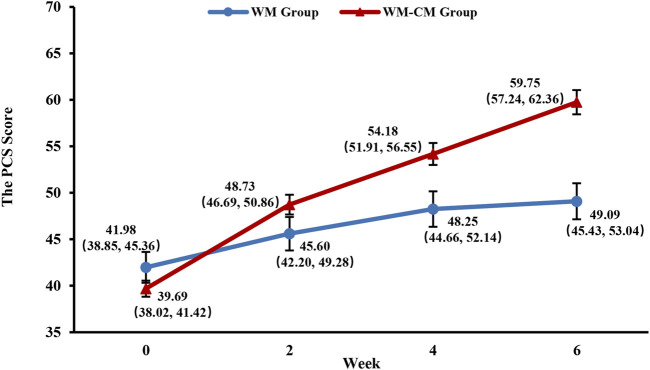
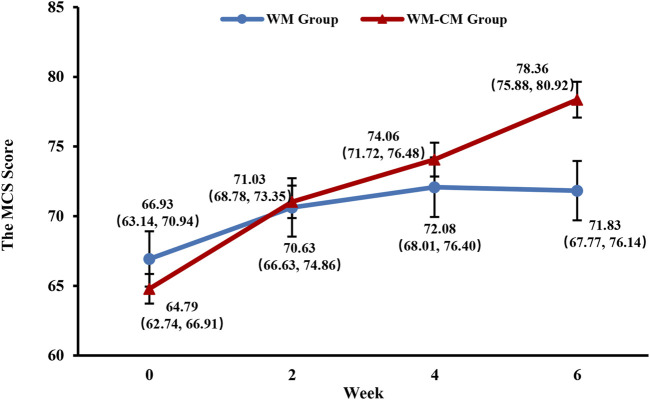
To conduct a real-world evaluation of the efficacy and safety of combined Chinese and Western medicine in treating knee osteoarthritis (KOA). A multicenter, prospective cohort study design was employed, enrolling 450 KOA patients (Kellgren-Lawrence score of 3 or less). The patients were divided into a Western medicine treatment group (WM group) and a combined Western and traditional Chinese medicine treatment group (WM-CM group). A 6-week treatment plan was administered, and follow-up visits occurred at 2 weeks, 4 weeks, and 6 weeks after initiating treatment. The primary outcome indicator was the total Western Ontario and McMaster Universities Arthritis Index (WOMAC) score after 6 weeks of treatment. Secondary outcome indicators included WOMAC subscales for pain, stiffness, and joint function, visual analogue scale (VAS) score, physical component summary (PCS), mental component summary (MCS), and clinical effectiveness. The incidence of drug-related adverse events was used as a safety evaluation indicator. A total of 419 patients were included in the final analysis: 98 in the WM group and 321 in the WM-CM group. The baseline characteristics of the two groups were comparable, except for the incidence of stiffness symptoms and stiffness scores. After 6 weeks of treatment, the WM-CM group exhibited superior results to the WM group in improving the total WOMAC score (24.71 ± 1.38 vs. 16.36 ± 0.62, < 0.001). The WM-CM group also outperformed the WM group in WOMAC pain and joint function scores, VAS score, PCS score, MCS score, and clinical effectiveness ( < 0.05), which was consistent with the findings of the main evaluation index. Subgroup analysis indicated that the combined Chinese and Western medicine treatment showed more pronounced benefits in patients under 65 years of age and in those with a Kellgren-Lawrence (K-L) classification of 0-I. Throughout the study, no adverse effects were observed in either group. The combination of Chinese and Western medicine demonstrated superiority over Western medicine alone in relieving knee pain symptoms, improving knee function, and enhancing the quality of life for KOA patients with a K-L score of 3 or less. Moreover, the treatment exhibited a good safety profile. (https://www.chictr.org.cn/), identifier (ChiCTR1900027175).
开展中西医结合治疗膝骨关节炎(KOA)疗效和安全性的真实世界评估。采用多中心、前瞻性队列研究设计,纳入450例KOA患者(Kellgren-Lawrence评分3级及以下)。将患者分为西药治疗组(WM组)和中西医结合治疗组(WM-CM组)。实施为期6周的治疗方案,并在开始治疗后的2周、4周和6周进行随访。主要结局指标为治疗6周后的西安大略和麦克马斯特大学骨关节炎指数(WOMAC)总分。次要结局指标包括WOMAC疼痛、僵硬和关节功能分量表、视觉模拟评分(VAS)、生理健康评分(PCS)、心理健康评分(MCS)及临床疗效。药物相关不良事件的发生率作为安全性评估指标。最终分析共纳入419例患者:WM组98例,WM-CM组321例。两组的基线特征具有可比性,但僵硬症状发生率和僵硬评分除外。治疗6周后,WM-CM组在改善WOMAC总分方面的效果优于WM组(24.71±1.38 vs. 16.36±0.62,P<0.001)。WM-CM组在WOMAC疼痛和关节功能评分、VAS评分、PCS评分、MCS评分及临床疗效方面也优于WM组(P<0.05),这与主要评估指标的结果一致。亚组分析表明,中西医结合治疗在65岁以下患者及Kellgren-Lawrence(K-L)分级为0-I级的患者中显示出更显著的益处。在整个研究过程中,两组均未观察到不良反应。中西医结合在缓解K-L评分3级及以下KOA患者的膝关节疼痛症状、改善膝关节功能和提高生活质量方面优于单纯西药治疗。此外,该治疗具有良好的安全性。(https://www.chictr.org.cn/),标识符(ChiCTR1900027175)