Faculty of Health, Charles Darwin University, Darwin, Australia.
School of Nursing and Midwifery, Edith Cowan University, Joondalup, Australia.
PLoS One. 2023 Sep 13;18(9):e0291036. doi: 10.1371/journal.pone.0291036. eCollection 2023.
In low-resource settings, midwives are the first contact for women with preeclampsia and lead the coordination of care. Unfavourable preeclampsia outcomes create a burden for women, families, and the health system. It is therefore important to understand the unique context of midwives' practice and the complex factors that influence the delivery of maternal healthcare.
This qualitative study explored the perspectives of key stakeholders in a tertiary hospital in Ghana regarding the facilitators and barriers influencing midwives' provision of preeclampsia care using a socioecological model.
Semi-structured interviews were conducted with 42 participants comprising senior managers (n = 7) and hospital midwives (n = 35) in 2021. Thematic analysis used Braun and Clarke's six-step method, and the findings were organised within four levels of the socioecological model: individual, interpersonal, organisational, and public policy.
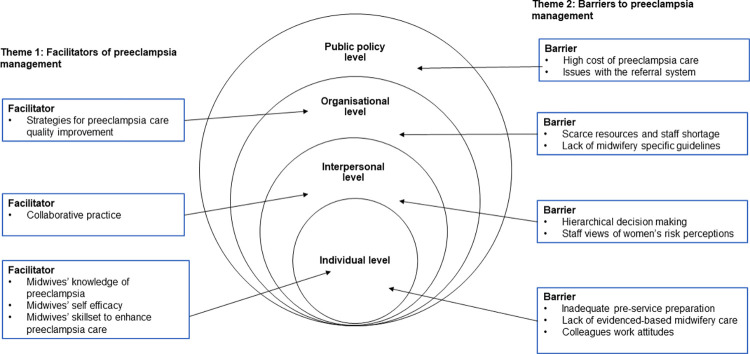
Two main themes were identified: 1) Facilitators of preeclampsia management, and 2) Barriers to preeclampsia management. Facilitators were identified at three levels (individual, interpersonal, and organisational) and included midwives' knowledge of preeclampsia; midwives' self-efficacy; midwives' skillset to enhance preeclampsia care; collaborative practice; and strategies for preeclampsia care quality improvement. At the individual level, the barriers were inadequate pre-service preparation, lack of evidence-based midwifery care, and colleagues' work attitudes. Hierarchical decision-making and staff views of women's risk perceptions were identified as barriers at the interpersonal level. At the organisational level, the barriers were: scarce resources and staff shortages, and a lack of midwifery-specific guidelines. Two barriers were identified within the public policy level: the high cost of preeclampsia care and issues with the referral system.
Multi-faceted factors play a significant role in midwives' management of preeclampsia. Hence context-specific multi-level interventions have the potential to improve the quality-of-care women in Ghana receive.
在资源匮乏的环境中,助产士是子痫前期妇女的首要接触者,并负责协调护理工作。不良的子痫前期结局给妇女、家庭和卫生系统带来了负担。因此,了解助产士实践的独特背景以及影响孕产妇保健服务提供的复杂因素非常重要。
本定性研究使用社会生态学模型探讨了加纳一家三级医院的主要利益相关者对影响助产士提供子痫前期护理的促进因素和障碍因素的看法。
2021 年,对 42 名参与者(包括高级管理人员[7 名]和医院助产士[35 名])进行了半结构式访谈。采用 Braun 和 Clarke 的六步主题分析法进行了主题分析,研究结果按照社会生态学模型的四个层次进行了组织:个体、人际、组织和公共政策。
确定了两个主要主题:1)子痫前期管理的促进因素,2)子痫前期管理的障碍。在三个层次(个体、人际和组织)发现了促进因素,包括助产士对子痫前期的了解;助产士的自我效能感;提高子痫前期护理技能;协作实践;以及子痫前期护理质量改进策略。在个体层面,障碍包括前期准备不足、缺乏循证助产护理以及同事的工作态度。在人际层面,层级决策和工作人员对妇女风险认知的看法被确定为障碍。在组织层面,障碍包括资源和人员短缺,以及缺乏专门的助产准则。在公共政策层面确定了两个障碍:子痫前期护理费用高和转诊系统问题。
多方面的因素对子痫前期的助产士管理起着重要作用。因此,具有特定背景的多层面干预措施有可能提高加纳妇女获得的护理质量。