Centre for Trauma Sciences, Blizard Institute, Queen Mary University of London, London, UK
Academic Department of Military Surgery and Trauma, RCI, Defence Medical Services, Birmingham, UK.
Emerg Med J. 2023 Nov;40(11):777-784. doi: 10.1136/emermed-2023-213086. Epub 2023 Sep 13.
Blood transfusion for bleeding trauma patients is a promising pre-hospital intervention with potential to improve outcomes. However, it is not yet clear which patients may benefit from pre-hospital transfusions. The aim of this study was to enhance our understanding of how experienced pre-hospital clinicians make decisions regarding patient blood loss and the need for transfusion, and explore the factors that influence clinical decision-making.
Pre-hospital physicians, from two air ambulance sites in the south of England, were interviewed between December 2018 and January 2019. Participants were involved in teaching or publishing on the management of bleeding trauma patients and had at least 5 years of continuous and contemporary practice at consultant level. Interviews were semi-structured and explored how decisions were made and what made decisions difficult. A qualitative description approach was used with inductive thematic analysis to identify themes and subthemes related to blood transfusion decision-making in trauma.
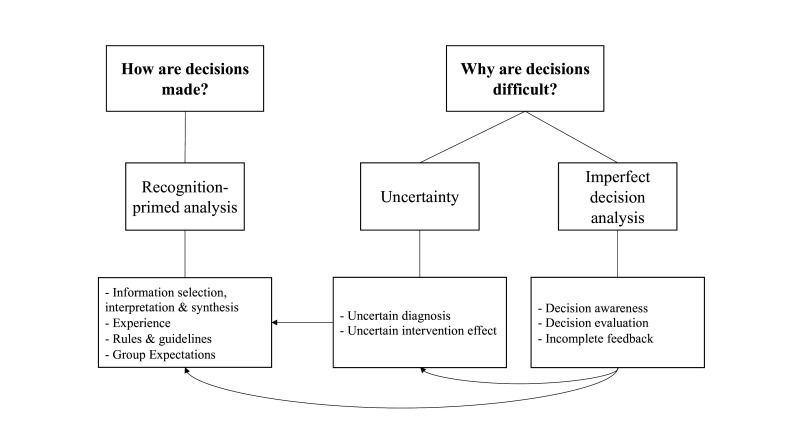
Ten pre-hospital physicians were interviewed and three themes were identified: , and . The first theme describes how participants make decisions using selected cues, incorporating their experience and are influenced by external rules and group expectations. What made decisions difficult for the participants was encapsulated in the uncertainty theme. Uncertainty emerged regarding the patient's true underlying physiological state and the treatment effect of blood transfusion. The last theme focuses on the issues with decision-making itself. Participants demonstrated lapses in decision awareness, often incomplete decision evaluation and described challenges to effective learning due to incomplete patient outcome information.
Pre-hospital clinicians make decisions about bleeding and transfusion which are recognition-primed and incorporate significant uncertainty. Decisions are influenced by experience and are subject to bias. Improved understanding of the decision-making processes provides a theoretical perspective of how decisions might be supported in the future.
对于出血创伤患者进行输血是一种有前途的院前干预措施,有可能改善预后。然而,目前尚不清楚哪些患者可能从院前输血中受益。本研究旨在增进我们对有经验的院前临床医生如何决定患者失血量和输血需求的理解,并探讨影响临床决策的因素。
2018 年 12 月至 2019 年 1 月,在英格兰南部的两个空中救护站对院前医生进行了访谈。参与者参与了关于创伤性出血患者管理的教学或发表工作,并且具有至少 5 年的连续和当代顾问级实践经验。访谈采用半结构化方式,探讨了决策的制定方式以及哪些因素导致决策困难。采用定性描述方法,对与创伤输血决策相关的主题和子主题进行了归纳主题分析。
共对 10 名院前医生进行了访谈,确定了 3 个主题:感知、不确定性和决策本身。第一个主题描述了参与者如何使用选定的线索做出决策,将经验纳入其中,并受到外部规则和群体期望的影响。使参与者感到决策困难的是不确定性主题。对患者真实潜在生理状态和输血治疗效果的不确定性出现了。最后一个主题关注决策本身的问题。参与者表现出决策意识的缺失,通常对决策评估不完整,并描述了由于患者结局信息不完整而导致有效学习的挑战。
院前临床医生根据出血和输血情况做出决策,这些决策是基于认知启发式的,并包含了很大的不确定性。决策受经验的影响,并受到偏见的影响。对决策过程的深入了解为未来如何支持决策提供了理论视角。