College of Acupuncture, Massage and Rehabilitation, Hunan University of Chinese Medicine, Changsha, 410208, China.
Acta Neurol Belg. 2024 Feb;124(1):25-36. doi: 10.1007/s13760-023-02377-w. Epub 2023 Sep 13.
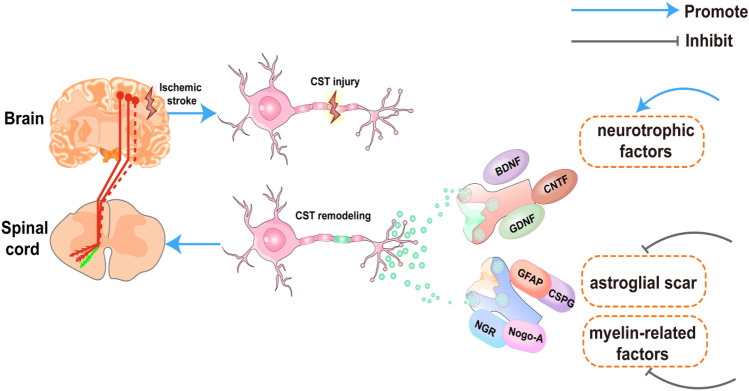
Stroke is the third leading cause of death and disability worldwide. Post-stroke spasticity (PSS) is the most common complication of stroke but represents only one of the many manifestations of upper motor neuron syndrome. As an upper motor neuron, the corticospinal tract (CST) is the only direct descending motor pathway that innervates the spinal motor neurons and is closely related to the recovery of limb function in patients with PSS. Therefore, promoting axonal remodeling in the CST may help identify new therapeutic strategies for PSS. In this review, we outline the pathological mechanisms of PSS, specifically their relationship with CST, and therapeutic strategies for axonal regeneration of the CST after stroke. We found it to be closely associated with astroglial scarring produced by astrocyte activation and its secretion of neurotrophic factors, mainly after the onset of cerebral ischemia. We hope that this review offers insight into the relationship between CST and PSS and provides a basis for further studies.
中风是全球范围内导致死亡和残疾的第三大原因。中风后痉挛(PSS)是中风最常见的并发症,但它只是上运动神经元综合征的众多表现之一。作为上运动神经元,皮质脊髓束(CST)是唯一直接支配脊髓运动神经元的下行运动通路,与 PSS 患者肢体功能的恢复密切相关。因此,促进 CST 中的轴突重塑可能有助于确定 PSS 的新治疗策略。在这篇综述中,我们概述了 PSS 的病理机制,特别是其与 CST 的关系,以及中风后 CST 轴突再生的治疗策略。我们发现,它与星形胶质细胞激活及其分泌的神经营养因子产生的星形胶质瘢痕密切相关,主要发生在脑缺血发作后。我们希望这篇综述能深入了解 CST 与 PSS 之间的关系,并为进一步的研究提供依据。