McDaniel Emma L, Akwafuo Sampson, Urbanovsky Joshua, Mikler Armin R
Department of Computer Science, Georgia State University, Atlanta, Georgia, United States of America.
Center for Disaster Informatics and Computational Epidemiology, Georgia State University, Atlanta, Georgia, United States of America.
PeerJ Comput Sci. 2023 Sep 1;9:e1541. doi: 10.7717/peerj-cs.1541. eCollection 2023.
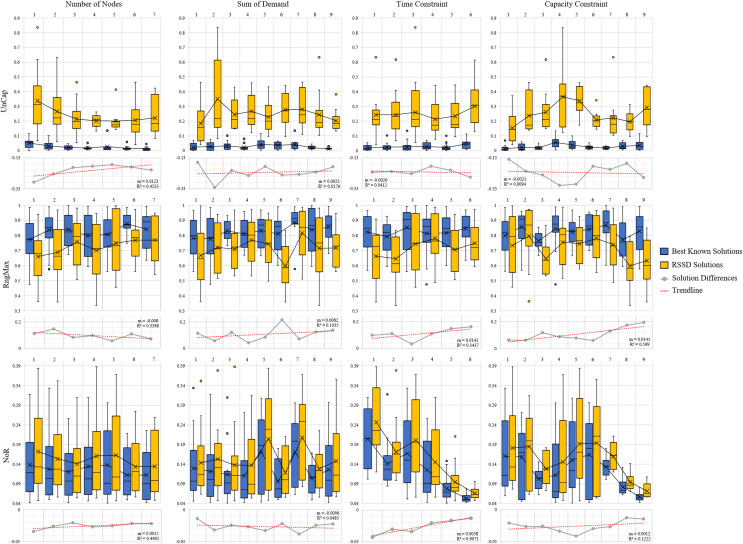
Due to situational fluidity and intrinsic uncertainty of emergency response, there needs to be a fast vehicle routing algorithm that meets the constraints of the situation, thus the receiving-staging-storing-distributing (RSSD) algorithm was developed. Benchmarking the quality of this satisficing algorithm is important to understand the consequences of not engaging with the NP-Hard task of vehicle routing problem. This benchmarking will inform whether the RSSD algorithm is producing acceptable and consistent solutions to be used in decision support systems for emergency response planning. We devise metrics in the domain space of emergency planning, response, and medical countermeasure dispensing in order to assess the quality of RSSD solutions. We conduct experiments and perform statistical analyses to assess the quality of the RSSD algorithm's solutions compared to the best known solutions for selected capacitated vehicle routing problem (CVRP) benchmark instances. The results of these experiments indicate that even though the RSSD algorithm does not engage with finding the optimal route solutions, it behaves in a consistent manner to the best known solutions across a range of instances and attributes.
由于应急响应的情况具有流动性和内在不确定性,需要一种能够满足具体情况约束的快速车辆路径规划算法,因此开发了接收-暂存-存储-配送(RSSD)算法。对这种满意算法的质量进行基准测试,对于理解不处理车辆路径规划问题这一NP难任务的后果非常重要。这种基准测试将告知RSSD算法是否正在产生可接受且一致的解决方案,以便用于应急响应规划的决策支持系统。我们在应急规划、响应和医疗对策分发的领域空间中设计指标,以评估RSSD解决方案的质量。我们进行实验并进行统计分析,以评估RSSD算法的解决方案与选定的有容量限制车辆路径规划问题(CVRP)基准实例的最佳已知解决方案相比的质量。这些实验结果表明,尽管RSSD算法没有致力于寻找最优路径解决方案,但在一系列实例和属性方面,它与最佳已知解决方案的表现一致。