Department of Epidemiology and Biostatistics, Research Institute for Tropical Medicine, Manila, Philippines.
Medical Department, Research Institute for Tropical Medicine, Manila, Philippines.
PLoS One. 2023 Sep 14;18(9):e0291523. doi: 10.1371/journal.pone.0291523. eCollection 2023.
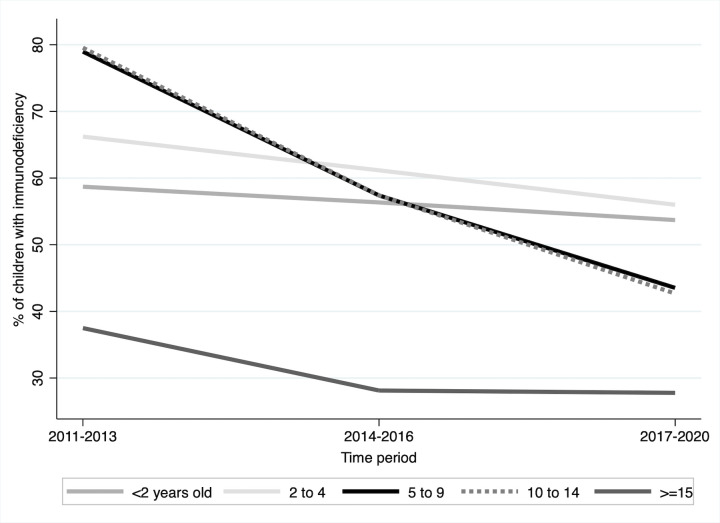
Despite improvements in HIV testing and earlier antiretroviral therapy (ART) initiation in children living with HIV through the years, a considerable proportion start treatment with advanced disease. We studied characteristics of children and adolescents living with HIV and their level of immunodeficiency at ART initiation using data from a multi-country Asian cohort. We included children and adolescents who were ART-naïve and <18 years of age at ART initiation from 2011 to 2020 at 17 HIV clinics in six countries. Incidence rates of opportunistic infections (OIs) in the first two years of triple-drug ART (≥3 antiretrovirals) was also reported. Competing risk regression analysis was performed to identify factors associated with first occurrence of OI. In 2,027 children and adolescents (54% males), median age at ART initiation increased from 4.5 years in 2011-2013 to 6.7 in 2017-2020, median CD4 count doubled from 237 cells/μl to 466 cells/μl, and proportion of children who initiated ART as severely immunodeficient decreased from 70% to 45%. During follow-up, 275 (14%) children who received triple-drug ART as first treatment and had at least one clinic visit, developed at least one OI in the first two years of treatment (9.40 per 100 person-years). The incidence rate of any first OI declined from 12.52 to 7.58 per 100 person-years during 2011-2013 and 2017-2020. Lower hazard of OIs were found in those with age at first ART 2-14 years, current CD4 ≥200 cells/μl, and receiving ART between 2017 and 2020. The analysis demonstrated increasing number of children and adolescents starting ART with high CD4 count at ART start. The rate of first OI markedly decreased in children who started ART in more recent years. There remains a clear need for improvement in HIV control strategies in children, by promoting earlier diagnosis and timely treatment.
尽管多年来通过提高 HIV 检测和早期抗逆转录病毒治疗(ART)的启动率,使许多 HIV 感染者儿童得到了治疗,但仍有相当一部分儿童在诊断时已经处于疾病晚期。我们利用亚洲多国队列研究的数据,研究了 HIV 感染者儿童和青少年的特征及其在开始接受抗逆转录病毒治疗时的免疫缺陷程度。我们纳入了 2011 年至 2020 年期间在六个国家的 17 个 HIV 诊所中首次开始接受抗逆转录病毒治疗且年龄<18 岁的初治儿童和青少年。还报告了在接受三联药物 ART(≥3 种抗逆转录病毒药物)的前两年内发生机会性感染(OI)的发生率。采用竞争风险回归分析确定与首次发生 OI 相关的因素。在 2027 名儿童和青少年(54%为男性)中,ART 开始的年龄中位数从 2011-2013 年的 4.5 岁增加到 2017-2020 年的 6.7 岁,CD4 计数中位数从 237 个细胞/μl 增加到 466 个细胞/μl,起始 ART 时被认为严重免疫缺陷的儿童比例从 70%下降到 45%。在随访期间,275 名(14%)接受三联药物 ART 作为一线治疗且至少有一次就诊的儿童在治疗的前两年中至少发生了一次 OI(9.40/100 人年)。在 2011-2013 年和 2017-2020 年期间,任何首次 OI 的发生率从 12.52 降至 7.58/100 人年。在起始 ART 年龄为 2-14 岁、当前 CD4 计数≥200 个细胞/μl 和 2017-2020 年期间开始 ART 的患者中,发生 OI 的风险较低。分析表明,开始 ART 时 CD4 计数较高的儿童和青少年开始 ART 的数量不断增加。在近几年开始接受 ART 治疗的儿童中,首次 OI 的发生率显著下降。通过促进早期诊断和及时治疗,仍需要改善儿童 HIV 控制策略。