Michigan Medicine, Division of Gastroenterology and Hepatology, Department of Internal Medicine, Ann Arbor, Michigan, United States.
Michigan Medicine, Department of Psychiatry, Ann Arbor, Michigan, United States.
Hepatol Commun. 2023 Sep 15;7(10). doi: 10.1097/HC9.0000000000000181. eCollection 2023 Oct 1.
Alcohol cessation improves mortality in alcohol-associated liver disease (ALD), but few ALD patients will engage in treatment. We aimed to demonstrate the feasibility and acceptability of a mobile health intervention to increase alcohol use disorder (AUD) treatment among ALD patients.
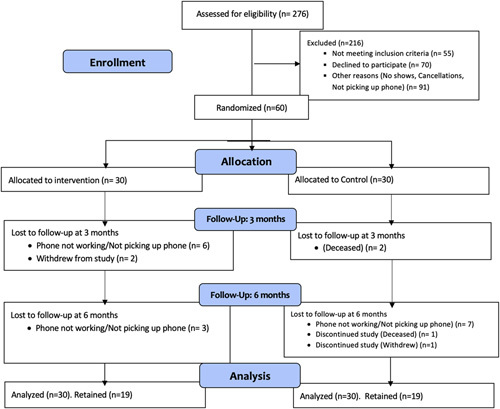
We conducted a pilot randomized controlled trial (September 2020 to June 2022) at a single tertiary care center in adults with any stage of ALD, past 6-month drinking, and no past-month AUD treatment. Sixty participants were randomized 1:1 to a mobile health application designed to increase AUD treatment engagement through preference elicitation and matching to treatment and misconception correction. Controls received enhanced usual care. The primary outcomes were feasibility (recruitment and retention rates) and acceptability. Exploratory outcomes were AUD treatment engagement and alcohol use, measured by Timeline Followback. Outcomes were measured at 3 and 6 months.
Baseline characteristics were balanced. The recruitment rate was 46%. Retention was 65% at 6 months. The intervention was highly acceptable to participants (91% were mostly/very satisfied; 95% felt that the intervention matched them well to AUD treatment). Secondary outcomes showed increased AUD treatment at 6 months in the intervention group (intent-to-treat: 27.3% vs. 13.3%, OR 2.3, 95% CI, 0.61-8.76). There was a trend toward a 1-level or greater reduction in World Health Organization (WHO) drinking risk levels in the intervention group (OR 2.25, 95% CI, 0.51-9.97).
A mobile health intervention for AUD treatment engagement was highly feasible, acceptable, and produced promising early outcomes, with improved AUD treatment engagement and alcohol reduction in ALD patients.
戒酒可改善酒精相关性肝病(ALD)患者的死亡率,但很少有 ALD 患者会接受治疗。我们旨在证明一种移动健康干预措施在增加 ALD 患者酒精使用障碍(AUD)治疗中的可行性和可接受性。
我们在一家三级保健中心进行了一项单中心、随机对照试验(2020 年 9 月至 2022 年 6 月),纳入了任何阶段的 ALD、过去 6 个月有饮酒史且过去 1 个月无 AUD 治疗的成年人。60 名参与者按 1:1 随机分为移动健康应用组和对照组,前者旨在通过偏好评估和治疗匹配以及错误观念纠正来增加 AUD 治疗的参与度,后者接受增强的常规护理。主要结局是可行性(招募率和保留率)和可接受性。探索性结局是 AUD 治疗的参与度和酒精使用,通过时间线随访进行测量。
基线特征平衡。招募率为 46%。6 个月时的保留率为 65%。该干预措施受到参与者的高度认可(91%的人表示非常满意/满意;95%的人认为该干预措施与他们的 AUD 治疗非常匹配)。次要结局显示,干预组在 6 个月时 AUD 治疗增加(意向治疗:27.3%比 13.3%,OR 2.3,95%CI,0.61-8.76)。干预组的世界卫生组织(WHO)饮酒风险水平降低 1 级或以上的趋势(OR 2.25,95%CI,0.51-9.97)。
针对 AUD 治疗参与的移动健康干预措施具有高度可行性、可接受性,并产生了有希望的早期结果,ALD 患者的 AUD 治疗参与度和酒精摄入量有所改善。