Department of Medicine, Massachusetts General Hospital, Boston, Massachusetts, USA.
Division of Gastroenterology, Department of Medicine, Massachusetts General Hospital, Boston, Massachusetts, USA.
Hepatol Commun. 2023 Sep 15;7(10). doi: 10.1097/HC9.0000000000000263. eCollection 2023 Oct 1.
Diet plays an important role in the pathogenesis of NAFLD. Inflammation is a potential mechanism linking diet to NAFLD development and its progression to cirrhosis.1 We analyzed data from a large, prospective cohort of US women to examine the influence of dietary inflammatory potential on the long-term risk of developing NAFLD and cirrhosis.
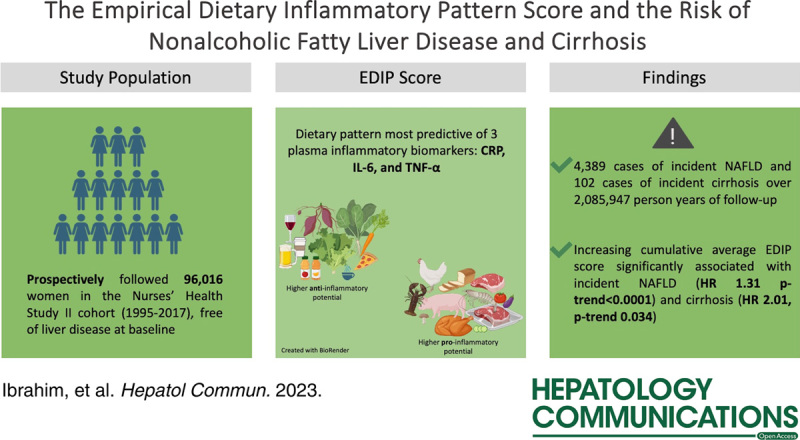
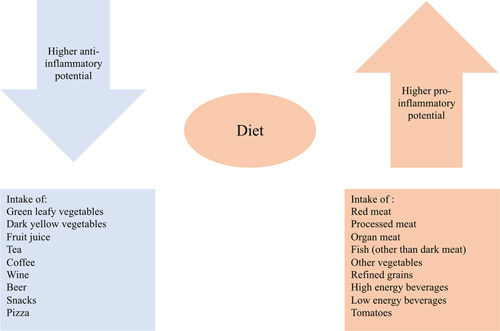
We prospectively followed 96,016 women in the Nurses' Health Study II cohort (1995-2017) who were free of chronic liver disease, including NAFLD, at baseline. The inflammatory potential of the diet was ascertained using an established, food-based empirical dietary inflammatory pattern score. Cox proportional hazard models were used to estimate multivariable-adjusted hazard ratios and 95% CIs for incident NAFLD and cirrhosis.
Over 2,085,947 person-years of follow-up, we documented 4389 cases of incident NAFLD and 102 cases of incident cirrhosis. Increasing cumulative average empirical dietary inflammatory pattern (EDIP) score was significantly and positively associated with incident NAFLD (multivariable-adjusted HR 1.31 per each 1-U increase in EDIP score, p-trend < 0.0001) and cirrhosis (p-trend of 0.034). Our findings also were consistent when examining recent diets using simple updated EDIP scores. In analyses of specific EDIP components, we observed an increased risk of incident NAFLD and cirrhosis with higher consumption of certain proinflammatory components of the EDIP score.
Dietary patterns with a higher proinflammatory potential may be associated with a higher risk of developing both NAFLD and cirrhosis. Reducing the inflammatory potential of diet may potentially provide an effective strategy for preventing the development of NAFLD and progression to cirrhosis.
饮食在非酒精性脂肪性肝病(NAFLD)的发病机制中起着重要作用。炎症是饮食与 NAFLD 发展及其向肝硬化进展相关的潜在机制之一。1 我们分析了一项来自美国女性的大型前瞻性队列研究的数据,以研究饮食炎症潜能对长期发生 NAFLD 和肝硬化风险的影响。
我们前瞻性地随访了护士健康研究 II 队列(1995-2017 年)中的 96016 名女性,这些女性在基线时无慢性肝病,包括 NAFLD。使用已建立的基于食物的经验性饮食炎症模式评分来确定饮食的炎症潜能。使用 Cox 比例风险模型估计多变量调整后的风险比和 95%置信区间,用于发生 NAFLD 和肝硬化的情况。
在超过 2085947 人年的随访期间,我们记录了 4389 例新发 NAFLD 和 102 例新发肝硬化。累积平均经验性饮食炎症模式(EDIP)评分的增加与新发 NAFLD 显著正相关(多变量调整后的 HR 为 EDIP 评分每增加 1 单位增加 1.31,p-trend <0.0001)和肝硬化(p-trend 为 0.034)。当使用简单的更新 EDIP 评分来检查最近的饮食时,我们的发现也是一致的。在对特定 EDIP 成分的分析中,我们观察到随着 EDIP 评分中某些促炎成分的摄入增加,发生 NAFLD 和肝硬化的风险增加。
具有更高促炎潜力的饮食模式可能与发生 NAFLD 和肝硬化的风险增加相关。降低饮食的炎症潜能可能为预防 NAFLD 的发展和向肝硬化进展提供有效的策略。