Health Management Center, The First Affiliated Hospital of Nanjing Medical University, Nanjing 210029, China.
Department of Epidemiology, China International Cooperation Center on Environment and Human Health, Center for Global Health, School of Public Health, Nanjing Medical University, Nanjing 211166, China.
Nutrients. 2022 Dec 15;14(24):5335. doi: 10.3390/nu14245335.
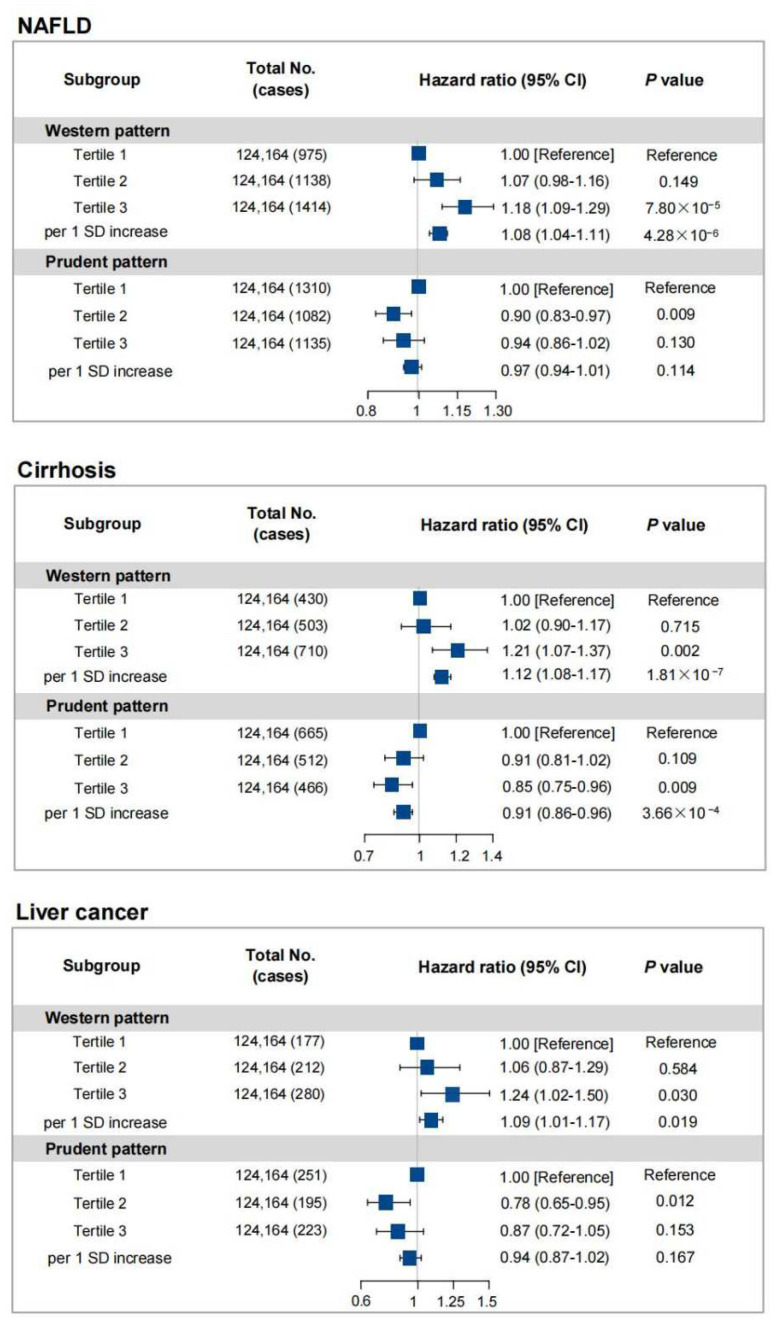
Background and Aims: Epidemiological evidence has shown the association between nutritional habits and liver disease. However, results remain conflicting. This study investigated the influence of dietary factors on the risk of incident non-alcoholic fatty liver disease (NAFLD), cirrhosis, and liver cancer. Methods: Data from the UK Biobank database were analyzed (n = 372,492). According to baseline data from the food frequency questionnaire, two main dietary patterns (Western and prudent) were identified using principal component analysis. We used cox proportional hazards models to explore the associations of individual food groups and dietary patterns with NAFLD, cirrhosis, and liver cancer. Results: During a median follow-up of 12 years, 3527 hospitalized NAFLD, 1643 cirrhosis, and 669 liver cancer cases were recorded among 372,492 participants without prior history of cancer or chronic liver diseases at baseline. In multivariable adjusted analysis, participants in the high tertile of Western dietary pattern score had an 18% (95%CI = 1.09−1.29), 21% (95%CI = 1.07−1.37), and 24% (95%CI = 1.02−1.50) higher risk of incident NAFLD, liver cirrhosis, and liver cancer, respectively, compared with the low tertile. Participants in the high tertile of prudent scores had a 15% (95%CI = 0.75−0.96) lower risk of cirrhosis, as compared with those in the low tertile. In addition, the higher consumption of red meat and the lower consumption of fruit, cereal, tea, and dietary fiber were significantly associated with a higher risk of NAFLD, cirrhosis, and liver cancer (ptrend < 0.05). Conclusions: This large prospective cohort study showed that an increased intake of food from the Western dietary pattern could be correlated with an increased risk of chronic liver diseases, while the prudent pattern was only correlated with a reduced liver cirrhosis risk. These data may provide new insights into lifestyle interventions for the prevention of chronical liver diseases.
流行病学证据表明,营养习惯与肝脏疾病之间存在关联。然而,结果仍然存在争议。本研究旨在调查饮食因素对非酒精性脂肪性肝病(NAFLD)、肝硬化和肝癌发病风险的影响。方法:对英国生物库数据库中的数据进行分析(n=372492)。根据基线食物频率问卷的数据,采用主成分分析方法确定两种主要的饮食模式(西方模式和谨慎模式)。我们使用 Cox 比例风险模型探讨个体食物组和饮食模式与 NAFLD、肝硬化和肝癌之间的关系。结果:在中位随访 12 年期间,在 372492 名无癌症或慢性肝脏疾病病史的参与者中,记录了 3527 例 NAFLD 住院患者、1643 例肝硬化患者和 669 例肝癌患者。多变量调整分析显示,与低三分位组相比,西方饮食模式评分较高的参与者发生 NAFLD、肝硬化和肝癌的风险分别增加 18%(95%CI=1.09-1.29)、21%(95%CI=1.07-1.37)和 24%(95%CI=1.02-1.50)。与低三分位组相比,谨慎模式评分较高的参与者肝硬化发病风险降低 15%(95%CI=0.75-0.96)。此外,较高的红肉类摄入量和较低的水果、谷物、茶和膳食纤维摄入量与 NAFLD、肝硬化和肝癌发病风险增加显著相关(ptrend<0.05)。结论:这项大型前瞻性队列研究表明,西方饮食模式的食物摄入增加可能与慢性肝病风险增加相关,而谨慎模式仅与肝硬化风险降低相关。这些数据可能为慢性肝病的生活方式干预提供新的见解。