Center for Global Surgery, University of Utah School of Medicine, Salt Lake City, Utah, United States of America.
Department of Surgery, University of Utah Health, Salt Lake City, Utah, United States of America.
PLoS One. 2023 Sep 15;18(9):e0291454. doi: 10.1371/journal.pone.0291454. eCollection 2023.
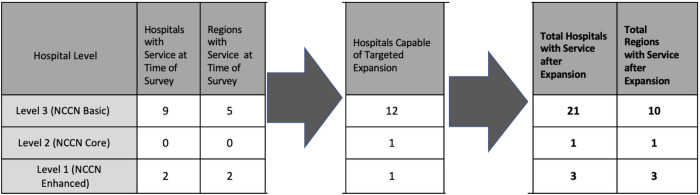
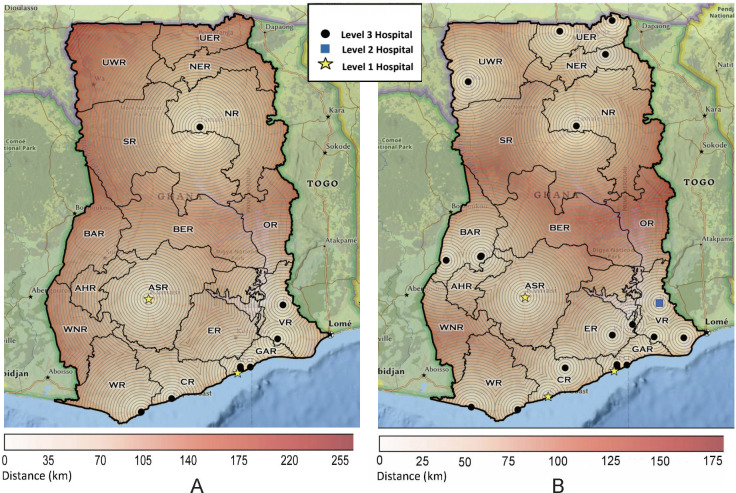
Breast cancer in Ghana is a growing public health problem with increasing incidence and poor outcomes. Lack of access to comprehensive treatment in Ghana may be a contributing factor to its high mortality. The purpose of this study was to evaluate the availability of treatments nationwide and systematically identify high yield areas for targeted expansion. We conducted a cross-sectional, nationwide hospital-based survey from November 2020-October 2021. Surveys were conducted in person with trained research assistants and described hospital availability of all breast cancer treatments and personnel. All individual treatment services were reported, and hospitals were further stratified into levels of multi-modal treatment modeled after the National Comprehensive Cancer Network (NCCN) Framework treatment recommendations for low-resource settings. Level 3 included Tamoxifen and surgery (mastectomy with axillary lymph node sampling); Level 2 included Level 3 plus radiation, aromatase inhibitors, lumpectomy, and sentinel lymph node biopsy; Level 1 included Level 2 plus Her2 therapy and breast reconstruction. Hospitals were identified that could expand to these service levels based on existing services, location and personnel. The distance of the total population from treatment services before and after hypothetical expansion was determined with a geospatial analysis. Of the 328 participating hospitals (95% response rate), 9 hospitals had Level 3 care, 0 had Level 2, and 2 had Level 1. Twelve hospitals could expand to Level 3, 1 could expand to Level 2, and 1 could expand to Level 1. With expansion, the population percentage within 75km of Level 1, 2 and 3 care would increase from 42% to 50%, 0 to 6% and 44% to 67%, respectively. Multi-modal breast cancer treatment is available in Ghana, but it is not accessible to most of the population. Leveraging the knowledge of current resources and population proximity provides an opportunity to identify high-yield areas for targeted expansion.
加纳的乳腺癌是一个日益严重的公共卫生问题,发病率不断上升,治疗效果不佳。加纳缺乏全面治疗的机会可能是导致其高死亡率的一个因素。本研究的目的是评估全国范围内的治疗方法,并系统地确定有针对性扩展的高收益领域。我们于 2020 年 11 月至 2021 年 10 月进行了一项基于全国医院的横断面调查。调查由经过培训的研究助理进行现场调查,描述了所有乳腺癌治疗方法和人员在医院的可及性。报告了所有个体治疗服务,并且根据国家综合癌症网络(NCCN)针对资源匮乏环境的治疗建议,将医院进一步划分为多模式治疗水平。第 3 级包括他莫昔芬和手术(乳房切除术伴腋窝淋巴结取样);第 2 级包括第 3 级加放射治疗、芳香化酶抑制剂、乳房肿瘤切除术和前哨淋巴结活检;第 1 级包括第 2 级加曲妥珠单抗和乳房重建。根据现有服务、位置和人员,确定可以扩展到这些服务水平的医院。通过地理空间分析确定了在假设扩展前后,总人群与治疗服务的距离。在参与的 328 家医院中(95%的应答率),有 9 家医院提供第 3 级治疗,0 家提供第 2 级,2 家提供第 1 级。有 12 家医院可以扩展到第 3 级,1 家可以扩展到第 2 级,1 家可以扩展到第 1 级。如果进行扩展,距离第 1、2 和 3 级治疗服务 75 公里范围内的人口百分比将从 42%增加到 50%、0 增加到 6%和 44%增加到 67%。加纳有多种模式的乳腺癌治疗方法,但大多数人无法获得这些治疗。利用现有资源和人口分布的知识,为有针对性地扩展提供了一个机会。