Jiang Zhengrong, Yang Hongyi, Zhu Meichen, Wu Longmei, Yan Feiyu, Qian Haoyu, He Wenjun, Liu Dun, Chen Hong, Chen Lin, Ding Yanfeng, Sakr Soulaiman, Li Ganghua
Sanya Institute of Nanjing Agriculture, Jiangsu Collaborative Innovation Center for Modern Crop Production, Key Laboratory of Crop Physiology Ecology and Production Management, Nanjing Agricultural University, Sanya, 572000, China.
China- Kenya Belt and Road Joint Laboratory on Crop Molecular Biology, Nanjing, 210095, China.
Rice (N Y). 2023 Sep 16;16(1):41. doi: 10.1186/s12284-023-00656-x.
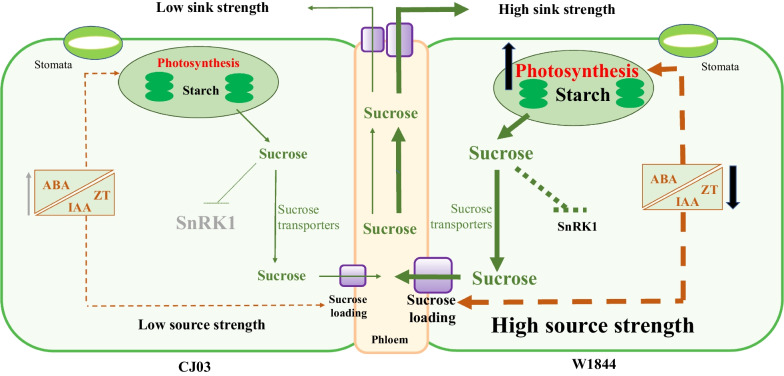
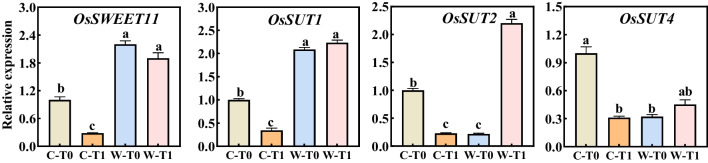
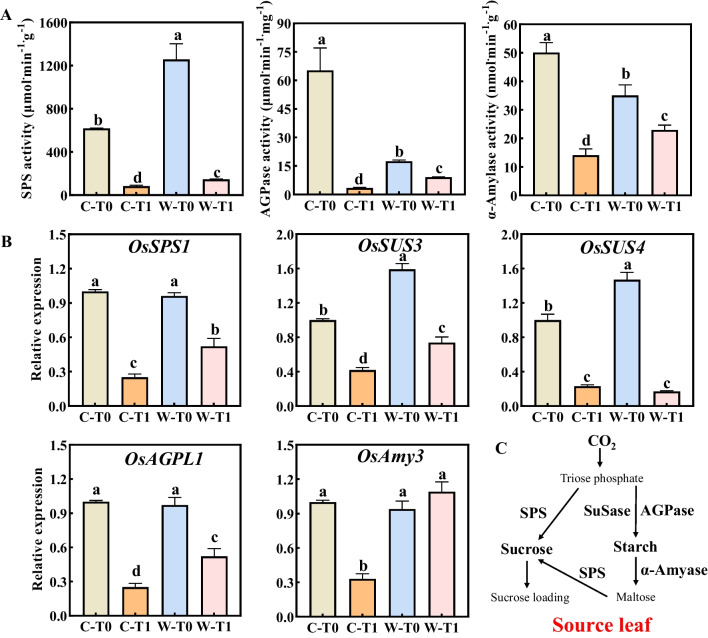
Poor grain-filling initiation in inferior spikelets severely impedes rice yield improvement, while photo-assimilates from source leaves can greatly stimulate the initiation of inferior grain-filling (sink). To investigate the underlying mechanism of source-sink interaction, a two-year field experiment was conducted in 2019 and 2020 using two large-panicle rice cultivars (CJ03 and W1844). The treatments included intact panicles and partial spikelet removal. These two cultivars showed no significant difference in the number of spikelets per panicle. However, after removing spikelet, W1844 showed higher promotion on 1000-grain weight and seed-setting rate than CJ03, particularly for inferior spikelets. The reason was that the better sink activity of W1844 led to a more effective initiation of inferior grain-filling compared to CJ03. The inferior grain weight of CJ03 and W1844 did not show a significant increase until 8 days poster anthesis (DPA), which follows a similar pattern to the accumulation of photo-assimilates in leaves. After removing spikelets, the source leaves of W1844 exhibited lower photosynthetic inhibition compared to CJ03, as well as stronger metabolism and transport of photo-assimilates. Although T6P levels remained constant in both cultivars under same conditions, the source leaves of W1844 showed notable downregulation of SnRK1 activity and upregulation of phytohormones (such as abscisic acid, cytokinins, and auxin) after removing spikelets. Hence, the high sink strength of inferior spikelets plays a role in triggering the enhancement of source strength in rice leaves, thereby fulfilling grain-filling initiation demands.
弱势小穗的灌浆起始不良严重阻碍了水稻产量的提高,而来自源叶的光合产物能极大地促进弱势籽粒灌浆(库)的起始。为了探究源库互作的潜在机制,于2019年和2020年开展了一项为期两年的田间试验,使用了两个大穗型水稻品种(CJ03和W1844)。处理包括完整穗和部分小穗去除。这两个品种的每穗小穗数没有显著差异。然而,去除小穗后,W1844在千粒重和结实率上的提升高于CJ03,尤其是对于弱势小穗。原因是W1844具有更好的库活性,与CJ03相比,其弱势籽粒灌浆起始更有效。CJ03和W1844的弱势籽粒重量直到花后8天(DPA)才显著增加,这与叶片中光合产物的积累模式相似。去除小穗后,W1844的源叶相比CJ03表现出更低的光合抑制,以及更强的光合产物代谢和转运。尽管在相同条件下两个品种的海藻糖-6-磷酸(T6P)水平保持恒定,但去除小穗后,W1844的源叶显示出蔗糖非发酵-1激酶1(SnRK1)活性显著下调,植物激素(如脱落酸、细胞分裂素和生长素)上调。因此,弱势小穗的高库强度在触发水稻叶片源强度增强中发挥作用,从而满足籽粒灌浆起始需求。