Zhou Huang, Wang Yingfeng, Zhang Yijin, Xiao Yunhua, Liu Xiong, Deng Huabing, Lu Xuedan, Tang Wenbang, Zhang Guilian
College of Agronomy, Hunan Agricultural University, Changsha 410128, China.
Hunan Provincial Key Laboratory of Rice and Rapeseed Breeding for Disease Resistance, Hunan Agricultural University, Changsha 410128, China.
Plants (Basel). 2022 Apr 13;11(8):1062. doi: 10.3390/plants11081062.
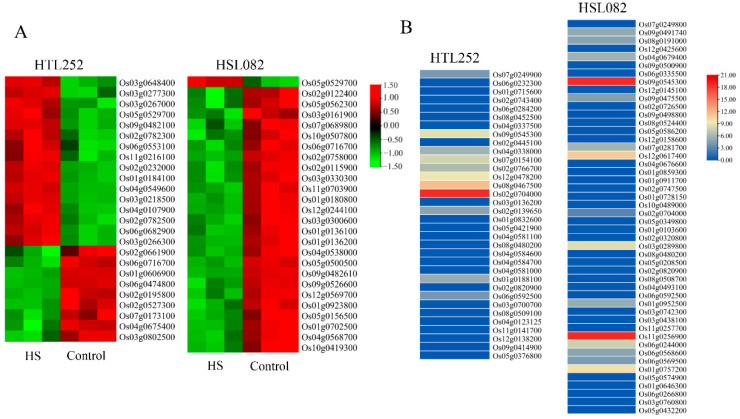
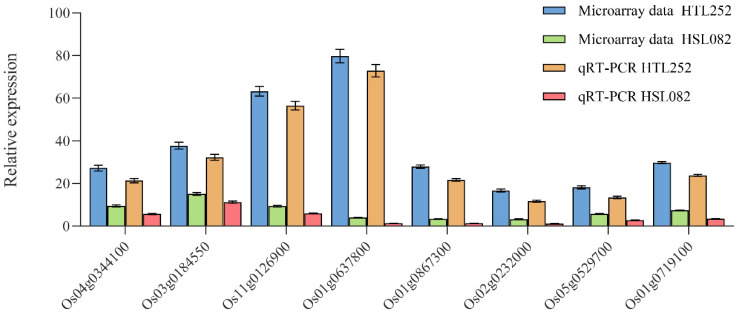
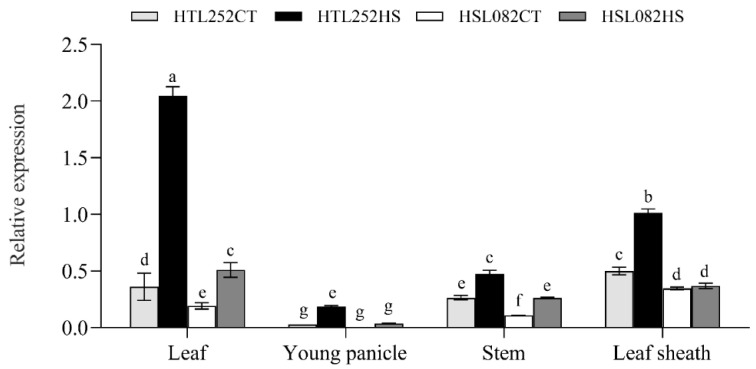
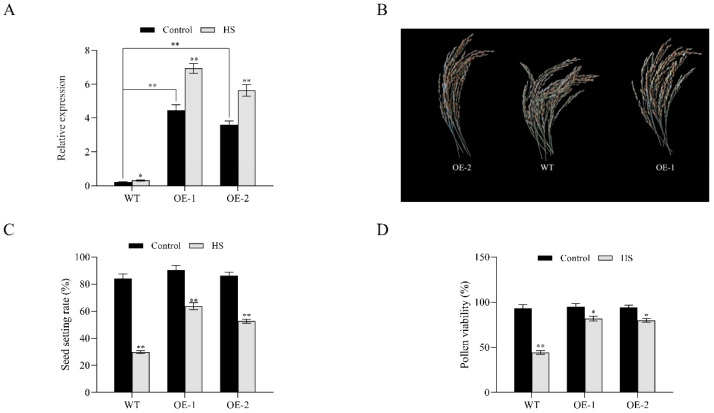
To elucidate the mechanism underlying the response of rice to heat stress (HS), the transcriptome profile of panicles was comparatively analyzed between the heat-tolerant line 252 (HTL252) and heat-susceptible line 082 (HSL082), two rice recombinant inbred lines (RILs). Our differentially expressed gene (DEG) analysis revealed that the DEGs are mainly associated with protein binding, catalysis, stress response, and cellular process. The MapMan analysis demonstrated that the heat-responsive (HR) genes for heat shock proteins, transcription factors, development, and phytohormones are specifically induced in HTL252 under HS. Based on the DEG analysis, the key gene (), which was induced under HS, was selected for further functional validation. Moreover, 9-cis-epoxycarotenoid dioxygenase (NCED) is a key rate-limiting enzyme in the ABA biosynthetic pathway. Overexpression of improved the HS tolerance of rice at the heading and flowering stage. -overexpression plants exhibited significant increases in pollen viability, seed setting rate, superoxide dismutase (SOD) and peroxidase (POD) activities, while significantly lower electrolyte leakage and malondialdehyde (MDA) content relative to the wild type (WT). These results suggested that overexpression can improve the heat tolerance of rice by enhancing the antioxidant capacity. Overall, this study lays a foundation for revealing the molecular regulatory mechanism underlying the response of rice to prolonged HS.
为阐明水稻对热胁迫(HS)响应的潜在机制,对两个水稻重组自交系(RILs),即耐热系252(HTL252)和热敏感系082(HSL082)的穗部转录组图谱进行了比较分析。我们的差异表达基因(DEG)分析表明,差异表达基因主要与蛋白质结合、催化、应激反应和细胞过程相关。MapMan分析表明,热休克蛋白、转录因子、发育和植物激素的热响应(HR)基因在热胁迫下的HTL252中被特异性诱导。基于差异表达基因分析,选择了热胁迫下诱导的关键基因()进行进一步的功能验证。此外,9-顺式环氧类胡萝卜素双加氧酶(NCED)是脱落酸生物合成途径中的关键限速酶。的过表达提高了水稻抽穗和开花期的耐热性。与野生型(WT)相比,过表达植株的花粉活力、结实率、超氧化物歧化酶(SOD)和过氧化物酶(POD)活性显著增加,而电解质渗漏和丙二醛(MDA)含量显著降低。这些结果表明,过表达可以通过增强抗氧化能力来提高水稻的耐热性。总体而言,本研究为揭示水稻对长期热胁迫响应的分子调控机制奠定了基础。